

A...
Chemotherapy-Induced Peripheral Neuropathy: An Evidence-Based Guide for Naturopathic Physicians
read more
By Michael Knapp, ND, DHANP
This case study examines the treatment journey of a 72-year-old male with premature ventricular contractions (PVCs) following atrial fibrillation ablation. The article highlights the use of Natrum muriaticum, homeopathic principles, and a holistic approach to address the patient’s cardiovascular symptoms and emotional context.
June 2021:
LC is a friendly, talkative 72-year-old male who consulted me regarding premature ventricular contractions (PVCs). He had a history of atrial fibrillation (AFib) of an unknown duration, which may have begun up to 15 years ago, accompanied by shortness of breath. In April 2021, he underwent a successful ablation procedure. However, it was subsequently discovered that PVCs, previously “masked” by AFib, were present.
He had been prescribed amiodarone and metoprolol, but these medications worsened his condition, causing his pulse to drop to 38 beats per minute and leading to several fainting episodes. Consequently, he decided to discontinue the medications. An earlier attempt at electrocardioversion provided only temporary relief, lasting 1-2 days. His cardiologist has now recommended starting flecainide, but LC is hesitant due to concerns about potential side effects and is not ready to proceed with the treatment.
LC experiences constant palpitations, described as a long pause between heartbeats. He notices a pattern where he feels 1-2 beats followed by the heart-stopping sensation, then 3-4 beats followed by the same sensation. These symptoms significantly limit his physical activity; he can only walk about 100 yards, and then his heart starts pounding. He feels better lying down at night, especially with his head elevated. His heart feels best when lying on his right side and worsens when lying on his left side. Upon standing or getting out of a chair, his palpitations intensify.
In addition, LC experiences chest pain described as heaviness and pressure, which he perceives as originating from the heart. This pain is mildly better in fresh air. He has shortness of breath daily.
LC also wakes at least 3-4 times at night to urinate. He drinks only water and has eliminated caffeine because it affects his pulse.
He describes heightened sensitivity to noise, particularly the sounds from his neighbors, which make him feel nervous and quick-tempered. He notes that these feelings were worse when he drank coffee in the past.
LC was born in Poland and fled the communist government. He spent time in a refugee camp in Austria before immigrating to the United States in 1982. When he discusses his past, LC avoids using personal pronouns like “I,” “my,” or “we.” Instead, he speaks in generalized terms about historical events and the collective challenges of being a refugee and immigrating to a strange, new place.
Past Medical History
Medications
He takes no herbal or nutritional supplements, and there is no additional pertinent psychosocial history, past medical history, review of systems, or family history relevant to his presentation.
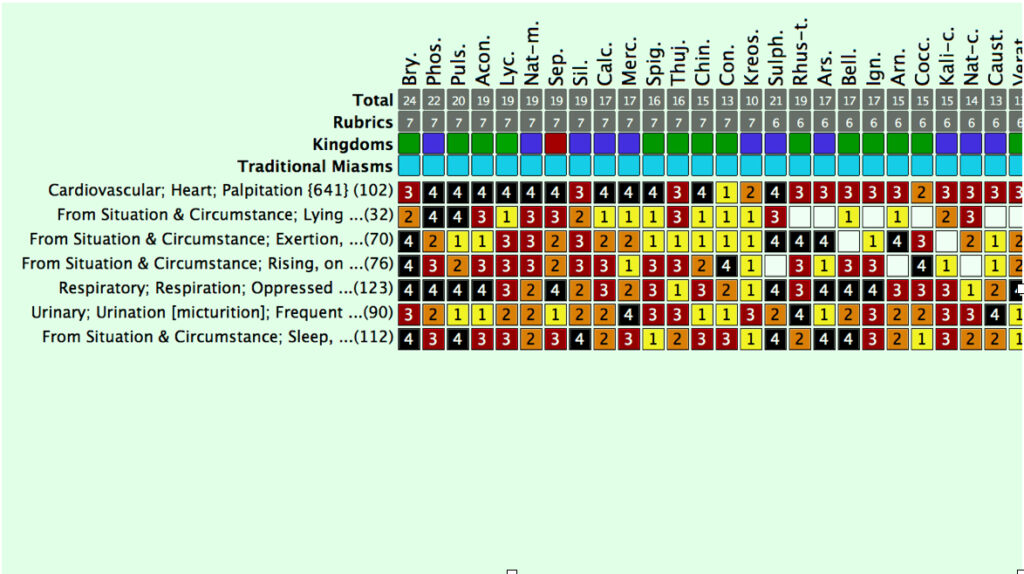
The most important and limiting symptom in this case is heart palpitations aggravated by physical exertion and aggravated by lying on the left side. Nocturia (frequent urination during sleep) is also considered in the analysis.
The following rubrics are taken from The Bönninghausen Repertory (TBR2) (see figure 1) with additional clarification of the meaning when the computer-generated breadcrumb trail is confusing:
Systemic {301 775}; Cardiovascular; Heart; Palpitation {641} (102)
Movement {2021}; side, on the amel. {2032}; left side [+ amel. Right side] {2034} (32)
(= worse lying on the left side)
Modalities {1687 1694}; From Situation & Circumstance; Exertion, mental {1911}; physical {1914} (70)
(= worse from physical exertion)
Modalities {1687 1694}; From Situation & Circumstance; Rising, on [on straightening-up, becoming erect] {2120}; bed, on rising from [on getting out of bed] {2122} (76)
(= worse rising from bed)
Systemic {301 775}; Respiratory; Respiration; Oppressed [tightness, difficult breathing] {568} (123)
Systemic {301 775}; Urinary; Urination [micturition]; Frequent [frequency] {448} (90)
Modalities {1687 1694}; From Situation & Circumstance; Sleep, before falling {2150}; during {2153} (112)
(= worse during sleep)
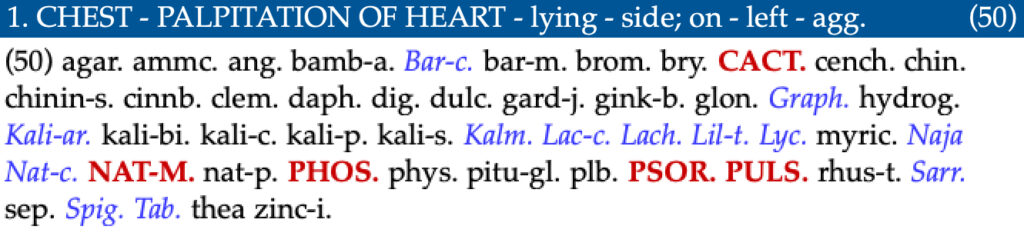
An alternate, simplified repertorization strategy could have been to consider the most important and characteristic symptom of the case as “palpitations worse lying on the left side” and limit the differential diagnosis to the 50 remedies appearing in that rubric in the Synthesis Repertory (see figure 2). This strategy is quick and concise, but a clear understanding of an essential element of the case is required, and limiting the analysis to one bit of information has risks that can lead to failure and frustration.
Key Remedies Considered:
Phosphorus has a keynote symptom of palpitation lying on the left side. It also covers the shortness of breath and heavy sensation in the chest. However, the characteristic emotional state of Phosphorus tends toward anxiety and excitability, and although he mentions feeling nervous from noise, the general flavor of Phosphorus anxiety is not present. The following symptoms from Allen’s Encyclopedia of Pure Materia Medica illustrate these characteristics specific to heart complaints: “Great anxiety in the precordial and epigastric regions…Palpitation and anxiety…Violent palpitation, in the afternoon, after slight emotional excitement.” The patient is superficially jovial and joking but avoids talking about himself and is reserved when questioned. This was not taken as a symptom because it may be a cultural trait. Still, when considering the differential diagnosis, it adds weight to the prescription of Natrum muriaticum, which tends to exhibit a reserved emotional state. The remedy clearly covers the palpitations and the specific modalities related to lying and movement.
Natrum muriaticum (Hahnemann The Chronic Diseases)
856. Oppression of the chest while in the room; weak as he was, he had to go into the open air, which relieved him.
861. Asthma and short breath when walking briskly.
900. Violent pressure below the heart, as if extending from the abdomen toward the chest, in the evening in bed, with palpitation of the heart, more rapid than intense, aggravated by lying on the left side, diminished by lying on the right side, lasting till he falls asleep.
902. Palpitation from the slightest movement.
907. Palpitation with pressure on the heart, like cardialgia, is somewhat diminished by pressing on it with the hand (at once.)
687. He had to urinate four times at night.
Treatment Plan:
1 Week After Initial Consult:
Five days after starting Natrum muriaticum 12c, reddish, very itchy spots appeared on the lower limbs. He presented it to the office on Monday, 2 days later. On observation, I noted mildly erythematous patches about 1cm in diameter on the left and right lower limbs. They were initially painful to touch, but the itching and pain have improved by 80%. He does not recall symptoms precisely like this before, but he does have a mild chronic rash with occasional itching on his torso and back. His pulse is consistently above 60 bpm, which the patient states is an improvement, and his BP is consistently 128/70 at home. PVCs are shorter in duration and less often.
The skin eruptions are a good sign because the main complaint is improved from baseline as they appear and improve. This is an exonerative discharge, which could be from the medications he has taken in the past, a suppressed skin complaint he has failed to recollect, or a temporary exacerbation of the chronic rash on his back and torso. Recognizing a return of old symptoms can often be difficult due to a generally low level of awareness on the part of the patient and the transient nature of the symptoms when brief and mild. Hopefully, by the time they are back in the office, the event will have been minor in severity and short in duration, so that it will have already been forgotten. However, this may not be the case when a person has undergone many years of suppressive treatment.
The apparent improvement of cardiac symptoms in conjunction with the appearance of a benign skin condition also resolving indicates a positive healing reaction. This assessment is aligned with “Hering’s Law,” a set of observations in the course of healing set forth by Constantine Hering and termed “law” by James Tyler Kent. In general, when the disease moves from the inside out, from the top downward, and from the more vital organs to the superficial, things progress toward cure and greater well-being. Understanding these principles and observing them in practice when they appear can significantly improve our case management skills and better guide our patients toward health. Based on the positive assessment, we discussed that it is best not to disrupt this process with medications or topical agents for the ideal healing course. He is instructed to decrease the Natrum muriaticum 12c to 1 dropper from his medicated stock bottle after five succussions taken every other day. There are two reasonable alternative case management options at this time. The first option is to stop the remedy because he is experiencing a striking improvement of symptoms, and the vital force is engaged, then re-evaluate after one week. The second is to continue the repetition of the remedy at daily intervals because the skin eruptions are already significantly improved. I chose a middle option to reduce the repetition frequency because he is quickly responding well but not stopping the remedy entirely. In this situation, changing the remedy, changing the potency, or treating the skin symptoms are unacceptable treatment options.
July 2021:
The rash on his legs fully resolved a few days previously. His palpitations are still much better. He does not feel the constant stopping of his heart, and he can walk a longer distance (1.5 miles) without the need to stop or sit down. Shortness of breath was previously experienced daily with simple walking around the home. He can now walk and talk without aggravation. His pulse continues to remain above 60 bpm. He overexerted himself yesterday moving and lifting, which brought on a worsening of PVCs that lasted until this morning.
He still experiences some chest pain lying on the left side, and he is urinating 2-3 times per night.
He continues to respond well to the remedy. We increase the frequency to daily—Natrum muriaticum 12c, two pellets in 1oz water, one dropper daily after five succussions.
At this time, we discussed a plant-based diet concerning continued heart health. We also added CoQ10 and a mineral supplement.
The patient canceled his next follow-up appointment, and I will not see him again. I emailed him in August 2021, encouraging follow-up and inquiring about his palpitations. I received the following concise reply: “Thank you, Dr., for considering me. I am OK. No palpitations (smiley face).” In the evaluation of this case, I didn’t speculate about the probable unresolved trauma of the patient leaving his homeland, being a refugee, and how that was affecting his health and even potentially causing his palpitations and previous atrial fibrillation. The body gave symptoms in its effort to heal itself, and they showed a pattern that coincides with a remedy that is an affinity for curing grief, sadness, and heartache. Morrison’s Desktop Guide summarizes this sensitivity, stating, “Natrum Muriaticum is our most prominent remedy in patients whose problems begin from grief or insufficiently processed grief.” As for his current relationship with trauma and the past, we’ll have to put it in the basket of the many unknowns in our clinic practice, but he was able to experience more freedom in his life quickly and gently (aphorism 2).

Dr. Michael Knapp attended National University of Natural Medicine in Portland, OR and completed a one year teaching and clinical residency at the university. His practice has an emphasis in the interconnection of digestive problems, (dis-)stress, hormonal and immune system complaints.
Dr. Knapp is a certified mindfulness meditation teacher and has taught meditation in jail for inmates in substance misuse treatment. He has provided outreach to the homeless and at domestic violence shelters in Northern Arizona. He is currently president of the Homœopathic Academy of Naturopathic Physicians.
The Bönninghausen Repertory: Therapeutic Pocketbook Method. Second Ed. 2010. Edited by George Dimitriadis.
Schroyens, Frederik. Synthesis Repertory, Treasure Edition. RadarOpus.