Stacie Deyglio, ND
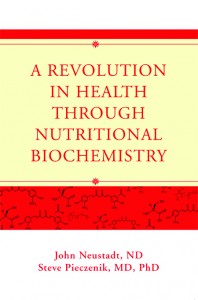 Drs. Neustadt and Pieczenik have transformed the Tolle Causam principle in the creation of their book, A Revolution in Health Through Nutritional Biochemistry. In seeking to identify and remove the underlying causes of illness, the authors contend that all health, disease and cures are derived from three premises: “1) All health problems and diseases are biochemical. 2) If someone was healthy and he or she is not now, something has changed in his or her biochemistry. 3) If you treat the underlying biochemical dysfunction(s), you can prevent and cure diseases” (xi).
The authors have compiled a vast body of research aimed at evaluating the underlying biochemical causes of diseases in a way that is fashioning a new paradigm for integrative medicine. Revealing the underlying nutritional biochemistry of an individual is an approach “whereby symptoms of disease are viewed as manifestations of biochemical dysfunctions that can largely be identified and corrected to support and promote health” (xii). The basic foundation the authors prescribe is that the source of all disease is biochemical and that in correcting the underlying biochemistry, health may be restored.
The book is written for both the lay or medically trained audience. The chapters begin with a brief discussion of the biochemistry of the body, including explanations of amino acids, vitamins, minerals, nutrients, fats, diet and digestion. Then the authors discuss biochemical kinetics and the impact of disease on cellular mitochondria. An interesting compilation is the section on pharmaceutical drugs documented to cause mitochondrial damage.
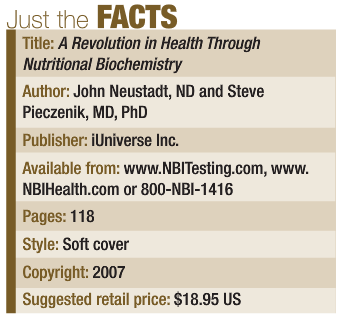 Most of the chapters focus on discussing the underlying biochemical causes of such illnesses as fatigue, depression, osteoporosis, dementia, memory loss, sexual dysfunction, addictions, obesity, cancer, seizures and insomnia. The book includes four case studies and a new system of classification (nosology) that describes the underlying causes (i.e., biochemical dysfunctions) of said diseases.
Evaluation of the individual is via comprehensive biochemical testing in a clinical laboratory. The testing requires seven vials of blood and up to two vials of urine. Dr. Neustadt specifically has extensively researched and compiled a program of assessing more than 400 biochemical variables. Using the data revealed by the testing, a customized treatment plan is created to correct the underlying biochemical dysfunction(s). Information on the actual tests may be found at www.NBITesting.com.
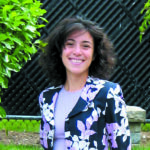 Stacie Deyglio, ND received her baccalaureate degree in biology with a minor in chemistry from the College of Mt. St. Vincent in New York. Her personal health issues paved the way to discovering naturopathic medicine in 1999. Resonating with the philosophy and principles of naturopathic medicine, Dr. Deyglio graduated from the University of Bridgeport, College of Naturopathic Medicine in 2003. As a medical student, she was involved in student government, fundraising and the generation of two successful student-run health fairs. Dr. Deyglio’s interests include relating integrative therapeutics to the health of pediatric and geriatric populations. Currently residing in Phoenix, Dr. Deyglio is an avid bookworm, and is actively creating her practice.