Joy Nauman, MEd
Education
Medical Resources for NDs
A Review of Current Publications for the Naturopathic Industry
What’s Making Our Children Sick?
Despite an increase in public health awareness and improved access to health care, parents and clinicians have noticed a new wave of chronic health problems affecting young children in the developed world. Illnesses such as asthma, allergies, food sensitivities, Crohn’s disease, GERD, IBS, autism, and ADHD have all increased dramatically within the 21st century. While these health problems are complex and can be attributed to a variety of factors, the authors of the book, What’s Making Our Children Sick, argue that these increases are largely due to the industrialization of our food. The incentive to create higher-yield, cost-effective foods has led to an increase in the use of pesticides and genetic modification, which have had detrimental impacts on children’s health. Chronic inflammation, immune system dysfunction, and impairments in the gut microbiome are just a few of the negative outcomes of repeated exposure to chemicals among children. Healing these children will depend on healing our food system and creating a better environment for growing healthy food.
Conventional medicine emphasizes symptomatic treatment for children with chronic illnesses. In this book, Dr Michelle Perro describes her integrated approach to working with children with complex illnesses. Dr Perro first focuses on assessing and correcting dysfunctional digestion. She uses food, nutrition, and homeopathics to help bring chronically sick children back into balance. Without a healthy food supply, however, integrative practitioners will have increasing difficulty healing sick children.
What’s Making Our Children Sick is co-authored by clinician Michelle Perro, MD, and medical anthropologist Vincanne Adams, PhD. Dr Perro worked for 15 years as an emergency room pediatrician. She eventually grew frustrated by only treating children’s symptoms, and started researching alternative and holistic treatments. As she moved away from her conventional medicine training, she discovered homeopathy and its medical system. She began focusing on food-based medicine and homeopathy to treat her patients, and got great results. Dr Perro discovered that improving children’s digestion had to come before introducing healthy food into their diets. She describes her “five R” approach to treating chronic illness: remove, replace, re-inoculate, repair, and rebalance. Dr Perro’s strategy is to remove any food intolerances or allergies, replace missing nutrients using supplements, re-inoculate the gut with healthy flora, repair any damage to the tissues using anti-inflammatory supplements, and rebalance using integrative techniques such as osteopathic manipulation, cognitive behavioral therapy, homeopathy, etc.
Vincanne Adams, PhD, is an academic with a special interest in medical anthropology. She has studied medical systems throughout the world and has focused on comparing these medical systems to the conventional Western approach. Through her studies, she has often wondered why the concept of food as both cause and treatment of dysfunction is present in many other medical systems yet absent from Western medicine. While she was first skeptical of the relationship between chronic illness and the use of pesticides or genetic modification (GM) technologies, she became convinced, while examining the science and politics of our current food system, of the need to work towards a sustainable, clean, and nutritious food source.
The book uses cases from Dr Perro’s private practice to show how she applied food-focused, integrative medicine and homeopathy to support children with chronic illnesses. Her cases include children with chronic digestive disorders, MTHFR mutations, conduct disorders, and autism spectrum disorders. She describes how she educated these children and their parents about the importance of food-focused medicine. Within each case presentation, the authors discuss how a diseased food source impacts children and families.
The majority of this book outlines the ways in which our industrialized food and medical systems are harming our children. The authors focus on the overuse of pharmaceuticals, pesticides (specifically glyphosate), and GM foods. The chapter on the politics and impact of genetically modified foods is especially interesting, as it offers a comprehensive overview of the current science and impacts on health. The book also includes an overview of the importance of a healthy gut microbiome, dysbiosis, and leaky gut.
Despite what the title suggests, a relatively small portion of the content focuses on ways in which individual families and physicians can overcome obstacles. Dr Perro’s approach is well defined: identify food sensitivities, eliminate common allergens, heal the gut, and slowly reintroducing organic, non-GM foods. However, there is little information on how families with limited resources or little access to organic/non-GM food can overcome health disparities.
Though this book describes a naturopathic approach to chronic disease, the authors do not mention the impact of naturopathic medicine on Dr Perro’s treatment strategies. While she mentions collaborating with alternative medicine professionals and obtaining a certification in homeopathy, Dr Perro does not mention whether naturopathic medicine had an impact on her approach to treating children with chronic illness. This was a missed opportunity to include naturopathic medicine in mainstream discussion of integrative medicine. The result is a treatment protocol that seems to be credited to Dr Perro, although any trained naturopathic physician would recognize her approach as part of any holistic treatment plan.
Overall, this book provides a complete and thorough critique of our current medical and food systems, and explains the resistance on both sides of the GM food argument. While the references for some of the chapters in the book rely heavily on outdated research and secondary sources that include Wikipedia and Buzzfeed News, the authors do a fine job of presenting a well-rounded argument in favor of organic, non-GM foods that will appeal to an audience already invested in natural approaches to health care.
Just the Facts
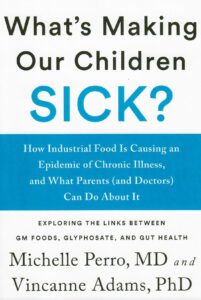 *Title: What’s Making Our Children Sick?
*Author: Michelle Perro, MD, and Vincanne Adams, PhD
*Publisher: Chelsea Green Publishing
*Available from: Amazon.com
*Pages: 272
*Style: Nonfiction
*Copyright: 2017
*MSRP: $24.95
Photo by Aga Putra on Unsplash
 Joy Nauman, MEd is finalizing her graduation from the National University of Natural Medicine as a dual ND/MSiMR student with a certificate in Natural Childbirth. Prior to NUNM, Joy taught Montessori education to children ages 6-12 and became interested in holistic treatments for children with neuropsychological disorders. She is currently living in Yakima, WA providing patient education courses, behavior modification workshops, and research consultation. She is writing her thesis on meditation and attention in children and plans to focus on women’s health, pediatrics, and midwifery once she is fully licensed.