Just the Facts
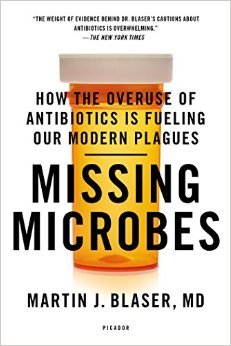
Title: Missing Microbes: How the Overuse of Antibiotics is Fueling Our Modern Plagues
Author: Martin Blaser, MD
Publisher: Henry Holt and Company
Available: Amazon, Barnes and Noble and others
Pages: 273
Style: Hardcover, Paperback, Audible and MP3 CD
Copyright: 2014
MSRP: $28
Missing Microbes: How the Overuse of Antibiotics is Fueling Our Modern Plagues, by Martin Blaser, MD, is a book I am recommending to all my gastroenterology students as well as those on my clinic rotations. It outlines an evidence-based explanation for the trends we see in chronic disease and makes the long-range viewpoint of naturopathic medicine even more evident. It explains the research supporting the beneficial effects of Helicobacter pylori from infancy through early adulthood and the profound negative health consequences of the absence of this key “ancient dominion organism.”
Bacteria in Decline
According to Blaser, the statistics reveal that only 7% of children and 10% of adults in the U.S. now have H. pylori as part of their commensal gastric flora. These percentages are down from an estimate of 100% prior to 1930. Blaser discusses the research showing that use of low dose antibiotics in commercial livestock and farmed fish feed, as well as repeated courses of single antibiotics in humans, have reduced H. pylori colonization. Additional factors include improved sanitation, decreased family size and less crowding and bed sharing in modern times. In addition, since 40% of women are given antibiotics during the delivery process, and the average woman has taken 17 courses of antibiotics by age 20 there is even less chance of inoculating her newborn with H. pylori. Anthropologists believe that helicobacter species have been in the human stomach for at least 60,000 years.
A Bit of Background
Martin Blaser is a gastroenterologist and researcher. He is the director of human microbiome research at NYU Medical Center and has been studying H. pylori since the early 1980s. He lays out the details of Robin Warren and Barry Marshall’s discovery of H. pylori as a cause of chronic gastritis and its relationship to peptic ulcer, gastric lymphoma and adenocarcinoma. These discoveries were first ignored, then ridiculed, but almost three decades later the two were given the Nobel Prize for their work. Unfortunately, these discoveries were taken as the entire picture and in the 1990’s medicine decided that the only good H. pylori was a dead H. pylori. The bacterial baby was thrown out with the bacterial bathwater! Luckily there were researchers around the world that were studying the place of helicobacter species in all mammalian stomachs. Even cheetahs, pigs, dolphins and whales have their resident helicobacter species. There had to be good reason for such a centrally placed organism.
What’s at Stake
The book explains the essential role of H. pylori in the maturation of the immune system. A low grade chronic gastritis shapes and matures immunity, reducing the risks of asthma, allergic rhinitis, GERD, Barrett’s esophagus, and esophageal adenocarcinoma. These conditions have all seen significant increases in incidence during the antibiotic era. Newer research shows evidence for protection against tuberculosis, Crohn’s disease, autistic spectrum disorders and dementia associated with H. pylori carriage.
If you still think of H. pylori as a pathogen and don’t also think of it as a commensal, please devour this book. It is well written and easy to read—a real page turner! It explains the effects of public health and modern childbirth interventions, modern agriculture and horticultural practices and polypharmacy on this key gastrobiome organism. It will make sense of many loose ends in your understanding of underlying causes of chronic disease.
 Steven Sandberg-Lewis, ND, DHANP, has been a practicing naturopathic physician since his graduation from National University of Natural Medicine (NUNM) in 1978. He has been a professor at NUNM since 1985, teaching a variety of courses but primarily focusing on gastroenterology and GI physical medicine. His clinic rotations are particularly popular among NUNM doctoral students. In addition to supervising clinical rotations he also maintains a part-time practice at 8Hearts Health and Wellness in Portland, Oregon.
He is a popular international lecturer at functional medicine seminars, presents webinars, writes articles for NDNR and the Townsend Letter and is frequently interviewed on issues of digestive health and disease. He is the author of the medical textbook Functional Gastroenterology: Assessing and Addressing the Causes of Functional Digestive Disorders, Second Edition, 2017, which is available at amazon.com. In 2010 he co-founded the SIBO Center at NUNM which is one of only four centers in the USA for Small Intestine Bacterial Overgrowth diagnosis, treatment, education and research. In 2014 he was named one of the “Top Docs” in Portland monthly magazine’s yearly healthcare issue and in 2015 was inducted into the OANP/NUNM Hall of Fame.
Within gastroenterology, he has special interest and expertise in inflammatory bowel disease (including microscopic colitis), irritable bowel syndrome (including post-infectious IBS), Small Intestine Bacterial Overgrowth (SIBO), hiatal hernia, gastroesophageal and bile reflux (GERD), biliary dyskinesia, and chronic states of nausea and vomiting.
Many of the patients referred to Dr. Sandberg-Lewis have digestive conditions that have defied diagnosis and effective resolution. Often these patients desire naturopathic treatment options in lieu of the courses of treatments they have previously undergone. He understands diseases of the gastrointestinal tract, but also can assess function and often find successful treatments to regain a balance in the digestive system.
Dr. Sandberg-Lewis lives in Portland with his wife, Kayle. His interests include mandolin, guitar and voice; cross country skiing; writing and lecturing.