Shaida Sina, ND
Tinea pedis (Athlete’s foot) is a fungal infection which primarily affects the foot. It can spread and create infection in the toenail (onychomycosis), the body (Tinea corporis) and/or groin area (Tinea cruris).
Technically, Tinea is classified as a dermatophyte (a ringworm fungi) whose life cycle requires a host. It is contagious and is spread from one host to another, or by contaminated inanimate objects such as damp surfaces. It is referred to as Athlete’s foot because most of the hosts have damp sweaty feet, such as athletes. Fungus requires warm damp areas in order to grow; therefore, bathrooms, changing rooms, and swimming pools are great breeding grounds.
Diagnosis of Tinea pedis is made by subjective findings and lab diagnosis. Tinea pedis can affect one or both feet, producing a hyperkeratotic (dry scaling) patch on the soles of the feet, heel, and between the digits. There may be clusters of pustules or blisters. Patients may or may not complain of itching. Tinea pedis is confirmed by the presence of dermatophytes. The specimen requires scraping the scales and examination under the microscope with KOH. A positive finding is the presence of hyphae (branched filaments).
The typical conventional treatment of Athlete’s foot includes topical and oral options. Topical treatments are creams, ointments, or medicated powders. Oral antifungals range from mildly toxic nystatin to highly toxic terbinafine (Lamisil).
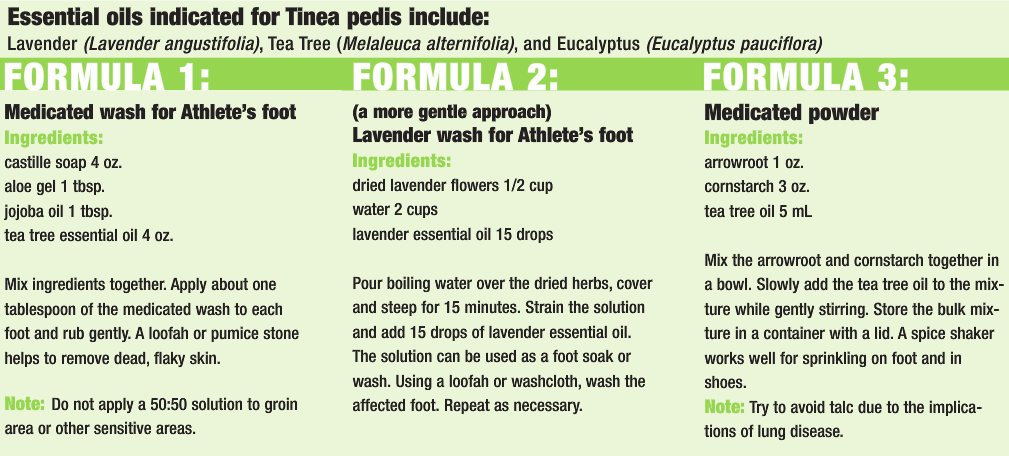
There are several essential oils currently being evaluated in the treatment of Tinea pedis. Many of these studies are looking at antimicrobial effects both by MIC (minimum inhibitory concentrations) and via KOH pre- and post-treatment. The most promising essential oils in the treatment of Tinea pedis include: Lavender [i](Lavender angustifolia), Tea Tree [i] (Melaleuca alternifolia), and Eucalyptus [i] (Eucalyptus pauciflora). In one study of 158 patients, 50% concentration of Tea Tree was highly effective in the treatment of Tinea pedis. There was a small but significant percentage (3.8%) that showed moderate to severe dermatitis from reactivity; therefore, it is very important to remember to skin test prior to treatment.*
There are several predisposing factors in contracting Tinea pedis. These may include walking barefoot on communal floors, dry skin, occlusive foot wear, poor hygiene, hyperhydrosis (excessive sweating, especially of feet), and immuncompromise.
Other treatments should include a generalized fungal cleanse such as an anti-candida diet (avoid simple carbs), oral antifungals (caprylic acid, garlic, grapefruit seed extract), intestinal support (glutamine, okra powder), and probiotic support. Because dry skin predisposes one to Tinea pedis, consider the use of oral essential fatty acids.

Shaida Sina, ND has been working in the field of medicine for over 20 years. Her initial training began as a clinical scientist where she received her BS from University of Maryland’s School of Medicine Department of Medical Research Technology. During her first 10 years in healthcare she worked in the field of laboratory medicine where she ultimately became lead technologist of a reference infectious disease laboratory. Dr. Sina began her studies in natural medicine in 1995 at SCNM and was the first naturopathic physician to do a clinical rotation at Mayo Clinic where she trained in reproductive endocrinology. Her areas of clinical focus include women’s healthcare, pediatrics and general family practice. She can be reached at 851 S. Main St., Suite E, Cottonwood, AZ
References
*Satchell AC. Treatment of interdigital tinea pedis with 25% and 50% tea tree oil solution: a randomized, placebo-controlled, blinded study. Australas J Dermatol. 2002 Aug;43(3):175-8.