
David Schleich, PhD
When a profession’s schools don’t quite fit the usual higher education type or model in the eyes of civil society, its members can get anxious. Happily, finding ways to locate our schools as institutions within civil society is helped by a growing scholarly literature about the so-called “social economy.” For example, there is the work of Salamon (1995) and Hirshhorn (1997), who call attention to the “dearth of conceptual and theoretical frameworks for studying nonprofits.” On a more macro level, it is illuminating to review the scholarship about the “economie sociale” (Snaith, 1991; Defourny and Monzon Campos, 1992), whose characteristics are, in many ways, virtual lenses for understanding this remarkable sector. Ascribing socio-economic values to nonprofit organizations, understanding better how to distinguish nonprofits from public sector organizations, and contemplating the third sector as a “buffer between the state and the individual” (Richmond, 1999) or a “commons” (Lohmann, 1992), both rather unquantifiable, are appropriate goals for this study. Miixed into this energetic smorgasbord is the voluntary dimension, referenced in an earlier column and central not only to our colleges’ experience, but also to the sector.
Running alongside these considerations is the need to better understand how the limits of public policy (Weisbrod, 1988) contribute to the emergence and growth of nonprofits such as NCNM, CCNM, Boucher (New Westminster, BC, Canada) or SCNM. When ND programs become ensconced in multi-program institutions (Bastyr, Bridgeport, NUHS – Lombard, Ill.), though, the types bump into each other. Part of that gray area of identity is the sometimes confusing way in which the limits of the private market are catalytic to the generation of nonprofits (Hansman, 1986). James (1987) flips this angle on the matter from the demand side to the supply side. And, just as these juxtapositions begin to settle into a helpful framework, Salamon (1995) points out that “neither consumer demands nor government and private sector failures to supply them account for the large and publicly subsidized role of nonprofits in the provision of public services” (p. 57).
Into this interesting fray come Samuel Martin’s (1985) phrase “humanistic sector” and his neat narrative on the four classes of humanistic service, “[moving] through the four stages of delivery at different speeds.” Using 1937 as a base year to assess just what North American choices have been in allocating resources, he guides the reader through a tour of historical Japanese, Chinese, western European (including Britain) and eastern European stages of “humanistic service.” Alessandrini (2002), on the other hand, developed a typology of nonprofit human service organizations like our schools, which helps to refine the classification of the mutual nonprofit. The mutual nonprofit is a framework that means, essentially, that we have a common goal and are going about it as nonprofit organizations. This typology just might capture the nature of our schools and programs after all. Alessandrini identified six organizational types “along a continuum characterized by increasing sophistication and distance from the traditional model characterized by altruism, voluntarism and mutuality.”
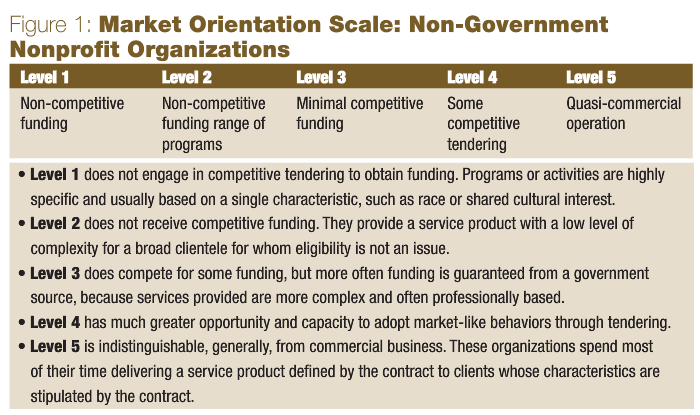 Figure 1 demonstrates that “the further organizations [are] from the traditional model [of the nonprofit], the greater their orientation to the market, in both their delivery of services and their funding sources” (Alessandrini, 2002, p. 3).
Alessandrini’s typology indicates that, “the structures, modes of operation, services (or activities) and clients (or members) differ dramatically from one end of the typology to the other” (p. 4). On first blush, our schools seem to fit most comfortably at the Level 5 end of the continuum. Alessandrini further differentiates nonprofit organizations into six types, manifesting varying aspects of the levels illustrated in Figure 1:
- Simple
- Single factor
- Non-hierarchical
- Semi-professional defined client
- Complex managerial entrepreneurial
- Pseudo-market entrepreneurial.
On close analysis, though, our schools do not fit snugly at all times into any of the levels or types, although the pseudo-market entrepreneurial category captures many of the characteristics of most. For example, whereas the simple type has a voluntary board, it has low levels of management proficiency and low staffing numbers. The pseudo-market entrepreneurial classification includes a management description in which the players are highly professional and financial management is highly complex.
 David Schleich, PhD is president and CEO of NCNM, former president of Truestar Health, and former CEO and president of CCNM, where he served from 1996 to 2003. Other previous posts have included appointments as vice president academic of Niagara College, and administrative and teaching positions at St. Lawrence College, Swinburne University (Australia) and the University of Alberta. His academic credentials have been earned from the University of Western Ontario (BA), the University of Alberta (MA), Queen’s University (BEd) and the University of Toronto (PhD).
References
Alessandrini M: A fourth sector: the impact of neo-liberalism on non-profit organizations. Refereed paper presented to the Jubilee Conference of the Australasian Political Studies Association, Australian National University, Canberra, October 16-19, 2002.
Defourny J: The origins, forms and roles of a third major sector. In Defourny J & Monzon Campos JL (Eds), The Third Sector: Cooperative, Mutual and Nonprofit Organizations, Brussels, 1992, CIRIEC, DeBoeck University, pp 27-50.
Defourny J and Monzon Campos JL (Eds): The Third Sector: Cooperative, Mutual and Nonprofit Organizations, Brussels, 1992, CIRIEC, DeBoeck University.
Hirshhorn R. (Ed): The emerging sector: in search of a framework. Canadian Policy Research Networks Inc., 1987.
Hansman H: The role of the nonprofit enterprise. In S Rose-Ackerman (Ed), The Economies of Nonprofit Institutions, New York, 1986, Oxford University Press.
James E. (1987). The nonprofit sector in comparative perspective. In W. W. Powell (Ed.), The Nonprofit Sector: A Research Handbook (pp. 397-415). New Haven, CT: Yale University Press.
Lohmann R. (1992). The Commons: New perspectives on nonprofit organizations and voluntary action. San Francisco: Jossey-Bass Publishers.
Martin SA (1985). An Essential Grace: Funding Canada’s Health Care, Education, Welfare, Religion and Culture. Toronto: McClelland and Stewart.
Richmond BJ (1999). Counting on Each Other: A Social Audit Model to Assess the Impact of Nonprofit Organizations. Ph.D. Thesis, Department of Adult Education, Community Development, and Counseling Psychology. Ontario Institute for Studies in Education of the University of Toronto.
Salamon L (1995). Partners in public service: government – nonprofit relations in the modern welfare state. Baltimore, MD: The Johns Hopkins University Press.
Snaith I (1991). The Economie Sociale in the New Europe. In Yearbook of Co-operative Enterprise, pp. 61-75.
Weisbrod BA (1988). The Nonprofit Economy. Cambridge, MA: Harvard University Press.