As you may remember, several months ago I treated a longtime patient for an unusual presentation of vaginitis. For this article, we will call her Susan. She responded very nicely to Cantharis. That particular episode so fascinated me that of course I went off in search of the historical and materia medica background of that remedy to which I mercilessly subjected my readers. As we all know, happy endings refer only to brief moments in time.
Menopause seems to have had quite a warming effect. Susan would wake at night, with her first conscious sensation being a surging hot flush. In the past, this was fleeting and mild and really not a hindrance to a good night’s rest.
In this moment, I could see the intensity of her insomnia in the anguished expressions accompanying the description. She would wake as if assaulted by a blast furnace. The burning heat would rise in her body, erupting in profuse perspiration. The heat was unsettling and roused her to a wakefulness that could last hours or even all night. Susan, sitting across my desk, was expressing her suffering with broad, expansive gestures and a gentle weeping. It was not long before I could see her face turn red with heat at the height of her emotion. Susan said that turning the air conditioning up was insufficient to allow her comfort at night. She found some relief in setting up a fan to blow directly at her face.
The first of the hot flushes would break her sleep sometime between 2 and 4 am, with further eruptions of heat occurring at variable times for the rest of the night. Life was now at the point of exhaustion, where making it through the day seemed as if she was pushing through water.
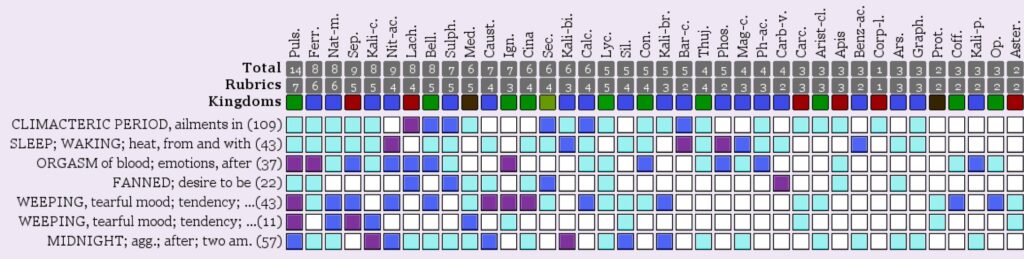
I was struck by the degree of discomfort these hot flushes created. As I had always suspected, I am just an insensitive man. Seeking salvation, I turned to my repertory. The rubrics that popped into my awareness were “Generalities; Fanned, desires to be and Sleep; Waking, from and with heat.”
Her objective appearance was striking. At the height of emotion, Susan’s face went red (“Generalities; Orgasm of blood, emotions with”), and she was crying (“Mind; weeps easily or Mind; weeps when telling of her sickness”).
If you work on this one for just a bit, Pulsatilla slaps you right in the face. I prescribed Pulsatilla 200D, 1 dose to be taken right then (2 pellets) and 3 more doses as a take-out order. Because of the aggression of Susan’s hormonal state, I felt I needed to be aggressive with my posology. I instructed Susan to wait 3 days and to assess for improvement. I suggested that if there was not a minimum of 30% improvement in a 3-day period that she was to repeat the dose. If, however, a dramatic improvement occurred (≥50%), she should wait to redose until she felt the improvement had plateaued.
Three doses later, another happy ending.
 Joseph Kellerstein, DC, ND graduated as a chiropractor in 1980 and as an ND in 1984. He graduated with a specialty in homeopathy from the Canadian Academy for Homeopathy, and subsequently lectured there for two years. He also lectured in homeopathy for several years at CCNM; for eight years at the Toronto School of Homeopathic Medicine; and for two years at the British Institute for Homeopathy. Dr Kellerstein’s mission is the exploration of natural medicine in a holistic context, especially homeopathy and facilitating the experience of healing in clients.