Joseph Kellerstein, ND
Homeopathy has been regarded in some naturopathic circles as being “too esoteric.” That is another name for airy-fairy or not good enough for us hard-headed scientists who need some evidence-based firmness to our prescriptions.
This is nonsense. Hahnemann tells us in aphorism 3 of the Organon that there is precision in medicine—for the first time—in homeopathy.
The problem is we have not been teaching it. Teachers at some schools claim to be teaching homeopathy but are teaching instead a speculative caricature of it.
Our future physicians may learn a lot about newer models of kingdoms and miasms. However, they are homeopathically illiterate because they have never been exposed to the true subject.
Jean came to see me in October 2008. She sat down and first thanked me for the Belladonna I had prescribed because within 3 days the horrible hot flushes she had been experiencing had vanished, until a month ago (not bad for a single dose).
This visit was going to be a slam dunk: up the potency and pat myself on the back. So, I reviewed the case and just increased the potency like a good little robot.
Two weeks later, back came Jean, and she was no better at all. How dare she, the nerve!
Well, it looks like I am forced to work. This lady was now waking hourly drenched in sweat. “It feels like the flu,” she said. When the hot flushes first returned, the heat would come after eating or drinking anything.
This changed with the dose of Belladonna. There is almost always some small change.
Hot flushes are interesting creatures. It seems to us that they have no peculiar symptoms, but our horizons open if we treat them not just as flushes due to menopausal causation but as febrile episodes.
What happens just before or after hot flushes? Does any other occurrence accompany them? Is there anything else anywhere else?
Febrile states are often characterized by a sequence of events that include heat, chill, and sweat. These can happen in a fixed order. Other phenomena may occur in association with one stage or another. Nux will be associated with the desire to be covered during all stages, including the heat. Eupertorium will likewise include thirst.
I asked these questions, and Jean reflected for a while. At first, she denied any associated symptoms, but I asked her to keep thinking.
Finally, she admitted having nausea with the flush. That was a good start. I then double backed and asked what she meant by saying she had felt fluish. The response was that she felt a prickling of the skin with all this. I asked when exactly? The prickling came just before the sweat!
“SKIN; PRICKLING; perspiration, followed by (1): Lob.”
After seeing this in the repertory, I prescribed 1 dose of Lobelia 200. The patient was to return (I assumed triumphantly) in 1 week.
A week later, my patient returned and told me that the prickling was gone but the flushes were still there. Oops.
Jean said the flushes were killing her. She could not think with them. It was like living in a fog. First, she felt the heat, and then she was freezing cold.
“MIND; DULLNESS, sluggishness, difficulty of thinking and comprehending; heat; during (16).”
“FEVER, HEAT; SUCCESSION of stages; heat; followed by; chill (42).”
The first remedy in the repertory chart was Pulsatilla.
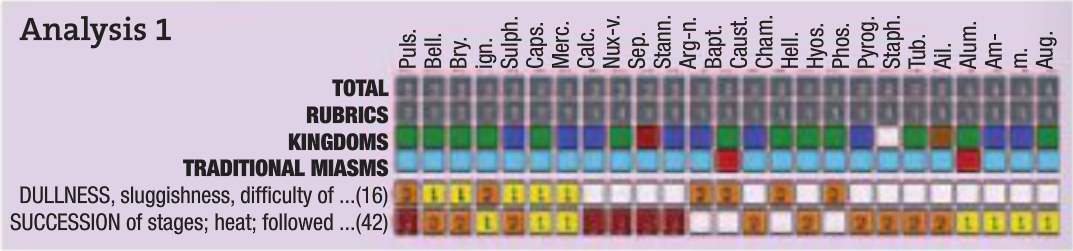
Something struck at my feeble memory. I looked back at the patient’s medical record. I had given her Pulsatilla in October 2009. Now, I carefully read the medical record. Belladonna had been given for the hot flushes just before Pulsatilla and had not worked then either. It was Pulsatilla that worked in a single dose of 30. Finally, I gave Jean a dose of Pulsatilla 200, and it worked.
Relative to the point of precision, Lobelia had contained a partial genius, but I nibbled anyway and was wrong. The body “re-presented” a picture to me that even I could not miss. It was precisely the same remedy that had worked years earlier in a single dose.
Why are we not insisting that our naturopathic students develop these homeopathic skills? Why do we allow some of our colleges to become almost cultlike in their adherence to certain lecturers on the seminar circuit, while not actually teaching the subject they claim to?
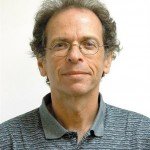 Joe Kellerstein, DC, ND graduated as a chiropractor in 1980 and as an ND in 1984. He graduated with a spe-cialty in homeopathy from the Canadian Academy for Homeopathy, and sub-sequently lectured there for two years. He also lectured in homeopathy for several years at CCNM; for eight years at the Toronto School of Homeopathic Medicine; and for two years at the British Institute for Homeopathy. Dr. Kellerstein’s mission is the exploration of natural medi-cine in a holistic context, especially homeopathy and facilitating the experience of healing in clients.