David J. Schleich, PhD
The naturopathic medical education network in North America does not include a standardized test among the requirements for admission to its 8 programs. Naturopathic educators rarely, if ever, bring the topic up, either in their own programs or at the AANMC. For most of a century, though, the allopaths through their AAMC organization (American Association of Medical Colleges) have designed and administered an MCAT (Medical College Admission Test). The MCAT is a standardized, multiple-choice screening examination for future MDs and DOs. It zeroes in on problem-solving, critical thinking, and core scientific knowledge (concepts and principles). An equivalent in prototype form was created at CCNM in the year 2000, but was not implemented for several reasons, among which was a concern that a comparable “NCAT” would discourage growth in the applicant pool and skew naturopathic medical education in a direction decidedly reductionist and mechanistic. An accompanying reason was the complexity of such a testing system, especially given the wobbles and bumps we went through to get NPLEX/NABNE on sustainable sure-footing across North America in those days. The biomedicine MCAT industry covers content learned in specific areas: Physical Sciences, Verbal Reasoning, and Biological Sciences (physics, general chemistry, general biology, and organic chemistry). Almost all students headed to allopathic, osteopathic, podiatric, and veterinary medical schools complete the MCAT.
Components of the MCAT
Most standardized graduate-school tests are designed to identify potential success, or capacities for success, rather than measure specific knowledge or achievement. They filter out applicants by score. While some subject knowledge is essential (the MCAT, for instance, evaluates fluency in the sciences), most standardized tests are supposed to judge a candidate’s thinking skills. That said, NCAT test designers would be looking to create an assessment instrument which gauges quantitative (math) skills, vocabulary, reading comprehension skills, and writing skills (the ability to construct an articulate and persuasive argument). The math is assessed against ideas about what constitutes basic knowledge gained at the secondary school level.
The allopathic MCAT tests have 3 clusters of skill assessment:
- Analytical skills: This includes the ability to process much data in order to extrapolate what is needed; implicit is the ability to master content, but also concomitant savvy about analyzing data types (graphs, tables, experimental setups) with a view to generating evaluative responses and conclusions
- Mathematical skills: This pertains to the ability to utilize equation templates en masse without a calculator
- Test-taking skills: Because it is computer-based, the modern MCAT also contemplates students having well-honed test-taking skills (timing, sorting, connecting, synthesizing, competing)
NCAT Challenges
In any case, there are a number of challenges to the creation of an NCAT (Naturopathic Medical Admission Test):
- Sheer volume of knowledge: Physical sciences: electronic structure to stoichiometry, thermodynamics to translational motion, Hooke’s Law (F=-kx) to geometrical optics; biological sciences: from enzymes and metabolism to genetic code; prokaryotic cells to organelles; endocrine systems to muscles and bones; embryogenesis to sigma and pi bonds; verbal reasoning: savvy in the humanities, social sciences, natural sciences, and technology; from comprehension to application; cognitive skills in physical and biological sciences: from interpreting content to hypothesis testing and evaluation
- Pros and cons of standardized testing
- The embarrassment of betraying the deference we accord, in our selection process, to the philosophical motivations cherished by many of our incoming students. These motivations are often embedded in a deep, abiding commitment to doing something about the social determinants of health, sustaining elder wisdom about natural medicine, and shunning the worst effects of the economic drivers of the agri- and pharmaceutical business on the planet.
- A yearning for respectability, in terms of assessment, accreditation, and equity in health education systems and their tools, which propels curriculum and methodology away from the mentoring/tutelage model of the early naturopaths, and toward the more systematized, standardized, and regulated practices of the higher education and professional education sectors
Results From a Survey
In the fall of 2013 I conducted an oral, 4-question survey of 35 students, 8 faculty members, and 2 administrators with long experience (Table 1).
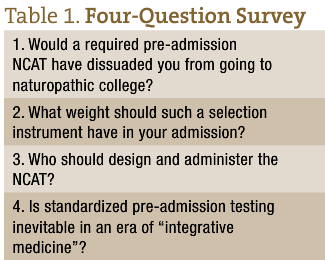
These were strong statements about an idea whose time has not come around, yet, or again.The overwhelming consensus among students, faculty, and administrators who volunteered their answers was that an NCAT was largely unnecessary, that it constituted part of a slippery slope which was already showing up in a too-“green-allopathic” curriculum and clinic experience, and that its measurements did not respect the essential characteristics needed to embody in practice the core values of naturopathic medicine, ie, holism, reverence for nature, and deep commitment to self-actualization and healing. While an NCAT, along with NPLEX, can bookend the collectivity of our professional education preparation, it is the quantitatively and qualitatively soft data about empathy, listening skills, compassion and humility which take precedence over competence and technical skill, even though these latter 2 elements of medicine are strongly assumed. During these survey conversations, decidedly non-NCAT pre-determinants of success as a naturopathic physician kept cropping up, such as emotional intelligence, ability to collaborate, and an interest in the whole person along with technical skill. Also among the qualitative data were these intriguing phrases: “respect for all people as living persons, not just life-support systems for a diagnosis”; “knowing how to tell the truth without rescuing, but without abandoning the patient to objective protocols”; “having a predisposition to all that allopathic stuff about evidence, which an NCAT might measure some of, is not the way to go; the way to go is to use evidence as a tool, not as a determinant, and that takes intuition and love of people… so, like, measure that in your NCAT, why don’t you?”; “so how can an NCAT make sure you’re going to live a balanced life, yourself, since your value as a doctor is going to be all about your own wholeness as a person if you’re going to practice naturopathic medicine, for gawd’s sake”; “no NCAT will prove that a doc cares more about the person than that person’s pathology.”
 David J. Schleich, PhD, is president and CEO of NCNM, former president of Truestar Health, and former CEO and president of CCNM, where he served from 1996 to 2003. Previous posts have included appointments as vice president academic of Niagara College, and administrative and teaching positions at St. Lawrence College, Swinburne University (Australia) and the University of Alberta. His academic credentials have been earned from the University of Western Ontario (BA), the University of Alberta (MA), Queen’s University (BEd), and the University of Toronto (PhD).