How systemic injustice, climate change, and displacement shape pediatric health—and what naturopathic doctors can do to address the root causes.
Leslie Solomonian, ND
Abstract
Pediatric health is shaped not only by individual biology and behavior but also by the larger systems in which children live. This article explores how systemic injustice, climate change, poverty, displacement, and racism profoundly influence child and adolescent health outcomes—often in ways that traditional clinical care overlooks. Through the case of Ahmed, a young Palestinian refugee with worsening asthma, Dr. Leslie Solomonian, ND, illustrates how the social and ecological determinants of health (SEDOH) intersect with clinical presentations and therapeutic outcomes. By integrating insights from Indigenous worldviews, Traditional Chinese Medicine, and naturopathic philosophy, the article calls for a justice-centered approach to pediatric care. It urges naturopathic doctors to expand their roles as advocates and changemakers, addressing not only symptoms but the root systemic forces that harm child health. A framework for multi-tiered action—personal, interpersonal, community, and policy-level—is presented to empower clinicians to act meaningfully within their sphere of influence.
Introduction
In clinical practice, it’s natural to focus on individual-level care. However, to be truly holistic, we must be critically attentive to the social and ecological determinants of health (SEDOH).1 SEDOH is responsible for up to 80% of individual well-being, and children are the most affected. Due to unique vulnerabilities and a rapidly changing global context, the health of kids is increasingly impacted by factors outside of their control–including the accelerating climate crisis, worsening economic inequity, and increasing global conflict.2 These influences span generations: a child born to parents, or into a community without adequate access to determinants of good health, is less likely to achieve their full potential.3 Indigenous perspectives underscore the importance of relationships, culture, and the enduring legacy of colonialism and imperialism.4 These determinants are complexly interwoven; individuals exist within family, nested in communities, economies (both local and global), and environments–all subject to natural laws and limits.5 As naturopathic doctors, we have influence on these determinants, and the opportunity and responsibility to confront the injustice of their distribution, and advocate for pediatric health equity.6
Case presentation
Ahmed is a 10-year-old boy who presents to a community health clinic with concerns of asthma (confirmed with pulmonary function tests, and improved with low-dose inhaled corticosteroids and a short-acting beta-agonist as needed). The frequency and intensity of exacerbations have increased this summer.
The framework of the therapeutic order can be helpful in this case. As naturopathic doctors, we know there are more options than just pharmaceutical suppression. With a vast repertoire of options, we might consider lifestyle counseling to reduce exposure to triggers, dietary modification, breathing exercises, acupuncture/pressure, herbs to support immune and respiratory function, or a well-suited homeopathic.
However, we cannot overlook the impact of the social and ecological determinants that underpin Ahmed’s ability to enact these strategies. A closer look at Ahmed’s circumstances reveals the following details:
Ahmed’s family lives in one of the most densely populated communities in Canada, if not North America. The city has identified the community as one needing greater municipal investment to promote health equity. Community members are essentially newcomers. Many are housing and food insecure, which has tremendous impacts on health, especially for youth, who form a large percentage of the community. The community includes limited green space and is built into the curve of a heavily travelled highway built along an ancient river. Ahmed’s family lives in a high-rise apartment building, which is decades old and is often in disrepair; rats, mold, and cockroaches are endemic. The family struggles to make ends meet; they rely on the local foodbank to supplement food they buy in the local grocery store, but there is never quite enough.7
Ahmed spent the first six years of his life in the Gaza Strip, the following four as a refugee in Jordan, and now lives in Canada, separated from his extended family and culture. In the past two years, multiple family members have died or gone missing due to Israel’s attacks and lack of humanitarian aid; his parents are often scared and upset by the news. The past year and a half has been fraught with anti-Palestinian racism and/or Islamophobia both at school and when they are out in the community.8
Considering the Social and Ecological Determinants
Poverty is arguably the most significant determinant of child health, as it intersects with nearly every other factor. It predicts worse birth outcomes, inadequate nutrition, limited physical activity, heightened exposure to environmental toxins, increased psychological stress, lower-quality education (even in a publicly-funded system), and reduced access to healthcare (ditto).9 While Ahmed’s care is made possible by a partnership between a local health center and a naturopathic medical school, the feasibility of his family implementing any recommendations remains in question. We must avoid labeling families as “non-compliant” when structural barriers limit their capacity.
Air quality—both indoors and outdoors—is a critical asthma trigger.. With global temperatures rising and extreme weather events becoming more common, the number of high-risk days is only increasing. On July 14 of this year, Toronto reported one of the worst air quality indices globally due to northern wildfires.10 Ahmed’s building, perched above a heavily trafficked roadway, exposes him to chronic particulate matter. The population of vermin that plagues Ahmed’s home is increasing due to the changing climate, including rising temperatures and more frequent flooding of the valley below.11,12 To what degree are we, as clinicians, equipped to understand and respond to the health effects of the climate crisis?13,14
Separation from family and culture, and one’s homeland, especially under adverse circumstances, is a notable determinant of poor health, especially when viewed through an Indigenous lens.15 According to the United Nations Refugee Agency, approximately one in every 67 people on the planet was forcibly displaced globally. 16 Ideally, Ahmed would never have had to leave Palestine. A constant state of intense emotions is a form of adversity, with predictable impacts on the development of a child’s neurological and immunological systems. From a Traditional Chinese Medicine standpoint, grief damages the Lungs while fear damages the Kidneys, both key organs in the pathology of asthma. How can we support Ahmed’s resilience in the face of rising militarization by the West against his homeland? Or the racism he endures here in his new home? What role can we play in mitigating these external forces?
Reflections on justice
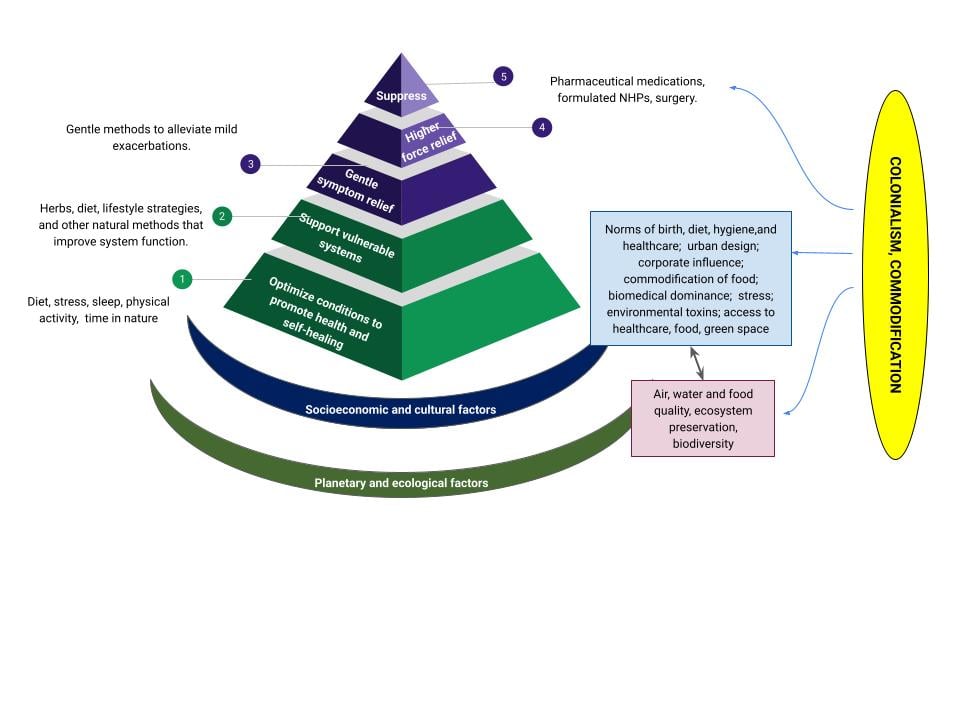
Injustice is the common denominator underpinning all these determinants.17 Privatisation of medicine, food systems, and housing results in inequitable access. When global capitalist systems result in the destabilization of ecosystems and violent competition for resources, people are forcibly separated from culture and land in an effort to survive. DEI initiatives fall short unless they address the underlying systemic structures that perpetuate injustice. Figure 1 illustrates how these forces influence every tier of the therapeutic order.
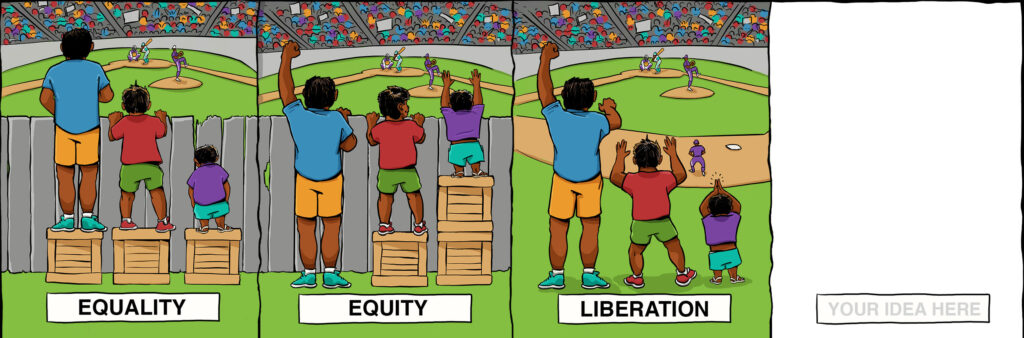
Our ultimate goal should not be simply to seek equity, but justice: removing systemic barriers to ensure all people … all beings – including the cockroaches and rats and mold … and the planet itself, as per our naturopathic oath … have free and unfettered access to the determinants of good health (figure 2). This allows for liberation for all to fully manifest their inherent self-actualization, as defined not by Maslow’s Eurocentric distortion, but by the Siksika people who inspired the concept, in which “people exist within a web of relational alliances wherein one’s actions reverberate to cause a reaction amongst these alliances. The notion of relational accountabilities supersedes aspirations for individual greatness.”18 This appreciation of our interconnectedness is almost always externalized by capitalistic systems.
Removing these barriers can seem insurmountable. However, it can be helpful to consider a multi-tiered framework: action can be taken at a personal, interpersonal, community, or systems level. None is more important than the others, and all levels work together to address the just distribution of these determinants.19
Possible approaches
Some non-exhaustive reflections with respect to justice in Ahmed’s case:
From a personal perspective:
- Do we understand the connections between justice and health? Do we accept the responsibility of taking action toward correcting injustice? Without that work, proceeding is somewhat moot.
- What work do you do to educate yourself about the geopolitical issues that face our world? What sources of information do you access, and do you have the necessary skills for critical analysis?
- What thoughts do you notice when you think about people who are newcomers to the country/town/neighbourhood you live in?
- Who do you vote for at various levels of government? Those that support social services and justice? Or those that prioritize economic growth?
- Where do you do your financial management? With a local credit union that reinvests in the community, or a massive bank that prioritizes profit for shareholders?
- How do you spend your money (eg, boycotting global conglomerates as opposed to supporting local enterprises)?
From an interpersonal perspective (including your clinical practice):
- What conversations do you have with others about geopolitical issues? Do you challenge comments you hear that perpetuate narratives of racism/ableism/capitalism/colonialism?
- Do you take SEDOH into consideration as causes of Ahmed’s health concerns? Do you name these in your conversations with him and his caregivers? Providing explicit education about these connections can be helpful to remove a sense of blame from the patient/family.
- Is your practice trauma-informed? Are your clinical recommendations culturally appropriate? What knowledge does the family already have? Colonization and commodification of health care, including the professionalization of naturopathic medicine, have contributed to stripping people of traditional knowledge. Ahmed’s grandmother probably had thoughts about how to help him using the plants and practices that were native to their land and may be available or grown here.
From a community/local perspective:
- Are you familiar with the social resources available to Ahmed and his family? Where can they access green space, recreational opportunities, local cultural connections, and solidarity? For example, in Ahmed’s neighbourhood is a thriving community garden that is open to all community members, including youth, and emphasizes foods and medicines that are culturally relevant to the local population.20
- Naturopathic doctors can build stronger relationships with local organizations (community hubs, food banks, places of worship, schools, libraries) to facilitate workshops, build connections, and cultivate access to health resources. Methods of social innovation can ensure the ND is compensated for their expertise. For example, a group-based health education program delivered in this community was an effective means of promoting pediatric health and building community.21
- From a policy perspective:
- Do you have the skills to advocate for policy change? Have you trained in writing opinion pieces for your local paper or taken deputation workshops? This author, for example, was deputed to the Toronto District School Board as part of a coordinated effort which resulted in an acceleration of a timeline to integrate anti-Palestinian racism into the board’s existing Anti-Hate and Anti-Racism Strategy.22
- Skills of research, critical analysis, and knowledge dissemination are helpful to support community organizations in writing grants and generating knowledge that can further funding (the time and expertise of the ND can be written into the budget)
- What positions do your professional organizations and affiliations take on issues related to justice? As a member – board or otherwise – you can encourage a deepening of this work through resolutions, position papers, conference themes, and coordinated advocacy efforts in the jurisdiction.
- Would you consider running for office? Or actively supporting a candidate that upholds shared values? In a society whose distribution of determinants of good health is dictated by politics, health is political and must be considered in every policy.23 Naturopathic doctors understand holism, and are ideally positioned to be at the table for these discussions.
These prompts may seem overwhelming. We are trained to focus on the individual; considering social and ecological determinants truthfully does draw upon expanded skill sets and knowledge. However, if we are truly to address the root causes of health, we must look at the factors that influence an individual’s ability to access optimal conditions. Treating the whole requires us to consider concepts of justice. The good news is that we don’t all have to do everything, or work at every level. As the educator Ursula Wolfe-Rocca so beautifully phrased it:
“It can be overwhelming to witness/experience/take in all the injustices of the moment; the good news is that they’re all connected. So if your little corner of work involves pulling at one of the threads, you’re helping to unravel the whole damn cloth.”Starting with the personal levels can go a long way towards taking a culturally relevant and trauma-informed approach to clinical practice. This author has found that when that work is being done, it is impossible to avoid it spilling over into other areas; manifestations of injustice become more visible, and one cannot avoid reaching out to communities that are actively doing the work to dismantle the systems that create them. In order to truly promote health, we must be radical and seek to disrupt the systems of power that lead to injustice and poor health.
Leslie Solomonian is a doctor of naturopathic medicine and retired professor from the Canadian College of Naturopathic Medicine. She co-founded Naturopathic Doctors for Environmental and Social Trust in order to support the naturopathic profession in taking action to promote justice. She holds a Masters degree in Public Health in family and community medicine. Leslie is the author of the textbook Naturopathic and Integrative Pediatrics, and All They Really Need, a book for caregivers on strategies to cultivate both child and planetary health.
References
1. Buse CG, Hancock T, Allison S, et al. Where are the ecological determinants of health?. Can J Public Health. 2023;114(1):152-153. doi:10.17269/s41997-022-00720-x
2. Clark H, Coll-Seck AM, Banerjee A, et al. A future for the world’s children? A WHO-UNICEF-Lancet Commission [published correction appears in Lancet. 2020 May 23;395(10237):1612. doi: 10.1016/S0140-6736(20)30891-6.]. Lancet. 2020;395(10224):605-658. doi:10.1016/S0140-6736(19)32540-1
3. Solomonian L. Scope of Practice and Principles of Care of Naturopathic Medicine in North America: A Commentary. Children (Basel). 2021;9(1):8. Published 2021 Dec 24. doi:10.3390/children9010008
4. Redvers N, Celidwen Y, Schultz C, et al. The determinants of planetary health: an Indigenous consensus perspective. Lancet Planet Health. 2022;6(2):e156-e163. doi:10.1016/S2542-5196(21)00354-5
5. Barton H, Grant M. A health map for the local human habitat. J R Soc Promot Health. 2006;126(6):252-253. doi:10.1177/1466424006070466
6. Solomonian L. Promoting planetary health: a necessary part of caring for children. Naturopathic Doctor News & Review. August 4, 2021. Accessed July 15, 2025. https://ndnr.com/pediatrics/promoting-planetary-health-a-necessary-part-of-caring-for-children/
7. Neighbourhood profile detail. City of Toronto. October 29, 2024. Accessed July 15, 2025. https://www.toronto.ca/city-government/data-research-maps/neighbourhoods-communities/neighbourhood-profiles/find-your-neighbourhood/neighbourhood-profile-detail/?id=NeighbourhoodProfiles-CityofToronto/Snapshot110&title=Neighbourhood%20Profile%20Data#type=filtered&filter=Select+a+Neighbourhood&value=Thorncliffe%20Park%20(55)
8. Wasser M. Co-Resisting Anti-Palestinian racism in Toronto Schools. Briarpatch. May 21, 2025. Accessed July 15, 2025. https://briarpatchmagazine.com/articles/view/co-resisting-anti-palestinian-racism-in-toronto-schools
10. Raveendran R. Wildfire smoke puts Toronto among worst in the world for air quality; weather alerts in place. CBC. Published July 15, 2025. Accessed July 15, 2025. https://www.cbc.ca/news/canada/toronto/extreme-heat-humidity-gta-monday-environment-canada-1.7584221. 11. Richardson JL, McCoy EP, Parlavecchio N, et al. Increasing rat numbers in cities are linked to climate warming, urbanization, and human population. Sci Adv. 2025;11(5):eads6782. doi:10.1126/sciadv.ads6782
12. Hiscox A, Spencer F, Dennehy J, et al. The impact of adverse weather events on cockroaches and flies, and the possible effects on disease. Med Vet Entomol. Published online March 7, 2025. doi:10.1111/mve.12797
13. Jagals P, Ebi K. Core Competencies for Health Workers to Deal with Climate and Environmental Change. Int J Environ Res Public Health. 2021;18(8):3849. Published 2021 Apr 7. doi:10.3390/ijerph18083849
14. Ahdoot S, Baum CR, Cataletto MB, et al. Climate Change and Children’s Health: Building a Healthy Future for Every Child. Pediatrics. 2024;153(3):e2023065505. doi:10.1542/peds.2023-065505
15. Assembly of First Nations. First Nations Holistic Policy and Planning a Transitional Discussion Document on the Social Determinants of Health. 2013. Accessed July 15, 2025. http://health.afn.ca/uploads/files/sdoh_afn.pdf
16. United Nations High Commissioner for Refugees. Global Trends: Forced displacement in 2024. Copenhagen, Denmark: United Nations High Commissioner for Refugees. 2025. Accessed July 15, 2025. https://www.unhcr.org/global-trends
17. Let’s Talk: Health equity. National Collaborating Centre for Determinants of Health. 2023. Accessed July 15, 2025. https://nccdh.ca/resources/entry/health-equity
18. Kapisi ERBCO, Choate P, Lindstrom G. Reconsidering Maslow and the hierarchy of needs from a First Nations’ perspective. Aotearoa New Zealand Social Work. 2022;34(2):30-41. doi:10.11157/anzswj-vol34iss2id959
19. Solomonian, L. We are Nature: Healing People, Healing the Planet. Naturopathic Doctor News & Review. December 20, 2024. Accessed July 15, 2025. https://ndnr.com/mindbody/we-are-nature-healing-people-healing-the-planet/
20. Bowden O, Fagan S. How Thorncliffe Park’s community garden is teaching kids about nature while tackling food insecurity. CBC. March 13, 2024. Accessed July 15, 2025. https://www.cbc.ca/news/canada/toronto/thorncliffe-park-community-garden-1.7141191.
21. Solomonian L, Kwan V, Bhardwaj S. Group-Based Naturopathic Education for Primary Prevention of Noncommunicable Disease in Families and Children: A Feasibility Study. J Altern Complement Med. 2019;25(7):740-752. doi:10.1089/acm.2019.0067
22. Oatley G. Toronto school board votes to speed up anti-Palestinian racism strategy. TorontoToday.ca. May 29, 2025. Accessed July 15, 2025.
23. Health in all policies. American Public Health Association. Accessed July 15, 2025.https://www.apha.org/topics-and-issues/health-in-all-policies