

A...
Chemotherapy-Induced Peripheral Neuropathy: An Evidence-Based Guide for Naturopathic Physicians
read more

Jack Duke, ND
Type 2 diabetes develops over years of progressive metabolic dysfunction. This article reviews the pathophysiology of insulin resistance, highlights strategies for early detection, and presents practice-based outcomes from a 12-week naturopathic metabolic intervention designed to improve insulin sensitivity and cardiometabolic health.
Preventing type 2 diabetes begins long before blood sugar reaches diagnostic thresholds. This article explores a root-cause, naturopathic framework for identifying and reversing early metabolic dysfunction while presenting clinical outcomes from a comprehensive 12-week Metabolic Reset Program that improved insulin sensitivity, body composition, and other markers of metabolic health.
Type 2 diabetes develops along a continuum of metabolic dysfunction that frequently precedes diagnosis by many years. This article reviews the pathophysiology of insulin resistance, discusses strategies for early identification, and presents practice-based outcomes from a 12-week naturopathic metabolic intervention program demonstrating improvements in insulin sensitivity, body composition, and cardiometabolic health.
Diabetes mellitus is a disorder of carbohydrate metabolism resulting from impaired insulin production, insulin resistance, or both.1 Its prevalence is strongly associated with Western dietary and lifestyle patterns.2 More than two in five U.S. adults has prediabetes, yet more than 80% remain undiagnosed.3 Type 2 diabetes (T2D) now affects approximately 40 million Americans and remains among the leading causes of morbidity, mortality, and healthcare expenditures worldwide.4, 5, 6 In the U.S., annual expenditures for T2D management exceed $400 billion.7 These statistics underscore the urgent need for preventative approaches that identify and address metabolic dysfunction before overt diabetes develops.
The pathophysiology of T2D is multifactorial, involving early disturbances in glucose regulation, insulin signaling, hepatic metabolism, inflammation, and energy homeostasis. Impaired glucose uptake, excessive hepatic glucose production, incretin dysfunction, and glucagon dysregulation contribute to progressive metabolic dysfunction.8
Insulin resistance develops when skeletal muscle, adipose tissue, and hepatic cells become less responsive to insulin, leading initially to compensatory hyperinsulinemia. Over time, progressive β-cell dysfunction results in impaired glucose regulation and ultimately hyperglycemia.9 Importantly, insulin resistance precedes T2D, and subtle disturbances in glucose regulation may precede measurable insulin resistance, emphasizing that diabetes develops along a continuum rather than as an abrupt disease state.
Traditional screening tools for diabetes include fasting glucose, hemoglobin A1c (HbA1c), and oral glucose tolerance testing (OGTT). However, these markers often fail to detect early metabolic dysfunction.
Additional clinical tools may identify insulin resistance before overt hyperglycemia develops:
Clinical risk factors include obesity, hypertension, dyslipidemia, polyendocrine metabolic ovarian syndrome (PMOS), metabolic dysfunction-associated steatotic liver disease (MASLD), history of gestational diabetes, physical inactivity, and chronic stress. However, metabolic dysfunction may also occur in individuals who appear healthy by conventional measures.
Additional factors associated with impaired glucose regulation include:
Continuous glucose monitoring (CGM) offers a valuable opportunity to detect postprandial dysglycemia and glycemic variability before abnormalities are reflected in fasting glucose or HbA1c measurements.
From a naturopathic perspective, preventing T2D requires addressing the upstream drivers of metabolic dysfunction rather than waiting for diagnostic thresholds to be crossed. The development of insulin resistance is rarely attributable to a single cause but instead reflects interactions among:
Interventions targeting these root causes may improve insulin sensitivity, reduce inflammation, enhance metabolic flexibility, and alter the trajectory of chronic disease progression.
The principles described above formed the basis of a 12-week Metabolic Reset Program implemented in clinical practice. To illustrate the application of a comprehensive naturopathic approach, outcomes from two representative participants are summarized below.
Participants completed baseline and post-intervention assessments, including:
The intervention consisted of:
Six educational modules, including determinants of metabolic health; dietary and nutritional fundamentals; understanding the gut microbiome; the impact of physical activity, sleep, and stress; the liver’s role in lipid metabolism and detoxification; mitochondrial health; and maintenance counseling. Weekly accountability sessions addressed obstacles, goal setting, and the importance of community. Additional interventions included weekly acupuncture (including 5-point auricular acupuncture weight loss protocol), individualized clinical care, movement analysis, and educational resources. The therapeutic framework emphasized low glycemic whole-food nutrition, adequate protein intake, reduction of ultra-processed foods, efficient physical activity, intermittent fasting, stress regulation, circadian rhythm optimization, and restoration of insulin sensitivity.
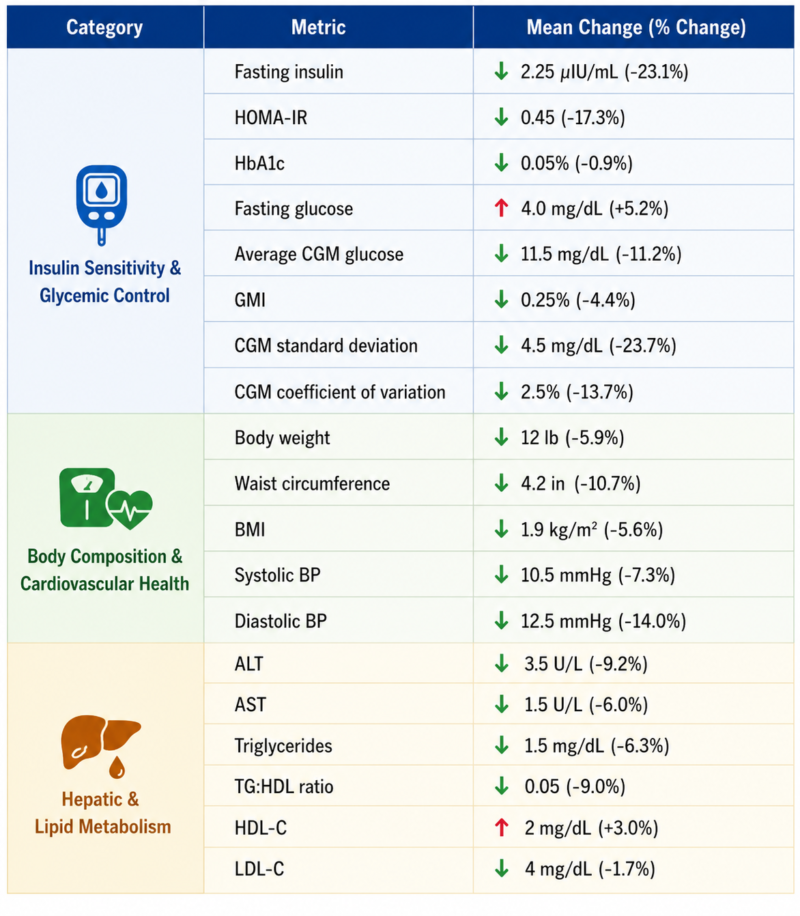
Participants completing the 12-week Metabolic Reset Program demonstrated improvements across multiple domains of metabolic health (Table 1). The largest mean improvements were observed in markers of insulin sensitivity, including fasting insulin (↓2.25 μIU/mL; -23.1%) and HOMA-IR (↓0.45; -17.3%). Clinically meaningful improvements were also observed in body weight (↓12 lb; -5.9%), waist circumference (↓4.2 in; -10.7%), and blood pressure (↓10.5/12.5 mmHg). Continuous glucose monitoring demonstrated improved glycemic control and stability, with reductions in average glucose (↓11.5 mg/dL; -11.2%), glucose standard deviation (↓23.7%), and coefficient of variation (↓13.7%). Favorable changes were also observed in hepatic enzymes and lipid-related markers, suggesting improvements extending beyond glycemic regulation.
The outcomes observed following this 12-week naturopathic metabolic intervention program support an increasingly recognized principle in metabolic healthcare: type 2 diabetes develops along a continuum of metabolic dysfunction that often begins years before conventional diagnostic thresholds are met. Rather than focusing exclusively on hyperglycemia after disease onset, this intervention targeted the upstream drivers of insulin resistance, including dietary patterns, body composition, physical activity, sleep quality, stress physiology, hepatic metabolism, and behavioral factors.
Perhaps the most clinically meaningful finding was the improvement in insulin sensitivity despite relatively modest changes in traditional glycemic markers. Participants demonstrated an average reduction in fasting insulin of 2.25 μIU/mL (-23.1%) and HOMA-IR of 0.45 units (-17.3%), suggesting improved insulin sensitivity despite relatively stable fasting glucose values. The modest increase in mean fasting glucose (87 to 91 mg/dL) reflects averaging between two participants, both of whom remained within the normal fasting glucose range. These findings reinforce the concept that compensatory hyperinsulinemia often precedes overt hyperglycemia and that fasting glucose alone may fail to identify early metabolic dysfunction. Improvements in insulin sensitivity likely reflect enhanced skeletal muscle glucose uptake, reduced hepatic glucose output, and decreased metabolic demand on pancreatic β-cells.
A major focus of the intervention involved restoring metabolic flexibility through whole-food nutrition emphasizing adequate protein intake, fiber-rich carbohydrates, and healthy fats, with postprandial walks and regular strength training. CGM metrics demonstrated favorable adaptations in glycemic control and variability, with mean average glucose decreasing from 102.5 to 91.0 mg/dL (-11.2%), GMI decreasing from 5.75% to 5.50% (-4.4%), standard deviation decreasing by 23.7%, and coefficient of variation decreasing by 13.7%. Emerging evidence suggests that glycemic variability itself may contribute to oxidative stress, endothelial dysfunction, and progression of insulin resistance independent of fasting glucose values.15
Clinically meaningful improvements were also observed in body composition and cardiometabolic risk factors. Participants experienced an average reduction in waist circumference by 4.2 inches (10.7%), accompanied by a 5.6% reduction in BMI and approximately 7% and 14% reductions in systolic and diastolic blood pressure, respectively. These findings are particularly relevant given the role of visceral adipose tissue as an active endocrine organ that contributes to insulin resistance through secretion of inflammatory cytokines, altered adipokine signaling, and ectopic lipid deposition.
Markers of hepatic and lipid metabolism also demonstrated favorable changes. The triglyceride-to-HDL ratio improved by 9%, while liver enzymes decreased, with reductions in ALT (-9.2%) and AST (-6.0%). Although triglycerides demonstrated only a modest average reduction (-6.3%), improvements in surrogate markers of insulin resistance, including the TyG Index, suggest enhanced metabolic flexibility and hepatic insulin sensitivity. The relatively modest triglyceride response may reflect transient physiologic lipid mobilization during active weight loss and metabolic remodeling.
A distinguishing feature of this intervention was its community-driven accountability with continuous metabolic feedback through laboratory testing and continuous glucose monitoring likely contributed synergistically to behavior change and clinical outcomes.
Type 2 diabetes develops along a continuum of metabolic dysfunction rather than at a single diagnostic threshold. These practice-based observations suggest that comprehensive naturopathic interventions targeting nutrition, movement, sleep, stress, and other upstream determinants of health may improve metabolic function before overt disease develops. By emphasizing early detection and treatment of the causes of insulin resistance, naturopathic medicine may play an important role in reducing the burden of type 2 diabetes. Larger prospective studies are warranted to further evaluate this approach.
This report has several limitations. It reflects outcomes from a practice-based observational case series (n = 2) and a relatively short intervention period of 12 weeks. Consequently, the reported averages should be interpreted as descriptive clinical observations rather than inferential estimates and are not intended to establish causality or generalize to broader populations. Individualized interventions, varying levels of adherence, and the absence of a control group may also have influenced outcomes. Nevertheless, these findings provide preliminary practice-based evidence supporting a comprehensive, root-cause approach to improving metabolic health and underscore the need for larger prospective studies evaluating naturopathic interventions for diabetes prevention.

John “Jack” Duke, ND, is a naturopathic physician at Kansas City Integrative Health in Overland Park, Kansas, where the Metabolic Reset Program described in this article was conducted. He earned his Doctorate in Naturopathic Medicine from Sonoran University of Health Sciences. His personal experience living with type 1 diabetes fuels his passion for metabolic health, diabetes prevention, and root-cause medicine. Dr. Duke’s clinical interests include metabolic health, gastrointestinal health, men’s health, and preventive care. Outside of clinical practice, he enjoys spending time with his family, staying active, cooking, and serving his local community.