
David J. Schleich, Ph.D.
The relationship between biomedicine and alternative medical systems has been characterized by processes of annihilation, restriction, absorption and even collaboration.
(Hans Baer, 2001)
The term CAM (complementary and alternative medicine) is routinely global these days, but it took root early in the United States and the UK. The Canadian equivalent for a time was CAHC (complementary and alternative health care). The literature about CAM/CAHC has grown in conjunction with the work of medical historians, medical anthropologists and medical sociologists. There is an extensive literature, as well, about community and socially purposive organizations as these relate to CAM.
The acronym, CAM, appears frequently in the literature about primary health care in North America. As do many scholars of complementary and alternative medicine practices, policies and developments, Pelletier begins his compendium of alternative medicine with Eisenberg’s definition: Those practices explicitly used for medical intervention, health promotion or disease prevention which are not routinely taught at United States medical schools, nor routinely underwritten by third-party payers within the existing United States health-care system. (Pelletier, 2001; Page 36)
The term CAM came into wide use after Eisenberg’s review of alternative health care utilization patterns among Americans (Eisenberg et al., 1993, 1998). Its relevance to “naturopathic medicine” is that the generic term, CAM, includes a wide range of alternative and complementary medical systems, therapies and modalities; naturopathy among them.5 A 1995 research methodology conference sponsored by the U.S. Office of Alternative Medicine (OAM) defined CAM as a broad domain of healing resources that encompasses all health systems, modalities and practices and their accompanying theories and beliefs; other than those intrinsic to the politically dominant health system of a particular society or culture in a given historical period. (ATHM, 1997; 3:50)
The U.S. National Institutes of Health panel on definition and description in 1997 added to the definition provided by the 1995 OAM Conference. A statement which Achilles (2000) claims “[recognizes] the fluid boundaries between CAHC (CAM) and conventional medicine.” (I.2): CAM includes all such practices and ideas self-defined by their users as preventing or treating illness or promoting health and well-being. Boundaries with CAM, and those between the CAM domain and the domain of the dominant system are not always sharp or fixed. (NIH Panel on Definition and Description, 1997).
The health-care map in North America of that dominant system is complex in terms of the nature, extent and inter-relatedness of its many medical specialties, modalities and therapies. In this connection, Tataryn and Verhoef (2001) point out “some complementary and alternative approaches are complete systems of assessment and treatment, while others are single modality interventions offered as alternatives or complements to conventional treatment (p. VII.87).” They further indicate “some approaches have well-developed regulatory structures (e.x. massage therapy); others are fragmented professions with little interdisciplinary agreement about regulation (e.x. acupuncture); or are not likely to ever be regulated (e.x. folk remedies) (VII.87).”
Tataryn has also further elucidated the terrain of CAM/CAHC by proposing a framework that “classifies both conventional and complementary, and alternative health-care practices according to basic assumptions regarding the nature of health and disease.” (See Figure 1 , Tataryn and Verhoef, 2001; VII.89)
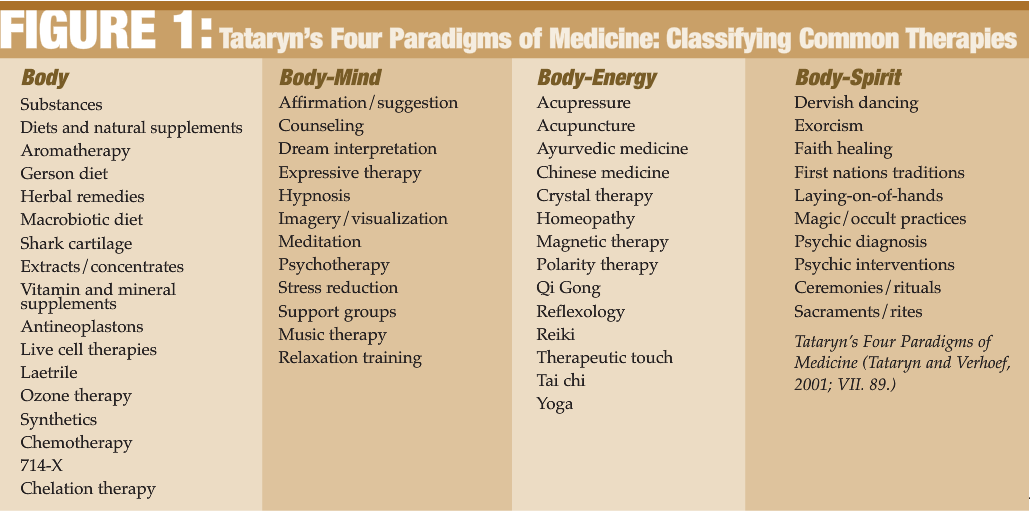
Tataryn’s classification system, Achilles explains, “does not take either conventional or alternative therapies as his point of departure. Rather, the groupings are conceptualized on the basis of their assumptions about the nature of health and disease, and the dimensions that the therapies or practices claim to target (Achilles, 2001; I.6).”
Kleinman’s (1980, 1978) framework for organizing health-care divides it into three intersecting areas: professional, popular and folk. As would be expected, the professional sector exhibits structures that include licensing, standardized training and self-regulation. The folk sector has specialized shamans and herbalists, and the popular sector comprises non-specialized “self-care, family, social network and community beliefs and activities (Kleinman, 1980; Page 39).” This effort to understand the diversity of health-care practices available to the patient focuses on function.
Another approach is to consider characteristics of CAM/CAHC which, as Achilles points out, “distinguish them from conventional medicine (Achilles, 2001; I.7).” Echoing the work of Chez and Jonas (1997), common characteristics of CAM or CAHC modalities and therapies were articulated in a 1999 York University Centre for Health Studies report. The list, predicated on “a residual and negative definition of CAHC as constituted by what conventional medicine is not (Achilles, 2001; I.7), is remarkably consistent with the similar characteristics frequently published by naturopathic associations as constituting the principles and philosophy of naturopathic medicine. These common characteristics include the following:
- Works with the body’s own self-healing mechanisms
- CAM is holistic
- Patient is active participant/personal responsibility
- Achieves well-being
- Goes to the roots of a health problem
- Treats individuals rather than disease categories
- Validates subjective experience
- Efficacy is based on personal anecdotes
(York University Centre for Health Studies, 1999)
Next month, we’ll continue to explore the cluttered landscape of CAM definitions.
David Schleich, PhD is president and CEO of NCNM, former president of Truestar Health, and former CEO and president of CCNM, where he served from 1996 to 2003. Previous posts have included appointments as vice president academic of Niagara College, and administrative and teaching positions at St. Lawrence College, Swinburne University (Australia) and the University of Alberta. His academic credentials have been earned from the University of Western Ontario (BA), the University of Alberta (MA), Queen’s University (BEd), and the University of Toronto