How shifts in testosterone, estrogen, cortisol, vasopressin, and prolactin may influence paternal mental health—and inform screening and individualized naturopathic care during pregnancy and postpartum.
Introduction
The perinatal and postpartum periods include significant physiological, mental-emotional, and lifestyle changes for all members of the family. Historically and culturally, much of the support provided to a family surrounding the birth of a child understandably goes to the baby and their mother. Less attention, though, is provided to the father who also experiences significant physiological changes. The combination of these changes during the perinatal period can lead to significant mental health conditions which can profoundly impact not only the father but all members of the family.
“Postpartum depression” is most commonly associated with mothers. Lesser known is that approximately 1 in 10 fathers also experience some kind of perinatal mood and anxiety disorder (PMAD).1 PMADs include depression but also encompass anxiety, OCD, and related mental health conditions. As such, the more inclusive term of PMADs will be used herein instead of simply the limited term, “postpartum depression.” The experience with fathers and PMADs is often different than that of mothers as the symptoms manifest differently. Even so, they are no less significant in their impact.
Central to the etiology of paternal PMADs are changes in hormones during the perinatal and postpartum period. Encompassing reproductive hormones (estrogen, testosterone), stress hormones (cortisol), and hormones pertaining to bonding and care of children (including oxytocin and prolactin), these hormonal fluctuations create conditions optimal for the onset of PMADs. This article aims to highlight these hormone changes, how they lead to perinatal mental health conditions, and avenues for both screening and treatment of paternal PMADs in this hormone context, including when direct hormone support may be warranted or suggested against.
Epidemiology, Risk Factors, and Symptoms
Paternal PMADs are growing in both prevalence and their impact on families and society. A 2016 meta-analysis found the prevalence of paternal PMADs to be between 8-13%. This is likely underestimated and underreported,1 in part, due to the well-established reluctance of men to seek healthcare.2 The prevalence of paternal PMADs doubles during the first year of fatherhood and is nearly double the rate of depression in the adult male population. Geographically, the highest rates were found in North America while lower prevalence rates were found in Europe and Australia, likely influenced by differing parental leave benefits and differing stigma around mental health.1
Paternal PMADs are distinguished from maternal PMADs in many ways. One of the most significant differences is the timing and onset. Paternal PMADs present more gradually and less abruptly, manifesting primary after the “fourth trimester,” around 3-6 months postpartum, though they can present anytime in the perinatal period. Instead of presenting simply as depression as is common in the “mommy blues,” paternal PMADs manifest as a spectrum of mental health conditions, including depression, anxiety, obsessive compulsive disorder (OCD), reclusion and withdrawal, intrusive thoughts, and post-traumatic stress disorder (PTSD).3 As such, it is important for clinicians to be mindful of and watching for non-traditional mental health symptom presentation during the perinatal period.
One of the most significant predictors for paternal PMADs is the presence of maternal PMADs.3,4 Other risk factors for the development of paternal PMADs include new demands and responsibilities; changing and evolving relationships with their partner; sleep deprivation; lack of involvement and rewards in parenting; difficulty building bonds with children, particularly during infancy; and familial, occupational, and general life stressors.3
Perinatal Hormone Changes
Perinatal changes in endogenous hormone levels are particularly seen in the mother but are also observed in the father, albeit to a lesser extent. While this might be surprising given a predominant non-birthing role, many of these changes are biologically intended to promote paternal bonding. However, one adverse side effect of these perinatal hormone fluctuations can be the onset of PMADs. An increased understanding of these hormone changes in context of paternal PMADs provides insight to appropriate workup and treatment.
“Factor in fathers—for the sake of the father, his family, and his community.”
Testosterone
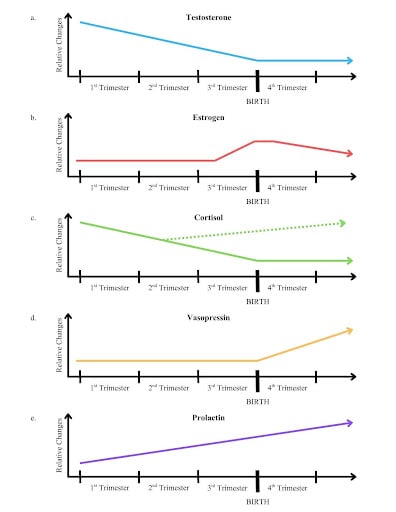
Changes in testosterone levels exert perhaps the most profound effect on fathers in the perinatal period. It is well established that male testosterone levels decrease at the beginning of their partner’s pregnancy (Figure 1a). This adaptive response is thought to help the father transition from mating to investing more time and energy at home, strengthening his direct nurturing role and indirect provisioning.5,6
This is not without its side effects, however. From a mechanistic perspective, testosterone exerts influence on androgen receptors in the cortex, limbic system, and brain stem, regions that oversee libido and sexual behavior, assertiveness, and cognitive and learning capacities.7 Thus, lower testosterone levels exert powerful levels on mental and emotional health. Low testosterone has been correlated with male depression3 and paternal PMADs.5 Additionally, higher levels of paternal testosterone may protect against paternal PMADs, but could lead to increased relationship dissatisfaction, partner aggression, and fathering stress, all predictors of subsequent higher maternal PMADs.5
Low testosterone serves as an easy therapeutic target for treating paternal PMADs. This may include hormone replacement therapy (HRT), providing precursor DHEA, or other herbal support (e.g. fenugreek, ashwagandha, red ginseng, forskohlii, and others).8 However, this is not advised given the biological role that lower testosterone levels serve to promote bonding and connections between a couple and their children.9 Thus, the relationship between testosterone and other hormones with PMADs is likely mediated in part through the adaptive responses that the hormone changes were intended to effect. Fathers who struggle to adapt to the new roles could then experience depression and other PMADs as a result. This adaptive evolutionary perspective must not be overlooked, as any treatments directly focused on testosterone may directly contradict the biological processes of nature. Other therapies discussed herein are advised instead.
Estrogen
During the last month of his partner’s pregnancy, paternal estrogen levels increase until the early postpartum period,10 correlating with increased active parenting behaviors optimal for infant care (Figure 1b).3 Beyond this, research is limited, so the relationship between changes in estrogen and PMADs is not completely defined. Some have suggested that lower estrogen contributes to paternal PMADs,3 but it is also feasible that higher estrogen could be at play.11
Given that estrogen is not a dominant hormone in men, it is likely that estrogen dysregulation has a minor influence on the etiology of PMADs compared to other hormones. Even so, the phase II breakdown of estrogen via catechol-O-methyltransferase (COMT) requiring methylated B vitamins could offer one therapeutic target. Relationships between low vitamin B12 and high methylmalonic acid (MMA) and 5-methyl tetrahydrofolate have been associated with maternal postpartum depression.12 Further research is needed in this area, but it remains plausible that dysregulated B vitamin levels could contribute to PMADs via disrupting estrogen metabolism and/or through other means. Supporting methylated B vitamin levels provides a low-risk therapeutic avenue for PMADs.13
Cortisol
The relationship between changes in cortisol levels and PMADs is not well defined. Despite generally conflicting research with the relationship between cortisol and depression overall, the prevailing observation is that maternal PMADs are associated with lower cortisol. Interestingly, one study observed higher cortisol associated with maternal postpartum depression, and lower cortisol levels with maternal postpartum anxiety.14 Given the positive relationship between maternal PMADs and paternal PMADs, and given similarities in the biological function of cortisol between men and women, it can be largely inferred that paternal PMADs are associated with lower cortisol levels, despite the lack of specific research on this subject.3,6,14 Since paternal PMADs tend more toward anxiety than depression, the lower cortisol correlation seems more consistent given the observation with maternal PMADs, though elevated cortisol may be present (Figure 1c).11
Cortisol remains a viable therapeutic target for paternal PMADs given the relationship with cortisol and various aspects of the perinatal period. First, cortisol leads to a state of arousal, including the cortisol awakening response. In their review, Kim and Swain highlighted how higher maternal cortisol levels lead to increased sensitivity toward the infant in the early postpartum period.3 Some fathers may similarly have heightened sensitivity toward the infant, prompting elevated cortisol.
Second is the relationship between cortisol and the circadian rhythm, which is likely disrupted due to frequent night-time awakenings to care for the infant. Sleep deprivation is negatively correlated with paternal mental health.15 Sleep deprivation is likely attributed to the blunted cortisol awakening response (CAR) and steeper decline in cortisol levels across the day, which changes contribute to PMADs.14
Lastly, increased stressors in the perinatal period, including familial, relationship, financial, and occupational, may also contribute to cortisol dysregulation and paternal PMADs.3 These stressors may contribute to high cortisol levels. Alternatively, the impaired ability to manage stress may be indicative of low cortisol levels.
Unlike testosterone, cortisol is a viable therapeutic target for paternal PMADs. Cortisol levels can be measured with saliva, urine, or blood serum testing and appropriate naturopathic treatments can be provided, including adrenal glandular and cortisol-regulating botanicals as indicated.
Vasopressin and Prolactin
Vasopressin and prolactin are two other hormones that modulate in the perinatal period and could contribute to PMADs. Low paternal levels of vasopressin are observed in multiple mammalian species, including humans (Figure 1d).3,16 These lower levels which rise after the birth of the infant are postulated to influence the prefrontal cortex and subsequent ability to plan and organize parental behaviors. If those abilities are impaired, the risk of PMADs is increased.3 Prolactin levels in fathers rise during pregnancy and into the postnatal period (Figure 1e).17 Given how prolactin helps fathers become more aware of infant needs, low prolactin levels could contribute to PMADs.3 From a therapeutic perspective, vasopressin and prolactin are viable but secondary targets that could be explored in treatment-resistant PMADs.
Diagnosis and Screening
With an increased understanding of hormonal influences on paternal PMADs, naturopathic physicians are more empowered to screen, diagnose, and treat individuals for paternal PMADs.
The foundation for screening and diagnosing paternal PMADs is recognition and awareness of these physiological and psychosocial changes in the father. Despite increasing awareness, paternal postpartum depression has yet to be characterized in the Diagnostic and Statistical Manual of Mental Disorders (DSM).3,18,19
When risk factors for paternal PMADs are present, especially maternal PMADS, providers can screen fathers using the Edinburgh Postnatal Depression Scale (EPDS). The EPDS has been validated to effectively screen for paternal PMADs, just as it does in mothers.1,19 Other effective screening tools include the Patient Health Questionnaire-2/-9, the Gotland Male Depression Scale20, and the Paternal Involvement with Infants Scale21.
Laboratory measurement of hormone levels may provide additional insight into this psychoneuroendocrinology. While morning testosterone is most often measured, it has been suggested that evening testosterone levels should also be considered.5
Treatment
As discussed herein, cortisol support and detoxification support provide the most clear therapeutic targets from a hormonal perspective. When thinking more broadly, all naturopathic therapeutic considerations for the treatment of depression, anxiety, OCD, and other manifestations of paternal PMADs are worthy of consideration. One study observed that fathers prefer psychological interventions, including individual and couple psychotherapy, over pharmacotherapy for the treatment of PMADs.4 That said, pharmacotherapy should not be excluded as a viable therapy. Neurotransmitter support, botanical nervines, homeopathy, and optimization of nutrition, movement, and sleep all remain at the center of a naturopathic approach to paternal PMADs.11 One effective resource is to refer fathers to community and peer-based support.
Conclusion
Paternal PMADs can exert a significant influence on the father and his family when a child is born. Just as maternal PMADs confer a risk of paternal PMADs, the opposite is true as well. Paternal PMADs can exacerbate both partner relationships and maternal mental health.4 Similarly, paternal PMADs confer a risk to offspring, negatively influencing their cognitive, emotional, and behavioral development.3,4,22 In an effort toward gender-equitable care, it behooves the naturopathic physician and all health care providers to recognize the existence of paternal anxiety and depression, the physiological etiology to them, and to “factor in fathers”11 for the sake of the father, his family, and his community. Indeed, all are benefited from a holistic, equitable treatment of perinatal mood and anxiety disorders.
Caption for Figure 1
Relative changes in male paternal hormones during the perinatal period. Given that research is somewhat inconclusive on some data, rates are approximated. a. Testosterone decreases during the perinatal period.5,6 b. Estrogen increases in the last month of pregnancy and slightly decreases thereafter.10 c. Low cortisol levels in the perinatal period are most associated with PMADs, though it is possible that high cortisol could also be present. 3,6,11,14 d. Vasopressin levels are low during pregnancy and increase after birth.3,16 e. Prolactin levels increase during pregnancy and postpartum.17