
A longitudinal case demonstrates how conventional cancer surveillance can be combined with metabolic, inflammatory, gastrointestinal, environmental, and lifestyle assessment to support whole-person health in localized prostate cancer.
Introduction
Active surveillance has become an increasingly accepted management strategy for carefully selected men with localized prostate cancer, allowing many patients to delay or avoid active treatment while maintaining quality of life.1 Conventional surveillance typically relies on serial prostate-specific antigen (PSA) measurements, imaging, repeat biopsy when indicated, and clinical assessment to identify evidence of disease progression. Although this approach effectively monitors tumor behavior, it often provides limited assessment of the patient’s broader physiologic health.
Applying a whole-person, systems-based clinical framework that evaluates the patient as an integrated biologic system rather than focusing exclusively on the tumor offers patients a proactive strategy beyond simply “watching and waiting.” Alongside cancer-specific surveillance, this approach seeks to identify and address modifiable physiologic factors that impact overall health, treatment tolerance, immune function, systemic inflammation, metabolic health, quality of life, and physiologic resilience. These factors may include metabolic dysfunction, nutritional status, chronic inflammation, environmental exposures, infectious burden, gastrointestinal health, sleep, stress, physical activity, and hormonal balance.
Within an integrative oncology setting, serial laboratory evaluation can extend beyond conventional cancer biomarkers to include longitudinal assessment of systemic inflammatory markers, metabolic health, hormonal status, immune-related parameters, and selected functional medicine testing when clinically indicated. Although these markers are not validated surrogate endpoints for cancer progression, they may provide objective information regarding changes in the patient’s overall physiologic status and help guide individualized supportive care.
This case describes a now 61-year-old male with localized intermediate-risk prostate adenocarcinoma, who after consultation with his treating physicians, elected an active surveillance approach on account of quality-of-life considerations associated with standard of care treatment. Over approximately 20 months of follow-up, conventional oncologic monitoring was integrated with serial assessment of metabolic, inflammatory, hormonal, nutritional, gastrointestinal, and environmental factors. Multiple potentially reversible physiologic challenges, including acute infections, gastrointestinal dysbiosis, suspected mold-related illness, pancreatic insufficiency, metabolic abnormalities, and lifestyle factors, were identified and addressed as they emerged. This report illustrates a longitudinal, adaptive model of whole-person integrative oncology care in which conventional cancer surveillance and individualized physiologic optimization evolved together through repeated objective reassessment.
“Applying a whole-person, systems-based clinical framework that evaluates the patient as an integrated biologic system rather than focusing exclusively on the tumor offers patients a proactive strategy beyond simply ‘watching and waiting.’”
Case Presentation
A physically active 59-year-old male presented to our integrative clinic in August 2024 seeking consultation following a recent diagnosis of localized intermediate-risk prostate adenocarcinoma. Although independent in all activities of daily living, he reported chronic daily fatigue and had been consuming a typical Western dietary pattern that included frequent fast-food meals and highly processed foods. At presentation, he also reported nocturia and increased daytime urinary frequency. His primary goals were to preserve urinary, sexual, and overall quality of life while taking an active role in improving his health through evidence-informed integrative care.
Initial evaluation included multiparametric prostate MRI demonstrating a PI-RADS 5 lesion within the peripheral zone measuring approximately 1.8 × 1.0 cm. MRI-guided biopsy confirmed adenocarcinoma of the prostate, Gleason score 3+4=7 (Grade Group 2). Initial PSA was approximately 6.8 ng/mL. Germline genetic testing was negative for clinically significant hereditary cancer mutations.
Initial staging raised concern for possible osseous metastatic disease after prostate-specific membrane antigen (PSMA) PET imaging and subsequent bone scintigraphy demonstrated a mildly active sclerotic lesion within the left iliac bone. The patient was evaluated by medical oncology, and systemic chemotherapy was initially considered because of concern for metastatic disease. However, subsequent longitudinal clinical assessment, serial laboratory trends, imaging review, and continued specialist follow-up ultimately supported localized disease without confirmed metastatic progression. Throughout the course of care, the patient remained under the management of his treating urologist and medical oncologist, who continued routine surveillance and shared decision-making regarding future treatment options.
After reviewing standard treatment recommendations, including androgen deprivation therapy and radiation therapy, the patient elected an active surveillance approach because of concerns regarding the potential impact of treatment on urinary, sexual, and overall quality of life. Rather than viewing surveillance as passive observation, he chose to actively engage in a comprehensive metabolic and integrative oncology program while remaining under close urologic surveillance. Should his disease remain localized, focal ultrasound ablation (high-intensity focused ultrasound [HIFU]) was identified as a potential future treatment option once he became Medicare eligible at age 65, when the procedure would be financially accessible.2
Through shared decision-making, the patient committed to substantial dietary and lifestyle modification and agreed to undergo comprehensive laboratory assessment approximately every four to six weeks throughout the surveillance period. Longitudinal monitoring included PSA and percent free PSA, complete blood count, comprehensive metabolic panel, high-sensitivity C-reactive protein (hsCRP), erythrocyte sedimentation rate (ESR), lactate dehydrogenase (LDH), fasting insulin, vitamin D status, ferritin, homocysteine, and additional biomarkers selected according to evolving clinical findings. Functional medicine testing, including organic acids testing and comprehensive stool analysis, was pursued selectively when serial assessment suggested additional potentially modifiable physiologic contributors. In addition, the patient monitored fasting blood glucose and blood ketone levels daily using a Keto-Mojo meter to track metabolic response and dietary adherence throughout the program.
Over the course of approximately 20 months, the patient demonstrated marked improvements in dietary quality, metabolic health, systemic inflammatory markers, subjective energy, and overall quality of life.
Longitudinal Clinical Course and Clinical Decision Points
Following the initial consultation, the patient began a comprehensive whole-person integrative oncology program consisting of a Mediterranean-style ketogenic dietary pattern, structured exercise, stress reduction, sleep optimization, and serial physiologic reassessment. Daily fasting blood glucose and blood ketone measurements were obtained using a Keto-Mojo meter to support nutritional ketosis, with periodic 2- to 3-day water fasts every four to six weeks to intermittently achieve therapeutic ketosis under physician supervision. Local-regional hyperthermia, subcutaneous Viscum pini mistletoe therapy, intermittent Helleborus 12X injections, exercise with oxygen therapy (EWOT), and individualized nutraceutical and prescription protocols were incorporated alongside ongoing active surveillance with his urologist and medical oncologist. Viscum pini was gradually titrated from 1 mg to 50 mg administered two to three times weekly based on clinical tolerance and local immune response.
Rather than relying solely on population-based reference intervals, treatment decisions emphasized evidence-informed physiologic targets to optimize metabolic health, reduce inflammation, support immune function, and identify reversible contributors to disease progression or impaired health. Examples included hsCRP <1.0 mg/L, ESR <10 mm/hr, LDH 145–175 U/L, fibrinogen <300 mg/dL, GGT <15 U/L, fasting insulin <4 µIU/mL, ferritin 45–100 ng/mL, galectin-3 <10 ng/mL, homocysteine <8–9 µmol/L, uric acid <4.0 mg/dL, and normalization of macrocytosis (MCV <91 fL). These targets served as objective guides for individualized therapeutic adjustments throughout surveillance.
During the first several months, the patient demonstrated exceptional adherence to the program. He eliminated fast food and highly processed foods, transitioned to an organic Mediterranean-style ketogenic diet, consistently consumed 7–9 cups of non-starchy vegetables daily, maintained regular physical activity, incorporated meditation and breathing practices, and progressively improved sleep habits. PSA density, calculated by ultrasound in January 2025, was favorable at 0.08, supporting continued candidacy for active surveillance.
Serial biomarker assessment demonstrated progressive physiologic optimization across multiple domains (Table 1; Figures 1 and 2). Fasting insulin decreased from 11.4 µIU/mL to below the clinic target of 4 µIU/mL. Homocysteine improved from 13.9 to 9.2 µmol/L, with a most recent value of 8.8 µmol/L. GGT decreased from 64 U/L to 15 U/L over the course of the surveillance period, suggesting resolution of hepatic stress. Elevated fibrinogen (366 mg/dL), ferritin (383 ng/mL), uric acid (5.5 mg/dL), macrocytosis (MCV 105 fL), and galectin-3 (19.2 ng/mL) each prompted targeted interventions, including modified citrus pectin (15 g/day), methylation support, dietary refinement, and ongoing metabolic optimization. Estradiol elevation (58–59 pg/mL) identified during follow-up prompted initiation of diindolylmethane (DIM), sulforaphane, and pomegranate extract, resulting in normalization of estradiol to 16 pg/mL with a free estradiol level of 0.23 while the androgen profile remained within physiologic limits. Throughout surveillance, hsCRP, ESR, and LDH generally remained within or near clinic targets, except during documented inflammatory or infectious events.
Frequent reassessment also allowed unexpected laboratory changes to be interpreted within their clinical context rather than being attributed solely to tumor progression. Occupational exposure to industrial solvents prompted counseling regarding environmental toxin reduction. A dental infection requiring endodontic treatment coincided with transient elevations in inflammatory markers and PSA, which improved following treatment. Later, a prolonged upper respiratory infection was associated with an increase in hsCRP to 4.46 mg/L, PSA elevation to 7.8 ng/mL, and reduction in percent free PSA. Management focused on treatment of the acute illness, intravenous vitamin C, hydration, temporary intensification of anti-inflammatory therapies, and repeat laboratory assessment. As the infection resolved, inflammatory markers returned to baseline and percent free PSA recovered.
Serial assessment extended beyond conventional oncology testing. Organic acids testing demonstrated fungal dysbiosis, suspected mold-associated gastrointestinal colonization, mitochondrial stress, and impaired fatty acid metabolism. Comprehensive stool analysis subsequently identified Salmonella species, significant Klebsiella overgrowth, fungal dysbiosis, pancreatic exocrine insufficiency, steatorrhea, elevated secretory IgA and lactoferrin, and absence of detectable Lactobacillus and Bifidobacterium species. These findings prompted individualized antimicrobial, antifungal, digestive enzyme, microbiome restoration, and gastrointestinal support protocols while conventional cancer surveillance continued.
By early 2026, systemic inflammatory markers had normalized following recovery from the respiratory illness; however, PSA remained above the patient’s previous baseline despite resolution of systemic inflammation. Based on the longitudinal trend rather than a single value, local-regional hyperthermia was reinitiated twice weekly for approximately six weeks while the patient continued his established metabolic program. Subsequent laboratory assessment demonstrated a decline in PSA from 7.4 to 5.9 ng/mL with recovery of percent free PSA to 29%, while hsCRP (0.5 mg/L), ESR (1 mm/hr), and LDH (150 U/L) remained within clinic targets. At most recent follow-up in May 2026, PSA measured 6.9 ng/mL with stable inflammatory markers; this finding is being monitored as part of ongoing surveillance. Repeat prostate MRI in 2025 showed stable findings without interval progression; a follow-up MRI is scheduled within the next several months, and repeat PSMA PET imaging of the previously noted iliac lesion is being discussed with the treating medical oncologist. At the time of manuscript preparation, the patient had maintained excellent functional status, sustained major lifestyle changes, and continued multidisciplinary active surveillance without evidence of confirmed metastatic progression.
Discussion
This case highlights how a whole-person, systems-based framework can be layered onto conventional active surveillance for favorable-risk localized prostate cancer without displacing guideline-based oncologic monitoring. Percent free PSA has established utility for risk stratification at the time of surveillance enrollment, but its value for interpreting trends during ongoing surveillance is less well established; in this case, transient reductions in percent free PSA coincided with documented acute illness rather than a validated marker of progression, underscoring the importance of clinical context.
High-sensitivity CRP is a well-characterized prognostic biomarker across solid tumors generally,3 though it is not a validated surrogate for prostate-specific progression; here it functioned primarily as a general index of physiologic stress that helped distinguish infection-related PSA fluctuation from a true trend. The temporal association between reinitiated local-regional hyperthermia and PSA decline is consistent with hyperthermia’s reported adjunctive benefit in oncologic care,4 though causality cannot be established from a single case.
Initiation of modified citrus pectin followed an elevated galectin-3, a target with preliminary clinical support in biochemically relapsed prostate cancer.5 Ketogenic dietary strategies have mechanistic rationale for reducing insulin/IGF-1 signaling in prostate cancer, though clinical evidence remains preliminary.6 The identified gut dysbiosis is consistent with emerging literature linking microbial composition to prostate cancer progression.7 Elevated homocysteine reflects disturbances in one-carbon metabolism increasingly implicated in carcinogenesis.8 DIM/sulforaphane supplementation is supported by controlled data demonstrating favorable shifts in estrogen metabolite ratios.9
Because multiple interventions, dietary changes, and intercurrent illnesses occurred concurrently, individual causal attribution is not possible, and these observations should be interpreted as hypothesis-generating rather than confirmatory.
Conclusion
This case demonstrates a longitudinal, whole-person integrative oncology model that complemented conventional urologic active surveillance in a patient with intermediate-risk localized prostate cancer. Serial multi-system laboratory assessment allowed the clinical team to identify and address reversible contributors to systemic inflammation, metabolic dysfunction, and gastrointestinal dysbiosis, and to interpret unexpected PSA fluctuations within their clinical context rather than assuming disease progression. At last assessment, the patient remained without confirmed metastatic progression, had sustained substantial lifestyle changes, and continued multidisciplinary surveillance. Prospective studies are needed to determine whether this integrative framework meaningfully affects long-term oncologic outcomes.
Table 1. Selected Laboratory Trends During Active Surveillance and Integrative Oncology Care
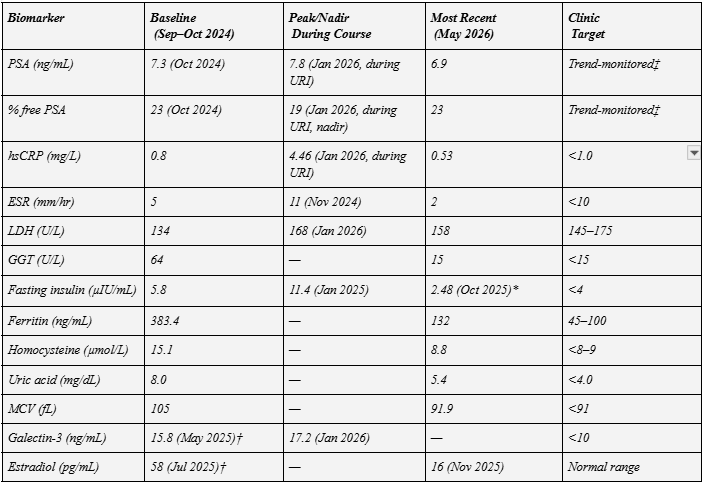
*Most recent available fasting insulin value (October 2025); no repeat draw thereafter. †First available measurement (biomarker not assessed at baseline). ‡Followed as a longitudinal trend in the context of clinical events rather than against a fixed numeric target.
Consent Statement
Written informed consent for publication of this de-identified case was obtained from the patient.