A Nearly Tenfold Rise in Total Motile Sperm Count After Analgesic Discontinuation and Integrative Care
An integrative case explores a marked improvement in semen parameters following discontinuation of concentrated analgesic exposure and implementation of a comprehensive preconception nutrition and lifestyle plan.
Fertility histories often capture current prescriptions while missing episodic over-the-counter analgesic use. Nonsteroidal anti-inflammatory drugs (NSAIDs) alter cyclooxygenase and prostaglandin signaling, creating a biologically plausible – but unproven – pathway through which sustained or high-dose exposure could influence male reproductive physiology. Human evidence remains mixed.
Case
A 40-year-old man with primary infertility and recurrent Achilles-tendinopathy flares reported concentrated high-dose use of naproxen and acetaminophen before fertility testing. Baseline semen analysis showed marked oligoasthenoteratozoospermia: concentration 7.6 million/mL, total count 10.9 million, total motility 25%, progressive motility 18%, strict morphology 1%, and total motile sperm count (TMSC) 2.72 million.
Intervention and outcome
Analgesic exposure was discontinued, pain management was redirected to appropriate clinical oversight, and a staged integrative plan addressed preconception nutrition, omega-3 intake, vitamin D status, antioxidant support, sleep, hydration, exercise, heat exposure, and relevant metabolic concerns. After 111 days, concentration increased to 32.5 million/mL, total count to 78 million, strict morphology to 6.5%, and TMSC to 26.5 million – a 9.7-fold increase. Total motility improved to 34% but remained below the WHO sixth-edition lower reference value. Sperm DNA fragmentation was 18% and was interpreted by the testing laboratory as within its reference range.
Conclusion
The timeline and magnitude of change make the exposure history clinically important, but they do not establish analgesic or NSAID causation. Concurrent interventions, within-person semen variability, incomplete collection data, and possible interlaboratory differences remain major confounders. This case supports analgesic-specific medication histories, coordinated management of plausible reversible exposures, and repeat testing after a biologically meaningful interval.
Keywords: male infertility; analgesics; NSAIDs; naproxen; chronic pain; oligoasthenoteratozoospermia; semen analysis; sperm DNA fragmentation; integrative medicine
Clinical relevance

Introduction
Male-factor infertility contributes to approximately half of infertility cases, yet the male evaluation may still be narrower than the female partner’s workup.[1-3] A standard assessment includes reproductive and medical history, physical examination, and semen analysis; medication and supplement review is also essential.[4]
Semen analysis is inherently variable. The AUA/ASRM guideline recommends at least two analyses obtained about a month apart when the first result is abnormal, and cautions that values above or below reference limits do not alone establish fertility or infertility.[4] In a series of 2,566 men, only 51.2% of second analyses confirmed the first by WHO criteria, while 23% of men with an initially abnormal result had a normal repeat.[6] Any single-patient improvement must be interpreted against that background.
The medication history is only as useful as the questions used to obtain it. Patients may not consider over-the-counter pain relievers to be medications, and episodic high-dose use may be overlooked when an intake asks only about daily prescriptions. This matters because febrile illness, heat exposure, abstinence interval, collection completeness, laboratory method, systemic disease, and medication exposure can all shift semen results.[4,5]
NSAIDs warrant particular attention. By inhibiting cyclooxygenase, they alter prostaglandin synthesis; prostaglandin signaling participates in Leydig-cell function, Sertoli-cell signaling, testicular homeostasis, and the hypothalamic-pituitary-gonadal axis.[7-9] Experimental ibuprofen exposure has produced a compensated hypogonadal pattern, while a 2025 nationwide cohort associated ibuprofen use for more than 60 days per year with a higher incidence of male infertility than matched acetaminophen use.[7,11]
The counterevidence is important. A systematic review found adverse ibuprofen effects across in vitro and animal studies but concluded that human confirmation was lacking.[10] In the PRESTO preconception cohort of 1,956 men, recent typical-dose use of ibuprofen, naproxen, aspirin, or acetaminophen was not associated with lower fecundability, although high total analgesic exposure generated a signal that warrants cautious study.[12] A short ibuprofen course in men with leukocytospermia did not significantly worsen conventional semen parameters, and a small naproxen study changed seminal prostaglandin concentrations without significantly altering sperm density or motility.[13,14]
This case describes marked improvement in several semen parameters after discontinuation of a concentrated analgesic exposure and a concurrent multicomponent integrative fertility plan. Its value is not proof of a drug effect; it is the clinical lesson contained in the timeline.
Case Presentation
A 40-year-old man was evaluated as part of a couple’s fertility care after more than one year of unsuccessful conception. His partner’s reproductive evaluation was described in the source record as largely unremarkable, increasing concern for a male-factor contribution.
A detailed intake identified a temporal relationship among an abnormal fertility assessment, recurrent pain, and concentrated analgesic exposure. He reported Achilles-tendinopathy flares, historically occurring approximately once per year, for which he used high doses of naproxen (Aleve, an NSAID) and acetaminophen (Tylenol, not an NSAID). Exposure was substantial during the interval preceding the baseline semen analysis, although the exact doses, number of days used, cumulative exposure, and cessation date were not retained in the available record.
He denied testosterone replacement therapy, anabolic steroid use, tobacco use, chemotherapy exposure, febrile illness, and a known varicocele. Other potential contributors – including cannabis exposure, occupational or environmental toxicants, genitourinary infection, full reproductive hormone testing, and detailed heat exposure – were not completely documented.
“For clinicians working at the intersection of fertility, pain, and physical medicine, the practical lesson is simple: ask better questions.”
Diagnostic Assessment
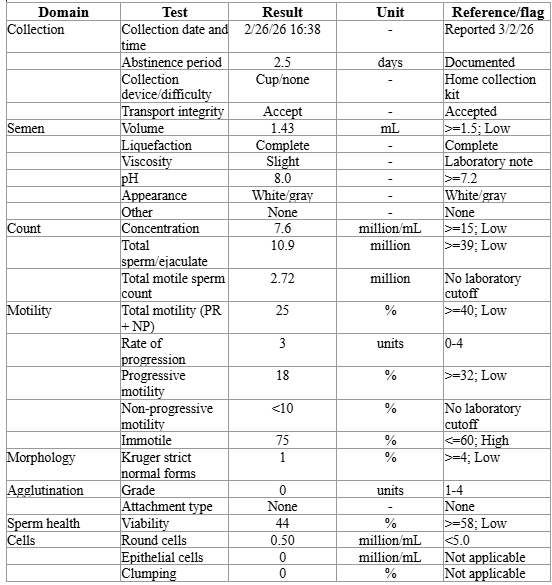
The baseline ReproSource semen analysis was collected on February 26, 2026 after 2.5 days of abstinence and showed oligoasthenoteratozoospermia: concentration, total count, total and progressive motility, strict morphology, semen volume, and viability were below the reporting laboratory’s reference values. TMSC was 2.72 million. The specimen was collected with a home collection kit, transport integrity was accepted, and no collection difficulty was reported. The laboratory associated with the June 17 repeat analysis and its collection conditions could not be confirmed.
Table 1. Semen parameters before and after intervention
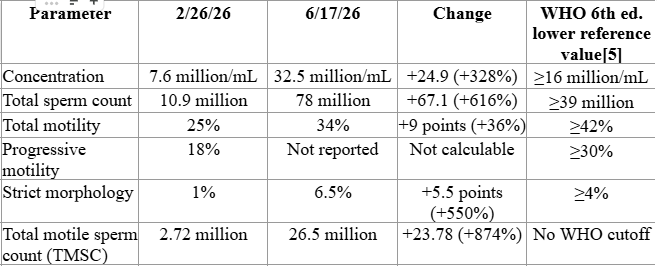
Note. Relative changes are calculated from reported values. WHO lower reference values describe the fifth centile among fertile men and are not stand-alone diagnostic cutoffs. Baseline abstinence was 2.5 days and semen volume was 1.43 mL; corresponding follow-up collection details, semen volume, laboratory identity, and analytic method were unavailable in the extracted record.
Broader Laboratory Assessment
A fasting blood and urine evaluation collected February 17, 2026 provided additional reproductive and systemic context. FSH was 14.7 mIU/mL and LH 9.4 mIU/mL, both above the laboratory ranges, while total testosterone (433 ng/dL), free testosterone (14.8 pg/mL), estradiol (17.8 pg/mL), prolactin (5.7 ng/mL), and sex hormone-binding globulin (20.9 nmol/L) were within range. This mild hypergonadotropic pattern with preserved testosterone is compatible with compensation but is not diagnostic of a medication effect. Vitamin D was low at 22.8 ng/mL. Total cholesterol (228 mg/dL) and calculated LDL cholesterol (151 mg/dL) were high. CBC, routine urinalysis, renal and hepatic markers, PSA, glycemic markers, thyroid hormones and antibodies, inflammatory markers, and ANA were otherwise within the reporting laboratory’s ranges.
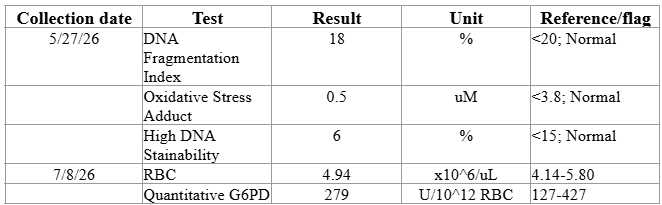
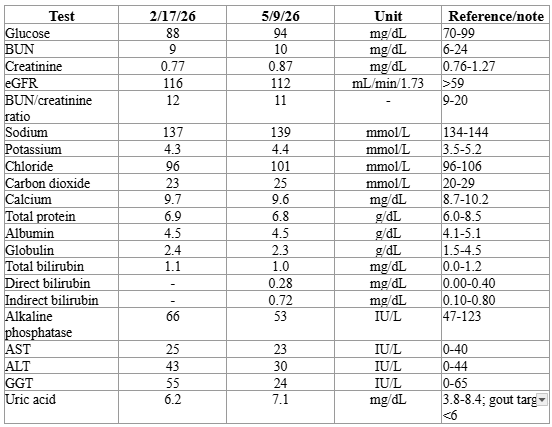
Salivary testing collected March 5 showed cortisol of 21 nmol/L on waking, 2.0 at noon, 1.4 in the evening, and 2.0 at night. Noon and evening values were below the laboratory reference intervals, while DHEA and secretory IgA were within range; the laboratory characterized the pattern as early or phase 1 HPA-axis dysfunction. A May 9 metabolic panel remained within range, with ALT decreasing from 43 to 30 IU/L and GGT from 55 to 24 IU/L. Uric acid increased from 6.2 to 7.1 mg/dL but remained within the laboratory interval. Quantitative G6PD activity collected July 8 was normal at 279 U/10^12 RBC. Complete de-identified values, units, reference intervals, and flags are provided in Appendix A.
Clinical Reasoning and Intervention
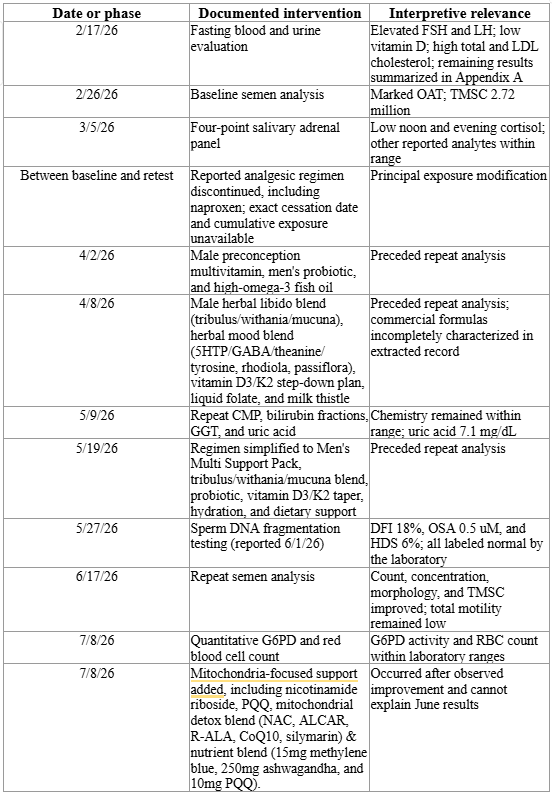
The clinical strategy was to address potentially reversible contributors before escalating directly to assisted reproductive technology.[4] The central exposure change was discontinuation of the reported analgesic regimen, including naproxen. The patient was advised to coordinate ongoing pain management with the appropriate clinician rather than relying on repeated high-dose analgesic courses or leaving pain untreated.
A staged naturopathic plan was started concurrently. Because these interventions overlapped, the case cannot isolate the effect of any individual component.
Table 2. Intervention timeline and relevance to outcome attribution
Lifestyle counseling addressed sleep, stress, regular exercise, heat avoidance, alcohol avoidance, hydration, and a Mediterranean-style dietary pattern. Additional care addressed vitamin D status and concurrent hepatic, metabolic, ferritin, and uric-acid concerns. Antioxidant support was included, but attribution is especially uncertain: a Cochrane review rated much of the evidence for male subfertility as low or very low certainty, and the MOXI randomized trial found no improvement in semen parameters, sperm DNA fragmentation, pregnancy, or live birth.[15,16]
Follow-up and Outcomes
The repeat semen analysis was obtained 111 days after baseline. In a direct stable-isotope study, newly produced sperm first appeared in ejaculate after a mean of 64 ± 8 days (range, 42-76 days), making the follow-up interval biologically meaningful while not proving mechanism.[17] Concentration increased 4.3-fold, total sperm count 7.2-fold, strict morphology 6.5-fold, and TMSC 9.7-fold. The follow-up sample no longer fell below the WHO lower reference values for concentration, total count, or morphology.[5]
The improvement was incomplete. Total motility rose from 25% to 34% but remained below the WHO lower reference value of 42%, and progressive motility was not available in the follow-up extract. Asthenozoospermia therefore remained the principal abnormality.
Sperm DNA Fragmentation
A specimen for a separate advanced semen report was collected May 27, 2026 and reported June 1 because conventional semen parameters and sperm chromatin integrity provide related but noninterchangeable information.[18-20] The laboratory reported a DNA Fragmentation Index of 18%, oxidative stress adduct of 0.5 micromolar, and high DNA stainability of 6%; all were labeled normal by the laboratory.
The result did not identify elevated SDF as an additional concern at that time, but it did not erase the residual motility abnormality or guarantee fertility. SDF thresholds are assay-specific and should be interpreted within the laboratory’s validated method and the couple’s broader clinical context.[18-20]
Post-outcome Management
Because sperm motility depends heavily on mitochondrial energy production, the July plan shifted toward mitochondria-focused support.[21-23] Nicotinamide riboside, pyrroloquinoline quinone, and a mitochondrial nutrient formula were added after the June semen analysis. This sequencing is important: these additions may be relevant to future motility outcomes, but they cannot explain the improvement already observed; their use here remained a mechanism-informed hypothesis rather than an established fertility treatment.
At the last documented follow-up in early July 2026, the couple was not actively attempting conception and planned to resume in fall 2026. Pregnancy and live-birth outcomes were therefore unavailable.
Discussion
This case is clinically striking because several parameters changed in the same favorable direction over a biologically plausible interval. TMSC rose from 2.72 million to 26.5 million – an increase that could materially change counseling about natural conception or intrauterine insemination, even though no universal TMSC threshold determines treatment eligibility. Concentration, total count, and morphology moved above WHO lower reference values, while motility remained suboptimal.
Discontinuation of naproxen-containing analgesic exposure is one plausible contributor. Cyclooxygenase inhibition changes prostaglandin signaling involved in testicular endocrine and paracrine function.[7-9] Kristensen and colleagues demonstrated endocrine effects during ibuprofen exposure, and Huang and colleagues reported an association between more than 60 days per year of ibuprofen use and incident male infertility.[7,11] Neither study proves that intermittent naproxen exposure caused this patient’s semen abnormalities or that discontinuation produced the recovery.
The neutral data matters just as much. The PRESTO cohort found no reduction in fecundability with recent typical-dose analgesic use, although high cumulative exposure remained a possible signal.[12] Short-term ibuprofen did not worsen conventional semen parameters in one clinical cohort, and naproxen altered seminal prostaglandins without a statistically significant change in sperm density or motility in a small older study.[13,14] Agent, dose, duration, indication, underlying inflammation, and individual susceptibility may all modify risk. Acetaminophen must also be distinguished from NSAIDs; the patient used both, but only naproxen belongs to the NSAID class.
Causal attribution is further limited by measurement and intervention design. In the 2,566-man repeat-analysis study, 23% of initially abnormal results were normal on retesting and only about half were confirmed by WHO criteria.[6] This patient also began a preconception multivitamin, omega-3 fatty acids, vitamin D, folate, probiotics, botanical and nutrient products, dietary changes, and lifestyle counseling before repeat testing. The follow-up abstinence interval and collection details were unavailable; regression toward the mean and possible interlaboratory variation offer additional explanations.
The antioxidant component cannot be assigned credit. Although antioxidant regimens remain common, the Cochrane evidence is low or very low certainty and the MOXI trial was null for semen parameters and reproductive outcomes.[15,16] The appropriate conclusion is therefore temporal association and hypothesis generation, not proof of medication-induced infertility or efficacy of the supplement protocol.
The SDF result adds nuance. Marked conventional abnormalities can coexist with an SDF value interpreted as within range, while an apparently normal semen analysis can coexist with elevated SDF.[18-20] Here, the follow-up shifted attention toward persistent motility rather than an identified chromatin-integrity abnormality. It did not establish mitochondrial dysfunction; mitochondrial support remained a mechanism-informed hypothesis.[21-23]
For clinicians working at the intersection of fertility, pain, and physical medicine, the practical lesson is simple: ask better questions. Specify the analgesic, dose, days per month, duration of each flare, cumulative annual exposure, indication, and timing relative to fertility testing. When an exposure may be unnecessary or excessive, collaborate on a safer pain plan that may include diagnosis-specific medical care, rehabilitation, physical therapy, and other appropriate modalities. Medically necessary NSAIDs should not be stopped without consultation, and untreated pain or inflammation should not be ignored.
Clinical Pearls
- Ask about over-the-counter analgesics by name. Patients may not volunteer ibuprofen, naproxen, or acetaminophen when asked only about ‘medications.’
- Build an exposure timeline. Record dose, frequency, days used per month or year, indication, and timing relative to the preceding months of sperm production and maturation.[17]
- Distinguish drug classes. Acetaminophen is not an NSAID, and data from ibuprofen should not be assumed to apply identically to naproxen or other agents.
- Coordinate, do not abruptly withdraw. Any medication change should preserve adequate pain treatment and involve the appropriate prescribing or treating clinician.
- Standardize repeat testing whenever possible. Use the same laboratory, comparable abstinence interval, complete collection, and clear documentation of illness or heat exposure.[5]
- Interpret SDF as complementary information. Apply assay-specific thresholds and use testing only when the result is likely to change counseling or management.[18-20]
- Time-stamp every intervention. Separating pre-outcome from post-outcome therapies prevents accidental overclaiming in case reports.
Limitations
- Single-patient observation without an untreated control, rechallenge, or pregnancy outcome.
- Exact analgesic doses, cumulative exposure, and cessation date were not preserved.
- The baseline abstinence period, semen volume, and collection method were documented, but corresponding follow-up collection details, semen volume, laboratory identity, and analytic method were unavailable.
- Multiple nutrition, supplement, and lifestyle interventions began before repeat testing, and adherence was not formally quantified.
- Potential confounders – including cannabis exposure, infection, complete reproductive hormone evaluation, occupational exposures, and detailed heat history – were not fully documented.
- The June improvement preceded the mitochondria-focused July regimen; no later semen analysis was available to assess that strategy.
Conclusion
A 40-year-old man with male-factor infertility and patient-reported concentrated high-dose analgesic exposure demonstrated marked improvement in concentration, total sperm count, morphology, and TMSC 111 days after discontinuing that exposure and beginning a multicomponent integrative plan. TMSC increased nearly tenfold, while total motility remained below the WHO lower reference value. The case does not prove that naproxen or another analgesic caused the initial abnormalities, that discontinuation caused the recovery, or that supplements produced the change. It does show why an analgesic-specific medication history, coordinated management of potentially reversible exposures, careful time-stamping of interventions, and standardized repeat semen testing belong in a rigorous male-fertility evaluation
Appendix A. Complete Laboratory Results
The following de-identified tables transcribe the laboratory reports supplied for this case. Dates are specimen collection dates unless otherwise stated. Reference intervals and high/low designations are those printed by the reporting laboratory; they are not independent clinical interpretations. These results provide context but do not establish a causal relationship with the semen changes.
Appendix Table A1. Complete baseline semen analysis (collected February 26, 2026)
Appendix Table A2. Complete fasting blood and urine results (collected February 17, 2026)
| Panel | Test | Result | Unit | Reference/flag |
| Iron | TIBC | 319 | ug/dL | 250-450 |
| UIBC | 206 | ug/dL | 111-343 | |
| Iron | 113 | ug/dL | 38-169 | |
| Ferritin | 351 | ng/mL | 30-400 | |
| Thyroid | TSH | 3.730 | uIU/mL | 0.450-4.500 |
| Free T4 | 1.05 | ng/dL | 0.82-1.77 | |
| CBC | WBC | 7.6 | x10^3/uL | 3.4-10.8 |
| RBC | 4.92 | x10^6/uL | 4.14-5.80 | |
| Hemoglobin | 13.6 | g/dL | 13.0-17.7 | |
| Hematocrit | 42.0 | % | 37.5-51.0 | |
| MCV | 85 | fL | 79-97 | |
| MCH | 27.6 | pg | 26.6-33.0 | |
| MCHC | 32.4 | g/dL | 31.5-35.7 | |
| RDW | 13.5 | % | 11.6-15.4 | |
| Platelets | 278 | x10^3/uL | 150-450 | |
| Differential | Neutrophils | 60 | % | Not established |
| Lymphocytes | 28 | % | Not established | |
| Monocytes | 7 | % | Not established | |
| Eosinophils | 4 | % | Not established | |
| Basophils | 1 | % | Not established | |
| Absolute neutrophils | 4.5 | x10^3/uL | 1.4-7.0 | |
| Absolute lymphocytes | 2.2 | x10^3/uL | 0.7-3.1 | |
| Absolute monocytes | 0.6 | x10^3/uL | 0.1-0.9 | |
| Absolute eosinophils | 0.3 | x10^3/uL | 0.0-0.4 | |
| Absolute basophils | 0.1 | x10^3/uL | 0.0-0.2 | |
| Immature granulocytes | 0 | % | Not established | |
| Absolute immature granulocytes | 0.0 | x10^3/uL | 0.0-0.1 | |
| Urinalysis | Specific gravity | 1.006 | – | 1.005-1.030 |
| pH | 6.5 | – | 5.0-7.5 | |
| Color | Yellow | – | Yellow | |
| Appearance | Clear | – | Clear | |
| WBC esterase | Negative | – | Negative | |
| Protein | Negative | – | Negative/trace | |
| Glucose | Negative | – | Negative | |
| Ketones | Negative | – | Negative | |
| Occult blood | Negative | – | Negative | |
| Bilirubin | Negative | – | Negative | |
| Urobilinogen | 0.2 | mg/dL | 0.2-1.0 | |
| Nitrite | Negative | – | Negative | |
| Microscopic examination | Performed | – | No abnormal findings | |
| WBC | None seen | /hpf | 0-5 | |
| RBC | None seen | /hpf | 0-2 | |
| Non-renal epithelial cells | None seen | /hpf | 0-10 | |
| Casts | None seen | /lpf | None seen | |
| Bacteria | None seen | – | None seen/few | |
| Urine culture reflex | Not triggered | – | Criteria not met | |
| Lipids | Total cholesterol | 228 | mg/dL | 100-199; High |
| Triglycerides | 136 | mg/dL | 0-149 | |
| HDL cholesterol | 53 | mg/dL | >39 | |
| VLDL cholesterol | 24 | mg/dL | 5-40 | |
| Calculated LDL cholesterol | 151 | mg/dL | 0-99; High | |
| Prostate | Total PSA | 0.6 | ng/mL | 0.0-4.0 |
| Free PSA | 0.19 | ng/mL | No interval | |
| Free PSA | 31.7 | % | No interval | |
| Reproductive | LH | 9.4 | mIU/mL | 1.7-8.6; High |
| FSH | 14.7 | mIU/mL | 1.5-12.4; High | |
| Total testosterone | 433 | ng/dL | 264-916 | |
| Free testosterone | 14.8 | pg/mL | 6.8-21.5 | |
| DHEA-S | 395.0 | ug/dL | 102.6-416.3 | |
| Prolactin | 5.7 | ng/mL | 3.9-22.7 | |
| Estradiol | 17.8 | pg/mL | 7.6-42.6 | |
| Progesterone | 0.2 | ng/mL | 0.0-0.5 | |
| SHBG | 20.9 | nmol/L | 16.5-55.9 | |
| Metabolic | Hemoglobin A1c | 5.6 | % | 4.8-5.6 |
| Insulin | 10.9 | uIU/mL | 2.6-24.9 | |
| IGF-1 | 163 | ng/mL | 90-278 | |
| Thyroid | Reverse T3 | 12.4 | ng/dL | 9.2-24.1 |
| Free T3 | 3.0 | pg/mL | 2.0-4.4 | |
| TPO antibody | <9 | IU/mL | 0-34 | |
| Thyroglobulin antibody | <1.0 | IU/mL | 0.0-0.9; not flagged | |
| Nutrients | 25-OH vitamin D | 22.8 | ng/mL | 30.0-100.0; Low |
| Inflammation | Cardiac CRP | 1.61 | mg/L | 0.00-3.00 |
| Homocysteine | 9.6 | umol/L | 0.0-14.5 | |
| LDH | 149 | IU/L | 121-224 | |
| Adrenal | Serum AM cortisol | 6.2 | ug/dL | 6.2-19.4 |
| Autoimmune | ANA by IFA | Negative | – | Negative <1:80 |
Appendix Table A3. Serum chemistry trend (February 17 and May 9, 2026)
Appendix Table A4. Salivary adrenal hormone results (collected March 5, 2026)
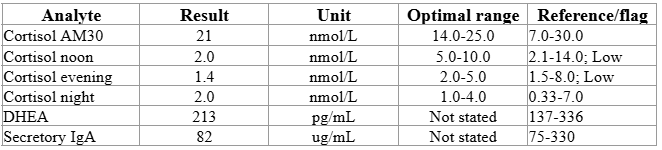
Laboratory interpretation: adequate AM cortisol with a suboptimal diurnal pattern characterized as early (phase 1) HPA-axis dysfunction. This interpretation is reported as issued and should not be treated as proof of causation.
Appendix Table A5. Sperm chromatin and G6PD testing