A practical approach to CIPN management using therapeutic nutrition, exercise, acupuncture, medication co-management, and careful supplement de-prescribing to support cancer survivors.
Chemotherapy-induced peripheral neuropathy (CIPN) is one of the most common and poorly managed side effects of cancer treatment. While agents like oxaliplatin cause acute, temporary nerve damage in the majority of patients within days of treatment, chronic CIPN develops in up to 50% of cases.1,2 For roughly a third of survivors, these symptoms can persist for six months or longer after the final infusion, and for some, they never fully resolve.3 The primary offending drug classes include taxanes (paclitaxel, docetaxel), platinum agents (oxaliplatin, cisplatin, carboplatin), vinca alkaloids, bortezomib, and thalidomide.
CIPN typically presents as a symmetrical, “stocking-and-glove” distribution of numbness, tingling, burning, shooting pain, and allodynia. Patients frequently experience a loss of proprioception, poor fine motor control, and an unsteady gait, which significantly increases their risk of falls. Beyond the physical limitations, chronic neuropathy drives anxiety, depression, and a steep decline in quality of life. From an oncology perspective, it is also a leading cause of chemo dose reductions or early treatment discontinuation, which directly threatens cancer control.3
Managing chronic nerve injury can be frustrating in a conventional setting, but patients often respond well to lifestyle changes. This makes naturopathic physicians uniquely positioned to support survivors dealing with persistent CIPN. This article reviews the practical, evidence-based tools that can be implemented in clinical practice today.
A Brief Overview of Mechanism
Chemotherapeutic agents damage nerves through several overlapping pathways, primarily axonal degeneration, mitochondrial dysfunction, oxidative stress, and neuroinflammation.3 Dorsal root ganglion (DRG) neurons are highly vulnerable to this toxicity because they lack a protective blood-nerve barrier.3 The specific presentation depends heavily on the drug class. Platinum agents directly injure the dorsal root ganglia, causing profound sensory deficits, while vinca alkaloids disrupt myelin and axonal microtubules.4
Nerve conduction tests show that CIPN is a large-fiber, axonal, length-dependent sensory neuropathy. It is marked by reduced sensory nerve action potentials, but relatively normal conduction velocity.4 This specific pattern explains the rationale behind anti-inflammatory diets and therapies that enhance blood flow and reduce inflammation, such as exercise and acupuncture. It also explains why antioxidant supplements remain popular. However, while antioxidants sound good in theory, they have repeatedly failed clinical trials, and in one major instance, actually caused long-term harm.
Diet
Naturopathic doctors can significantly impact CIPN care by emphasizing the importance of diet. Evidence strongly supports the idea that both the quality of one’s diet and eating patterns influence CIPN development and severity. For example, a prospective cohort study of 132 colon cancer patients on oxaliplatin (the FORCE trial) found that higher scores on the Alternative Healthy Eating Index (AHEI-2010) correlated with a lower risk of developing moderate-to-severe CIPN, approximately 4% lower for each one-point increase. Participants following a high-quality diet also experienced a 65% reduced risk of severe CIPN.1 Furthermore, a separate study revealed that each one-point increase in the Healthy Eating Index was associated with a decrease in patient-reported CIPN.5
The FORCE trial found that vegetables offered protection, while sugar-sweetened beverages and red/processed meat each increased the risk of CIPN.1 In a large breast cancer trial (SWOG SO221, n = 9900), higher whole-grain intake reduced the worsening of neuropathy.6 These direct benefits could be attributed to the lower levels of hyperglycemia, oxidative stress, and inflammation.1
One of the most research-backed eating patterns ideal for this patient population is the Mediterranean diet. It includes a variety of vegetables, fruits, whole grains, legumes, extra-virgin olive oil, nuts, and oily fish. These foods provide monounsaturated fats, omega-3s, and polyphenols that help reduce inflammation and support healthy neural membranes.7 In survivors, following the Mediterranean diet reduces pro-inflammatory cytokines like IL-1β, IL-6, IL-8, and TNF-α.8 A systematic review of diet during chemotherapy found that Mediterranean and anti-inflammatory eating patterns may help reduce treatment-related side effects.9
Clinical Takeaways: Focus patient education on adding vegetables, whole grains, legumes, olive oil, and oily fish, while systematically crowding out sodas and processed meats. Finally, address any documented deficiencies instead of relying on high-dose antioxidants. These are low-risk, high-adherence messages that are suitable for any survivorship visit.
“The best-supported plan combines a Mediterranean/anti-inflammatory diet, regular exercise, acupuncture…a trial of duloxetine for painful neuropathy, and eliminating low-yield or harmful supplements.”
Supplements
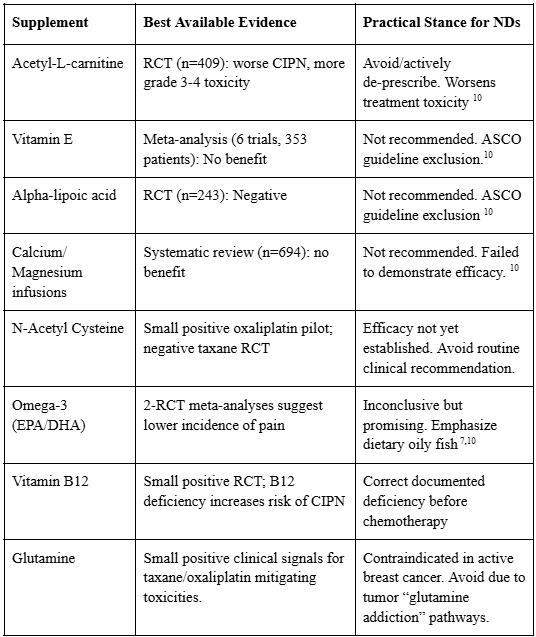
Currently, evidence doesn’t support using supplements to prevent or treat CIPN. In most cases, de-prescribing is more effective. The 2020 ASCO (American Society of Clinical Oncology) guidelines recommend against acetyl-L-carnitine (ALC), vitamin E, B vitamins, calcium/magnesium, glutathione, and omega-3 for prevention.10 Among these recommendations, the most important to be aware of is ALC, which actually worsens chemotherapy-induced peripheral neuropathy (CIPN). A study published in the SWOG S0715 trial (involving 409 women receiving adjuvant taxanes and taking 1000 mg of ALC three times daily) found that supplementation significantly worsened neuropathy at 24, 36, and 52 weeks. Furthermore, a two-year follow-up revealed increased grade 3-4 toxicity.11
The only agent recommended by ASCO for established, painful CIPN is duloxetine.10 The CALBG 170601 trial demonstrated that taking 60 mg daily significantly reduced pain and improved function and quality of life. Specifically, the relative risk of achieving at least 50% pain reduction was 2.42 (95% confidence interval, 1.11–5.30).12 Patients treated with oxaliplatin may respond better than those treated with taxanes.
Duloxetine is effective for only about half of patients, should be tapered off gradually rather than abruptly, and requires caution in older adults.10 In breast cancer survivors taking tamoxifen, duloxetine acts as a moderate CYP2D6 inhibitor. This theoretically reduces the conversion of tamoxifen to endoxifen. However, the clinical significance of this effect is debated and generally considered less pronounced than with stronger inhibitors like paroxetine or fluoxetine. Therefore, duloxetine remains a reasonable option, though it is warranted to flag usage to the oncology team.3, 13 Gabapentinoids and tricyclics, despite their widespread off-label use, lack convincing evidence of specific efficacy for CIPN10
Table 1: Clinical Summary of Supplements in CIPN Management
Acupuncture
Acupuncture has some of the most consistent data among integrative options. The 2022 Society for Integrative Oncology–ASCO integrative pain guideline states it may be offered for CIPN.14 A 2026 network meta-analysis of 32 trials revealed that acupuncture-based interventions were the only category to significantly reduce CIPN pain compared to control. However, when ranked by P-score, cryotherapy (0.86) and exercise (0.68) outperformed acupuncture (0.54).15 A multi-center randomized controlled trial demonstrated that acupuncture improved hand numbness, tingling, discomfort, pain, and overall physical function.16 An umbrella review suggests benefits usually appear by week two and last for about six weeks, with sensory recovery occurring before motor recovery.17
A 2024 meta-analysis with data mining (21 studies, 2,121 patients) identified a consistent core prescription, echoed by multiple reviews:18-20
- LI4 (Hegu) and LI11 (Quchi) — upper-limb symptoms
- ST36 (Zusanli) — the most versatile point (neuropathy, pain, GI symptoms)
- LR3 (Taichong) and SP6 (Sanyinjiao) — lower-limb symptoms and general regulation
- EX-UE9 (Baxie, hands) and EX-LE10 (Bafeng, feet) — for the glove-and-stocking distribution19
Electroacupuncture (typically at 2 Hz) and warm acupuncture or moxibustion are common add-ons. Network analyses suggest electroacupuncture may be the most effective treatment for pain.20 Dosing in trials typically involves twice-weekly administration for six to eight weeks, followed by tapering. While adverse events are rare and generally mild, cost, access, and time remain significant barriers. The strongest data support the use of electroacupuncture in CIPN in breast cancer patients.10
Exercise
Exercise remains a promising intervention in caring for CIPN. A 2025 network meta-analysis of 24 trials revealed that combining aerobic, resistance, and balance/sensorimotor training was the most effective strategy for managing CIPN symptoms. Sensorimotor/balance training showed the strongest and most specific benefits.21 The landmark STOP trial demonstrated that supervised sensorimotor training significantly reduced the onset of CIPN by approximately 50% to 70% compared to standard care.22 Furthermore, it improved deep sensitivity, touch, lower-leg strength, pain, and balance.22 While the evidence base does carry a high risk of bias and modest pooled effect sizes (SMD ≈0.46 for symptoms and ≈0.45 for quality of life),23,31 ASCO refrains from making a formal treatment recommendation. This is due to the lack of adequately powered trials with CIPN as the primary endpoint. However, the favorable risk-benefit profile makes exercise a defensible first-line recommendation.
An Evidence-Based Prescription
- Sensorimotor/balance training yields the highest results and should be done 2–3 times per week. In STOP, patients performed four balance exercises on progressively unstable surfaces, each three times for 20 seconds, with 40–60-second rests to prevent neural fatigue. This resulted in a total of 15–30 minutes of training.22 The practical progression involves moving from two-legged to tandem to single-leg stance, standing on a foam pad or wobble board, practicing weight shifting and controlled reaching, and incorporating Tai Chi for more capable patients. Patients often experience noticeable improvements within four weeks.23
- Resistance training should be done 2–3 times per week, targeting all major muscle groups. Examples include sit-to-stand, chest press, and back rows using body weight or resistance bands. Progress by increasing the number of reps or the weight used (NCCN recommends 2–3 sets of 10–15 reps).24,25 In the Müller trial, exercisers who adhered to the program experienced less worsening of foot sensory symptoms, improved strength and quality of life, and received a higher relative dose of chemotherapy.26
- Aerobic training should be at least 150 minutes per week at a moderate intensity, such as brisk walking or cycling. This is the foundation of both the EXCAP and EX-CIPN programs.24,25
- Daily hand-foot and desensitization work is essential. This includes rolling a textured ball under your foot to numb the area, along with calf and wrist stretches and nerve gliding or flossing. A network meta-analysis ranked hand-foot exercises as the most effective for pain reduction.21
- CIPN-specific safety (NCCN Survivorship): First, assess stability, balance, and gait. Supervise balance training whenever possible. If balance is impaired, switch to stationary cycling, water aerobics, or yoga. Wear protective footwear to prevent unnoticed skin breakdown. For hand symptoms, use rubber-coated dumbbells, padded gloves, or machines instead of free weights.27 If pain restricts activity, coordinate duloxetine to allow the patient to participate.27
Cryotherapy and Compression During Infusion.
Worn during infusion, these methods were ranked highest for prevention in network meta-analyses. For example, frozen gloves and socks on one side during weekly paclitaxel nearly eliminated severe chemotherapy-induced peripheral neuropathy (CIPN) on the treated side in a self-controlled trial. Specifically, the hand experienced a reduction from 41.7% to 2.8%. Similarly, tight surgical gloves significantly reduced grade ≥2 sensory neuropathy from 76% to 21% of hands.10 The randomized POLAR trial revealed that both cooling and compression significantly reduced Grade ≥2 CIPN. Cooling resulted in a 29% reduction, while compression achieved a 38% reduction. However, there was no clear winner, and combining the two methods did not yield a greater benefit.28
The overall results remain inconsistent. Several trials, along with a 2025 meta-analysis, found no significant reduction in symptoms, often due to cold intolerance and treatment interruptions.29 Cooling also carries a frostbite/vasospasm caution, especially in oxaliplatin patients who experience cold-triggered symptoms.28 Cryotherapy and compression are plausible prevention strategies that can be coordinated with the infusion team, but they are not treatments for established CIPN.
Where NDs Play an Important Role
- Screening and validation. Chemotherapy-induced peripheral neuropathy(CIPN) is often under-elicited. Simply asking patients about numbness, tingling, pain, balance, and difficulty buttoning or typing—and taking their concerns seriously—is itself an intervention.30
- Diet as mainstay therapy. Deliver a Mediterranean/anti-inflammatory pattern; emphasize vegetables and whole grains; cut sugar-sweetened beverages and red/processed meat.18
- De-prescribing. Stop acetyl-L-carnitine and reset expectations around vitamin E, B vitamins, and calcium-magnesium.10
- Movement prescription. Individualized aerobic, resistance, and balance programs that address neuropathy, fatigue, and fall risk at once.15
- Coordinated referral. Facilitate acupuncture using the core-point protocol, plus physical/occupational therapy and pain or rehabilitation specialists.14
- Safe co-management. Support appropriate duloxetine use and flag the tamoxifen interaction to oncology.3
There’s no cure for established CIPN, and no proven pharmacologic prevention. The best-supported plan combines a Mediterranean/anti-inflammatory diet, regular exercise, acupuncture using the core LI4–LI11–ST36–LR3–SP6 (plus Baxie/Bafeng) protocol, a trial of duloxetine for painful neuropathy, and eliminating low-yield or harmful supplements. This comprehensive, whole-person survivorship plan is where naturopathic physicians, working within their scope and alongside oncology, can significantly enhance survivors’ quality of life.