

A...
Chemotherapy-Induced Peripheral Neuropathy: An Evidence-Based Guide for Naturopathic Physicians
read more

Lillea Hartwell, ND
A comprehensive review of Nigella sativa seed oil, its active constituents, safety profile, pharmacology, and emerging clinical evidence for supporting immune regulation and thyroid function in Hashimoto’s thyroiditis.
This monograph reviews the botanical characteristics, phytochemistry, pharmacology, safety, and clinical applications of Nigella sativa (black seed oil), with a focus on Hashimoto’s thyroiditis and autoimmune thyroid disease. It examines evidence supporting the herb’s immunomodulatory, antioxidant, and anti-inflammatory effects, along with dosing considerations for integrative clinical practice.
The following article is a monograph outlining the basics of Nigella sativa seed oil. The definition, synonyms, selected vernacular names, and geographical distribution of Nigella sativa are covered. Characteristics of the oil, as in major chemical constituents, are discussed at length. The analysis concludes with a review of its medicinal uses in Hashimoto’s thyroiditis (and autoimmune thyroid disease), pharmacology, toxicology, and dosing.
Nigella seminis oleum is the seed oil of Nigella sativa (family Ranunculaceae).1,2 The family Ranunculaceae is also called the Buttercup family.3,4
Black seed5, 6
Black cumin7, 8
Nigella sativa is native to the Mediterranean, east Africa, and central Asia9. This plant is often grown as an annual medicinal and ornamental garden plant in the USA.10, 11
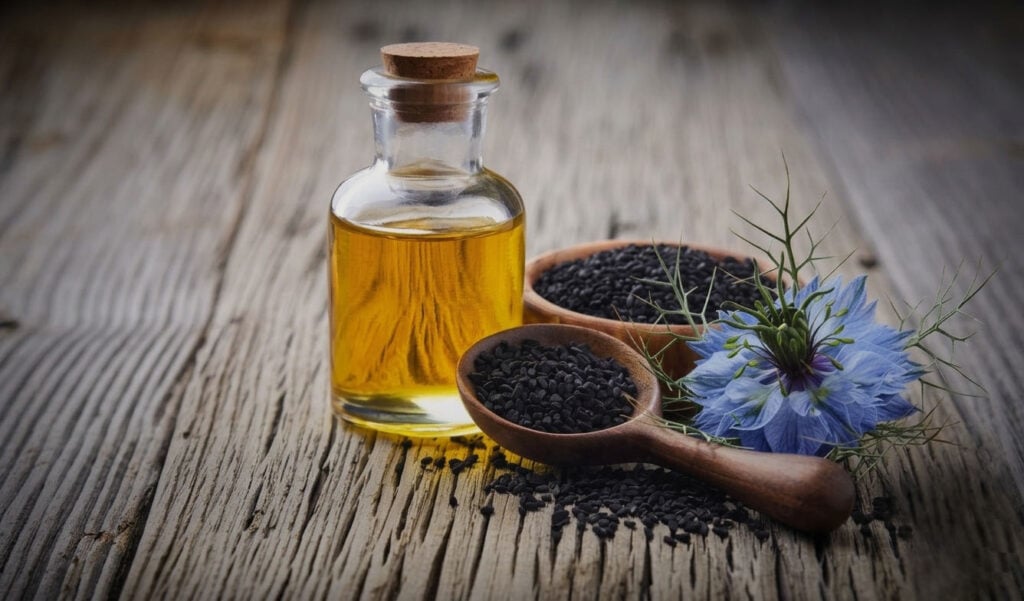
The medicinal plant parts are its tiny seeds, approximately 2-4mm long.12 Seeds in the plant are described as “black boat-shaped seeds”.13 True to its Buttercup family14, the plant features stunning “white or blue flowers” with “finely divided sepals and leaves.”15
Plant Material of Interest: Seed oil
Figure 1. Nigella sativa
One of Nigella’s most important major chemical constituents that research attributes medicinal benefit to is the terpenoid thymoquinone.16,17 Other active medicinal terpenoids found in black cumin seeds include thymol, limonene, carvacrol, p-cymene, 4-terpineol.18, 19
Less researched but thought to still be responsible for medicinal benefit of black seed include “isoquinoline alkaloids (e.g. nigellimine), pyrazole alkaloids (e.g. nigellidine, nigellicine), and unsaturated fatty acids.”20, 21 Omega-6 fatty acids, linoleic acid in higher quantities and omega-9 fatty acid and oleic acid in lesser quantities.22 Research suggests saturated fat in black cumin is represented by palmitic acid.23 It’s important to note that concentrations of these major chemical constituents in the literature often do not clearly identify if the oil studied was the volatile or fixed oil of Nigella.24 The seed oil was examined under column chromatography to evaluate it for sterols.25 Under different forms of fractionation, the seed oil has been found to contain cholesterol, campesterol, stigmasterol, β–sitosterol and α–spinasterol.26 β–sitosterol was determined to be the predominant source of sterols followed by stigmasterol.27
Antioxidant, immunomodulating, and inflammation modulating.28,29 These three main actions can be attributed to the active constituent thymoquinone.30,31 Thymoquinone has been shown in human clinical trials to affect the regulatory T cells which plays a key role in the pathophysiology of Hashimoto’s thyroiditis.32 Literature suggests that upregulated T cells may improve autoimmune diseases including Hashimoto’s thyroiditis as reduction of their activities increases likelihood of Hashimoto’s thyroiditis progression (as well as other autoimmune diseases).33 This T-cell mediated autoimmune disease of the thyroid glands is characterized by the production of thyroid autoantibodies.34 Specifically anti-thyroid peroxidase (TPO-Ab) and anti-thyroglobulin (TG-Ab) antibodies are produced in the blood that attack thyroid.35 It can also lead to neoplasms of the thyroid.36 Elevated serum vascular endothelial growth factor (VEGF-1) has been proposed to play a role in regulating thyroid epithelial cell formation and function.37 Serum VEGF-1 elevations have also been associated with thyroid cancer cell lines.38
Powdered Nigella sativa seed also improved thyroid function, anthropometric features and decreased serum vascular endothelial growth factor (VEGF-1)39 in a 2016 human clinical trial. The study was a randomized control trial that administered pharmaceutical grade capsules containing 2g of Nigella sativa seed powder per day.40 The results of the study suggest that the thyroid measurements showed improvements as well as a decrease in expression of VEGF-1, including decreased TSH, increased T3, and decreased Anti-TPO, though T4 remained stable.41
A rat study of treatment with Nigella sativa oil improved “several reproductive hormones, including estrogen, luteinizing hormone, thyroxine, triiodothyronine, and thyroid stimulating hormone.”42
A human trial in which patients with Hashimoto’s thyroiditis took 2 grams of seed powder also showed %profound antioxidant, immunomodulating and anthropometric changes suggesting that the seed oil may also have those benefits.43
Please note that there may have been uses of this plant described in pharmacopeias and traditional systems of medicine but that they were not included as they did not describe a use for autoimmune thyroiditis. There may have been uses of this plant described in folk medicine that are not supported in experimental or clinical data that were not included as they did not describe a use for autoimmune thyroiditis.44,45
None known46
Caution with blood thinners such as warfarin, as well as antidiabetic and antihypertensive drugs 68-70
None known but some reports of rash (allergic contact dermatitis most commonly) in long term use in patients with hypersensitivity and a fall in the leukocyte and platelet count though the values were still within the range of normal.48-51 There have been some reports of GI distress with high doses of black seed oil use over sustained periods but this seems to vary by individual.52
Research in human clinical trials using thymoquinone suggest isolated thymoquinone should not be consumed in high doses, i.e. no more than 0.5mg/kg of body weight per day.53
Pregnant or lactating women should use caution with using black seed oil medicinally until more research is done54. Although some literature does not currently suggest it was dangerous in pregnant rat studies55, other evaluations do suggest this56.
There have been varying proposed uses of black cumin seed as powder and fixed seed oil and various dosing strategies. Though the focus of this monograph is on Nigella seed oil, many research trials were conducted using seed powder or seed oil so dosing for seed powder is also provided below and sourced via the esteemed written work of Dr. Eric Yarnell, ND, RH(AHG) for use in naturopathic clinical practice57: “The usual adult dose of black cumin seed powder is 500-1,000 mg tid.”58
“The usual adult dose of pressed (fixed) seed oil is 3-5ml bid, while that of the volatile oil is 3 -5 gtt bid.”59
Note: the seed oil should be stored in a dark container, away from heat and light.60
The Mediterranean plant, Nigella sativa, can be processed into a seed oil. The seed oil contains many chemical constituents associated with positive human functioning including healing inflammation related to autoimmune thyroiditis, specifically Hashimoto’s thyroiditis.
A large body of research exists regarding use of black seed oil to treat infertility61,62, neurodegenerative disorders like Alzheimer’s disease and Parkinson’s disease63, atopic dermatitis, asthma, seizure frequency, diabetes and metabolic syndromes, as well as in the treatment of cancer (antineoplastic) and as a chemotherapy adjunct64. This is important to note as individuals diagnosed with Hashimoto’s thyroiditis may have co-morbidities and there’s an increased risk of thyroid neoplasm65. Studies also suggest that in patients with Hashimoto’s thyroiditis (as well as other chronic conditions), “administration of black cumin seeds in different formulations significantly improved lipid profile and blood sugar”66. With few SE, CI, and drug interactions, it makes sense to use Nigella seed oil with the current standard of care pharmaceutical Levothyroxine67 in patients with Hashimoto’s thyroiditis. As a whole this seed oil appears to hold promise for many chronic conditions of the modern age as well as the ever elusive, somewhat intractable, autoimmune disease Hashimoto’s thyroiditis.
1.Yarnell E. Natural Approach to Urology. Aeon Academic; 2019.
2.Farhangi MA, Dehghan P, Tajmiri S, Abbasi MM. The effects of Nigella sativa on thyroid function, serum Vascular Endothelial Growth Factor (VEGF) – 1, Nesfatin-1 and anthropometric features in patients with Hashimoto’s thyroiditis: a randomized controlled trial. BMC Complementary and Alternative Medicine. 2016;16(1). doi:https://doi.org/10.1186/s12906-016-1432-2
3.Elpel TJ. Botany in a Day : The Patterns Method of Plant Identification : An Herbal Field Guide to Plant Families of North America. Hops Press, Llc; 2018.
4.Farhangi MA, Dehghan P, Tajmiri S, Abbasi MM. The effects of Nigella sativa on thyroid function, serum Vascular Endothelial Growth Factor (VEGF) – 1, Nesfatin-1 and anthropometric features in patients with Hashimoto’s thyroiditis: a randomized controlled trial. BMC Complementary and Alternative Medicine. 2016;16(1). doi:https://doi.org/10.1186/s12906-016-1432-2
5.Yarnell E. Natural Approach to Urology. Aeon Academic; 2019.
6.Farhangi MA, Dehghan P, Tajmiri S, Abbasi MM. The effects of Nigella sativa on thyroid function, serum Vascular Endothelial Growth Factor (VEGF) – 1, Nesfatin-1 and anthropometric features in patients with Hashimoto’s thyroiditis: a randomized controlled trial. BMC Complementary and Alternative Medicine. 2016;16(1). doi:https://doi.org/10.1186/s12906-016-1432-2
7.Yarnell E. Natural Approach to Urology. Aeon Academic; 2019.
8.Farhangi MA, Dehghan P, Tajmiri S, Abbasi MM. The effects of Nigella sativa on thyroid function, serum Vascular Endothelial Growth Factor (VEGF) – 1, Nesfatin-1 and anthropometric features in patients with Hashimoto’s thyroiditis: a randomized controlled trial. BMC Complementary and Alternative Medicine. 2016;16(1). doi:https://doi.org/10.1186/s12906-016-1432-2
9.Yarnell E. Natural Approach to Urology. Aeon Academic; 2019.
10.Yarnell E, Abascal K. Nigella sativa: Holy Herb of the Middle East. Alternative and Complementary Therapies. 2011;17(2):99-105. doi:https://doi.org/10.1089/act.2011.17203
11.Yarnell E. Natural Approach to Urology. Aeon Academic; 2019.
12.Yarnell E. Natural Approach to Urology. Aeon Academic; 2019.
13. Yarnell E, Abascal K. Nigella sativa: Holy Herb of the Middle East. Alternative and Complementary Therapies. 2011;17(2):99-105. doi:https://doi.org/10.1089/act.2011.17203
14.Elpel TJ. Botany in a Day : The Patterns Method of Plant Identification : An Herbal Field Guide to Plant Families of North America. Hops Press, Llc; 2018.
15. Yarnell E, Abascal K. Nigella sativa: Holy Herb of the Middle East. Alternative and Complementary Therapies. 2011;17(2):99-105. doi:https://doi.org/10.1089/act.2011.17203
16.Yarnell E. Natural Approach to Urology. Aeon Academic; 2019.
17.Hannan MdA, Rahman MdA, Sohag AAM, et al. Black Cumin (Nigella sativa L.): A Comprehensive Review on Phytochemistry, Health Benefits, Molecular Pharmacology, and Safety. Nutrients. 2021;13(6):1784. doi:https://doi.org/10.3390/nu13061784
18.Yarnell E. Natural Approach to Urology. Aeon Academic; 2019.
19.Hannan MdA, Rahman MdA, Sohag AAM, et al. Black Cumin (Nigella sativa L.): A Comprehensive Review on Phytochemistry, Health Benefits, Molecular Pharmacology, and Safety. Nutrients. 2021;13(6):1784. doi:https://doi.org/10.3390/nu13061784
20.Yarnell E. Natural Approach to Urology. Aeon Academic; 2019.
21.Hannan MdA, Rahman MdA, Sohag AAM, et al. Black Cumin (Nigella sativa L.): A Comprehensive Review on Phytochemistry, Health Benefits, Molecular Pharmacology, and Safety. Nutrients. 2021;13(6):1784. doi:https://doi.org/10.3390/nu13061784
22. Yarnell E, Abascal K. Nigella sativa: Holy Herb of the Middle East. Alternative and Complementary Therapies. 2011;17(2):99-105. doi:https://doi.org/10.1089/act.2011.17203
23.Yarnell E, Abascal K. Nigella sativa: Holy Herb of the Middle East. Alternative and Complementables Therapies. 2011;17(2):99-105. doi:https://doi.org/10.1089/act.2011.17203
24.Yarnell E, Abascal K. Nigella sativa: Holy Herb of the Middle East. Alternative and Complementary Therapies. 2011;17(2):99-105. doi:https://doi.org/10.1089/act.2011.17203
25.Salama R. Sterols in the Seed Oil of Nigella sativa. Planta Medica. 1973;24(08):375-377. doi:https://doi.org/10.1055/s-0028-1099512
26.Salama R. Sterols in the Seed Oil of Nigella sativa. Planta Medica. 1973;24(08):375-377. doi:https://doi.org/10.1055/s-0028-1099512
27.Hannan MdA, Rahman MdA, Sohag AAM, et al. Black Cumin (Nigella sativa L.): A Comprehensive Review on Phytochemistry, Health Benefits, Molecular Pharmacology, and Safety. Nutrients. 2021;13(6):1784. doi:https://doi.org/10.3390/nu13061784
28.Yarnell E, Abascal K. Nigella sativa: Holy Herb of the Middle East. Alternative and Complementary Therapies. 2011;17(2):99-105. doi:https://doi.org/10.1089/act.2011.17203
29.Farhangi MA, Dehghan P, Tajmiri S, Abbasi MM. The effects of Nigella sativa on thyroid function, serum Vascular Endothelial Growth Factor (VEGF) – 1, Nesfatin-1 and anthropometric features in patients with Hashimoto’s thyroiditis: a randomized controlled trial. BMC Complementary and Alternative Medicine. 2016;16(1). doi:https://doi.org/10.1186/s12906-016-1432-2
30.Ali MdY, Akter Z, Mei Z, Zheng M, Tania M, Khan MdA. Thymoquinone in autoimmune diseases: Therapeutic potential and molecular mechanisms. Biomedicine & Pharmacotherapy. 2021;134:111157. doi:https://doi.org/10.1016/j.biopha.2020.111157
31.Farhangi MA, Dehghan P, Tajmiri S, Abbasi MM. The effects of Nigella sativa on thyroid function, serum Vascular Endothelial Growth Factor (VEGF) – 1, Nesfatin-1 and anthropometric features in patients with Hashimoto’s thyroiditis: a randomized controlled trial. BMC Complementary and Alternative Medicine. 2016;16(1). doi:https://doi.org/10.1186/s12906-016-1432-2
32. Ali MdY, Akter Z, Mei Z, Zheng M, Tania M, Khan MdA. Thymoquinone in autoimmune diseases: Therapeutic potential and molecular mechanisms. Biomedicine & Pharmacotherapy. 2021;134:111157. doi:https://doi.org/10.1016/j.biopha.2020.111157
33.Ali MdY, Akter Z, Mei Z, Zheng M, Tania M, Khan MdA. Thymoquinone in autoimmune diseases: Therapeutic potential and molecular mechanisms. Biomedicine & Pharmacotherapy. 2021;134:111157. doi:https://doi.org/10.1016/j.biopha.2020.111157
34.Farhangi MA, Dehghan P, Tajmiri S, Abbasi MM. The effects of Nigella sativa on thyroid function, serum Vascular Endothelial Growth Factor (VEGF) – 1, Nesfatin-1 and anthropometric features in patients with Hashimoto’s thyroiditis: a randomized controlled trial. BMC Complementary and Alternative Medicine. 2016;16(1). doi:https://doi.org/10.1186/s12906-016-1432-2
35. Farhangi MA, Dehghan P, Tajmiri S, Abbasi MM. The effects of Nigella sativa on thyroid function, serum Vascular Endothelial Growth Factor (VEGF) – 1, Nesfatin-1 and anthropometric features in patients with Hashimoto’s thyroiditis: a randomized controlled trial. BMC Complementary and Alternative Medicine. 2016;16(1). doi:https://doi.org/10.1186/s12906-016-1432-2
36.Farhangi MA, Dehghan P, Tajmiri S, Abbasi MM. The effects of Nigella sativa on thyroid function, serum Vascular Endothelial Growth Factor (VEGF) – 1, Nesfatin-1 and anthropometric features in patients with Hashimoto’s thyroiditis: a randomized controlled trial. BMC Complementary and Alternative Medicine. 2016;16(1). doi:https://doi.org/10.1186/s12906-016-1432-2
37.Farhangi MA, Dehghan P, Tajmiri S, Abbasi MM. The effects of Nigella sativa on thyroid function, serum Vascular Endothelial Growth Factor (VEGF) – 1, Nesfatin-1 and anthropometric features in patients with Hashimoto’s thyroiditis: a randomized controlled trial. BMC Complementary and Alternative Medicine. 2016;16(1). doi:https://doi.org/10.1186/s12906-016-1432-2
38.Farhangi MA, Dehghan P, Tajmiri S, Abbasi MM. The effects of Nigella sativa on thyroid function, serum Vascular Endothelial Growth Factor (VEGF) – 1, Nesfatin-1 and anthropometric features in patients with Hashimoto’s thyroiditis: a randomized controlled trial. BMC Complementary and Alternative Medicine. 2016;16(1). doi:https://doi.org/10.1186/s12906-016-1432-2
39.Farhangi MA, Dehghan P, Tajmiri S, Abbasi MM. The effects of Nigella sativa on thyroid function, serum Vascular Endothelial Growth Factor (VEGF) – 1, Nesfatin-1 and anthropometric features in patients with Hashimoto’s thyroiditis: a randomized controlled trial. BMC Complementary and Alternative Medicine. 2016;16(1). doi:https://doi.org/10.1186/s12906-016-1432-2
40. Farhangi MA, Dehghan P, Tajmiri S, Abbasi MM. The effects of Nigella sativa on thyroid function, serum Vascular Endothelial Growth Factor (VEGF) – 1, Nesfatin-1 and anthropometric features in patients with Hashimoto’s thyroiditis: a randomized controlled trial. BMC Complementary and Alternative Medicine. 2016;16(1). doi:https://doi.org/10.1186/s12906-016-1432-2
41. Farhangi MA, Dehghan P, Tajmiri S, Abbasi MM. The effects of Nigella sativa on thyroid function, serum Vascular Endothelial Growth Factor (VEGF) – 1, Nesfatin-1 and anthropometric features in patients with Hashimoto’s thyroiditis: a randomized controlled trial. BMC Complementary and Alternative Medicine. 2016;16(1). doi:https://doi.org/10.1186/s12906-016-1432-2
42. Hannan MdA, Rahman MdA, Sohag AAM, et al. Black Cumin (Nigella sativa L.): A Comprehensive Review on Phytochemistry, Health Benefits, Molecular Pharmacology, and Safety. Nutrients. 2021;13(6):1784. doi:https://doi.org/10.3390/nu13061784
43. Hannan MdA, Rahman MdA, Sohag AAM, et al. Black Cumin (Nigella sativa L.): A Comprehensive Review on Phytochemistry, Health Benefits, Molecular Pharmacology, and Safety. Nutrients. 2021;13(6):1784. doi:https://doi.org/10.3390/nu13061784
44. Hannan MdA, Rahman MdA, Sohag AAM, et al. Black Cumin (Nigella sativa L.): A Comprehensive Review on Phytochemistry, Health Benefits, Molecular Pharmacology, and Safety. Nutrients. 2021;13(6):1784. doi:https://doi.org/10.3390/nu13061784
45. Farhangi MA, Dehghan P, Tajmiri S, Abbasi MM. The effects of Nigella sativa on thyroid function, serum Vascular Endothelial Growth Factor (VEGF) – 1, Nesfatin-1 and anthropometric features in patients with Hashimoto’s thyroiditis: a randomized controlled trial. BMC Complementary and Alternative Medicine. 2016;16(1). doi:https://doi.org/10.1186/s12906-016-1432-2
46. Farhangi MA, Dehghan P, Tajmiri S, Abbasi MM. The effects of Nigella sativa on thyroid function, serum Vascular Endothelial Growth Factor (VEGF) – 1, Nesfatin-1 and anthropometric features in patients with Hashimoto’s thyroiditis: a randomized controlled trial. BMC Complementary and Alternative Medicine. 2016;16(1). doi:https://doi.org/10.1186/s12906-016-1432-2
47. Farhangi MA, Dehghan P, Tajmiri S, Abbasi MM. The effects of Nigella sativa on thyroid function, serum Vascular Endothelial Growth Factor (VEGF) – 1, Nesfatin-1 and anthropometric features in patients with Hashimoto’s thyroiditis: a randomized controlled trial. BMC Complementary and Alternative Medicine. 2016;16(1). doi:https://doi.org/10.1186/s12906-016-1432-2
48.Yarnell E, Abascal K. Nigella sativa: Holy Herb of the Middle East. Alternative and Complementary Therapies. 2011;17(2):99-105. doi:https://doi.org/10.1089/act.2011.17203
49. Farhangi MA, Dehghan P, Tajmiri S, Abbasi MM. The effects of Nigella sativa on thyroid function, serum Vascular Endothelial Growth Factor (VEGF) – 1, Nesfatin-1 and anthropometric features in patients with Hashimoto’s thyroiditis: a randomized controlled trial. BMC Complementary and Alternative Medicine. 2016;16(1). doi:https://doi.org/10.1186/s12906-016-1432-2
50.Zaoui A, Cherrah Y, Mahassini N, Alaoui K, Amarouch H, Hassar M. Acute and chronic toxicity of Nigella sativa fixed oil. Phytomedicine. 2002;9(1):69-74. doi:https://doi.org/10.1078/0944-7113-00084
51.Mashayekhi-Sardoo H, Rezaee R, Karimi G. Nigella sativa (black seed) safety: an overview. Asian Biomedicine. 2020;14(4):127-137. doi:https://doi.org/10.1515/abm-2020-0020
52.Mashayekhi-Sardoo H, Rezaee R, Karimi G. Nigella sativa (black seed) safety: an overview. Asian Biomedicine. 2020;14(4):127-137. doi:https://doi.org/10.1515/abm-2020-0020
53.Yarnell E, Abascal K. Nigella sativa: Holy Herb of the Middle East. Alternative and Complementary Therapies. 2011;17(2):99-105. doi:https://doi.org/10.1089/act.2011.17203
54. Yarnell E, Abascal K. Nigella sativa: Holy Herb of the Middle East. Alternative and Complementary Therapies. 2011;17(2):99-105. doi:https://doi.org/10.1089/act.2011.17203
55.Yarnell E, Abascal K. Nigella sativa: Holy Herb of the Middle East. Alternative and Complementary Therapies. 2011;17(2):99-105. doi:https://doi.org/10.1089/act.2011.17203
56.Mashayekhi-Sardoo H, Rezaee R, Karimi G. Nigella sativa (black seed) safety: an overview. Asian Biomedicine. 2020;14(4):127-137. doi:https://doi.org/10.1515/abm-2020-0020
57. Yarnell E. Natural Approach to Urology. Aeon Academic; 2019.
58.Yarnell E. Natural Approach to Urology. Aeon Academic; 2019.
59. Yarnell E. Natural Approach to Urology. Aeon Academic; 2019.
60.Kane CW. Herbal Medicine Trends and Traditions : A Comprehensive Sourcebook on the Preparation and Use of Medicinal Plants. Lincoln Town Press; 2009.
61. Yarnell E. Natural Approach to Urology. Aeon Academic; 2019.
62.Kolahdooz M, Nasri S, Modarres SZ, Kianbakht S, Huseini HF. Effects of Nigella sativa L. seed oil on abnormal semen quality in infertile men: A randomized, double-blind, placebo-controlled clinical trial. Phytomedicine. 2014;21(6):901-905. doi:https://doi.org/10.1016/j.phymed.2014.02.006
63.Hannan MdA, Rahman MdA, Sohag AAM, et al. Black Cumin (Nigella sativa L.): A Comprehensive Review on Phytochemistry, Health Benefits, Molecular Pharmacology, and Safety. Nutrients. 2021;13(6):1784. doi:https://doi.org/10.3390/nu13061784
64.Yarnell E, Abascal K. Nigella sativa: Holy Herb of the Middle East. Alternative and Complementary Therapies. 2011;17(2):99-105. doi:https://doi.org/10.1089/act.2011.17203
65.Hannan MdA, Rahman MdA, Sohag AAM, et al. Black Cumin (Nigella sativa L.): A Comprehensive Review on Phytochemistry, Health Benefits, Molecular Pharmacology, and Safety. Nutrients. 2021;13(6):1784. doi:https://doi.org/10.3390/nu13061784
66.Hannan MdA, Rahman MdA, Sohag AAM, et al. Black Cumin (Nigella sativa L.): A Comprehensive Review on Phytochemistry, Health Benefits, Molecular Pharmacology, and Safety. Nutrients. 2021;13(6):1784. doi:https://doi.org/10.3390/nu13061784
67. Farhangi MA, Dehghan P, Tajmiri S, Abbasi MM. The effects of Nigella sativa on thyroid function, serum Vascular Endothelial Growth Factor (VEGF) – 1, Nesfatin-1 and anthropometric features in patients with Hashimoto’s thyroiditis: a randomized controlled trial. BMC Complementary and Alternative Medicine. 2016;16(1). doi:https://doi.org/10.1186/s12906-016-1432-2
68. Wang Z, Wang Z, Wang X, Lv X, Yin H, Jiang L, Xia Y, Li W, Li W, Liu Y. Potential food-drug interaction risk of thymoquinone with warfarin. Chem Biol Interact. 2022 Sep 25;365:110070. doi: 10.1016/j.cbi.2022.110070.
69. Maideen NMP. Antidiabetic Activity of Nigella Sativa (Black Seeds) and Its Active Constituent (Thymoquinone): A Review of Human and Experimental Animal Studies. Chonnam Med J. 2021 Sep;57(3):169-175. doi: 10.4068/cmj.2021.57.3.169.
70. Maideen NMP, Balasubramanian R, Ramanathan S. Nigella Sativa (Black Seeds), A Potential Herb for the Pharmacotherapeutic Management of Hypertension – A Review. Curr Cardiol Rev. 2021;17(4):e230421187786. doi: 10.2174/1573403X16666201110125906
 Author Bio:
Lillea Hartwell, ND, RH (AHG) is a graduate of Sonoran University of Health Sciences. She obtained a BS in Plant Sciences, with a minor in Environmental Sciences at the University of Arizona. Dr Hartwell has earned the distinction of Registered Herbalist with the American Herbalists Guild. She teaches at the college level and practices medicine at her private practice, Saguaro Blossom Medical Center, in Tucson, AZ. Dr Hartwell has a passion for general medicine, especially in urgent care settings like wound care, acute upper respiratory infections and acute urinary tract infections, as well as rheumatology and other autoimmune conditions. For more information, visit drlilleahartwell.com.
Disclosure: No actual or potential conflict of interest in relation to this article to disclose.