Mark Woodall, MS, ND
The therapeutic order, as elaborated by Drs Jared Zeff and Pamela Snider, begins with, “Establish the conditions for health.”1 Optimizing sleep quality and duration is therefore one of the most essential first steps. The aim of this article is to focus on unique ways to restore sleep quality. More than 25% of Americans report not getting enough sleep, and 10% of the population suffers from chronic insomnia.2
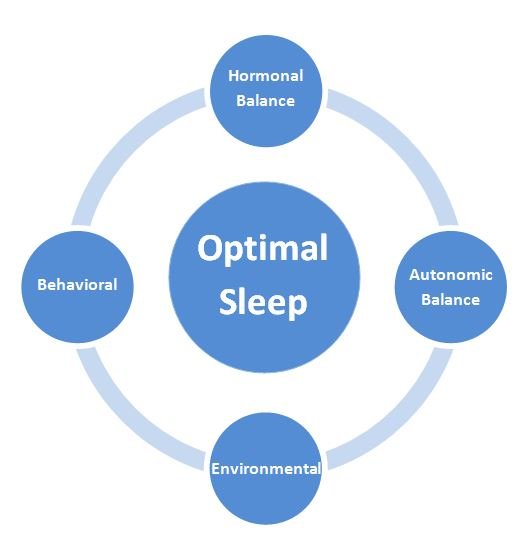
Because the body is a system of systems, restoring optimal sleep quality must include addressing multiple systems to achieve desired outcomes. Our optimal model of sleep includes 4 key regulators: hormones, autonomic function, behavioral, and environmental, with the understanding that many of these treatments overlap in their system affinity (Figure 1).
Hydrotherapy – Balance the Autonomic Nervous System
It is clear that the mind-body connection plays a role in sleep regulation. Any patient or physician can describe memories of lying in bed with their mind wandering about pleasant or unpleasant previous, current, or future events. Stressful thoughts can activate the sympathetic nervous system, which reveals itself as 1 potential pathway for a clinician to restore.
Hydrotherapy has long been a naturopathic tradition that continues today, kept alive by elders and enthusiastic naturopathic students. This clinician has found contrast hydrotherapy to the feet to be a very successful intervention for rebalancing many of the biological oscillators of the body (brain, heart, and gut).3 Two standard 5-gallon buckets can be easily purchased at one’s local hardware store, and allow for convenient use and storage. The standard naturopathic parameters of alternating 3 minutes hot and 30 seconds cold, continue to hold true in clinical practice. Patients should be cautioned about having the water too hot, in order to prevent burns, and the emphasis should be placed on the contrast of temperatures perceived by the patient. Epsom salt (magnesium oxide) can be added to the hot bucket to provide additional benefits, such as relaxing smooth and skeletal muscles.
Blue Light-Blocking Goggles – Shift the Environment
Melatonin, derived from the pineal gland, is released in a circadian rhythm, with normal concentrations highest at night and lowest during the day. Its release is controlled by a photoreceptor housed in the suprachiasmatic nucleus of the hypothalamus. This photoreceptor is sensitive to blue and blue-green light at wavelengths of less than 550 nm – enough to suppresses melatonin secretion. How many of us stare at our tablets and smart phones at night? This electronic practice is clearly affecting melatonin secretion and our subsequent sleep quality, but how many of us are going to get rid of our iPads? Is there a 21st century compromise that we can implement that can allow us to continue to use these devices while preserving our melatonin and sleep quality?
Blue light-blocking glasses, which can be purchased for less than $10, offer an effective, non-invasive strategy to improve sleep quality. Several clinical trials have demonstrated the effectiveness of this accessory. One study involving night-shift workers, who often have altered circadian rhythms and lower total sleep time compared to controls, showed these individuals to increase their sleep time by 40 minutes by wearing blue light-blocking glasses during their night shift.5 Another study showed improvements in sleep quality and mood from wearing blue light-blocking glasses for the 3 hours before sleep.6
Emotional Freedom Technique
Develop by Gary Gray, Emotional Freedom Technique (EFT) is a very simple process that enables a person to release stuck or blocked energy by tapping on the meridian system7 After introducing my patients to EFT, I then provide them search terms for YouTube that direct them to a 10-minute video featuring a highly trained EFT practitioner; this expert guides them through a session while focusing on quality sleep.8 Many commonly searched websites dismiss EFT as quackery, but so is naturopathic medicine, according to some.
Herbal Medicine – Hormonal/Behavioral
Herbs rank 1 step below drugs on the therapeutic order, as we address specific pathologies using natural substances. When thinking about herbal medicine, it is important to remember not only the pharmacology of the plant chemistry (GABA agonists, sympatholytics, etc), but also the energetics of the plant, and your own experience and intuition. In general, individual formulations theoretically yield better results than mixed formulations; however no trials have addressed this question. Dose, route, and assessment of patient adherence should be factored in when considering phytotherapy. For instance, patients may do better with a tea if the goal is to modify behavior towards a healthier lifestyle.
Framing this treatment as a “new routine,” or a “peace point,”9 helps patients to form new neural connections that may allow detachment from the “on-the-go” personality that interferes with their sleep. If, however, patient compliance is a potential barrier, herbal capsules or tinctures may provide better outcomes. Piper methysticum (kava kava) is an inexpensive herb with solid evidence for reducing anxiety,10 and can be a helpful herb for improving sleep.11 Commercially available formulas are easily found in grocery and health food stores. Dosing is important, though, in regards to commercially available tea bags, as 1 tea bag is frequently insufficient to yield a clinically meaningful outcome. A standard medicinal dose would begin at 2 tea bags, and might not be achieved until 4.
 Mark Woodall, MS, ND, is a naturopathic doctor and graduate of Bastyr University. His passion is to help patients who are struggling with acute or chronic pain and disease make informed lifestyle modifications that put their health into better balance. He is particularly interested in the human microbiome, or “gut flora,” as well as discovering the connections between dysbiosis/co-infections inside the bowels that can complicate and confound many rheumatological issues such as Lyme disease, fibromyalgia, and rheumatoid arthritis. As a medical detective, he helps patients systematically examine cutting-edge medical research and traditional knowledge to make informed decision about their health.
References
- eff J, Snider P, Myers SP, DeGrandpre Z. A Heirarchy of Healing: The Therapeutic Order. A Unifying Theory of Naturopathic Medicine. In: Pizzorno JE, Murray MT, eds. Textbook of Natural Medicine. 4th ed. St Louis, MO: Elsevier; 2013: 26.
- Centers for Disease Control and Prevention. Sleep and Sleep Disorders. Last updated March 12, 2015. CDC Web site: http://www.cdc.gov/sleep/. Accessed October 20, 2014.
- Mooventhan A, Nivethitha L. Scientific evidence-based effects of hydrotherapy on various systems of the body. N Am J Med Sci. 2014;6(5):199-209.
- Wood B, Rea MS, Plitnick B, Figueiro MG. Light level and duration of exposure determine the impact of self-luminous tablets on melatonin suppression. Appl Ergon. 2013;44(2):237-40.
- Rahman SA, Shapiro CM, Wang F, et al. Effects of filtering visual short wavelengths during nocturnal shiftwork on sleep and performance. Chronobiol Int. 2013;30(8):951-962.
- Burkhart K, Phelps JR. Amber lenses to block blue light and improve sleep: a randomized trial. Chronobiol Int. 2009;26(8):1602-12.
- Emotional Freedom Technique – What is It? EFT Website. http://www.emotionalfreedomtechniques.net/eft.htm. Accessed October 20, 2014.
- Tap O’ The Evenin’ with Brad Yates –EFT. YouTube. https://www.youtube.com/watch?v=xWTouQnHVPI. Accessed October 20, 2014.
- Paul Chek’s Blog. Dr. Quiet And Peace Points. July 25, 2013. http://www.paulcheksblog.com/dr-quiet-and-peace-points/. Accessed October 22, 2014.
- Lakhan SE, Vieira KF. Nutritional and herbal supplements for anxiety and anxiety-related disorders: systematic review. Nutr J. 2010;9:42.
- Lehrl S. Clinical efficacy of kava extract WS 1490 in sleep disturbances associated with anxiety disorders. Results of a multicenter, randomized, placebo-controlled, double-blind clinical trial. J Affect Disord. 2004;78(2):101-110.