Joe Kellerstein, DC, ND
Stephen seemed quiet. A bit too quiet for an 11-year-old boy. Clearly he was uncomfortable being in the office. Not in an antagonistic way. No, it was more of an underlying fear.
A glance at the intake form confirmed my impressions. In order, the complaints were:
- Sleep problems
- Anxiety
- Sensitive skin
- Emotional sensitivity
I wondered if that last one was really in the right ranking.
At 5 years of age Stephen had a viral pneumonia caused by coxsackievirus. In the bargain, he also suffered a bout of cerebellar ataxia. Thankfully, neither has ever been repeated.
Also at 5 years of age, his tonsils overgrew their welcome and were removed. Apparently they may be growing back.
Sleep
Sleep has been a lifelong struggle. Stephen must be exhausted to easily get to sleep. In the first year of life he would sleep for no more than 3 hours at a stretch and then be up for at least a full hour. Waking was not pleasant. He would wake crying hysterically, but after a while could be appeased by being held.
Once accomplished, he would fall into a “dead sleep”.
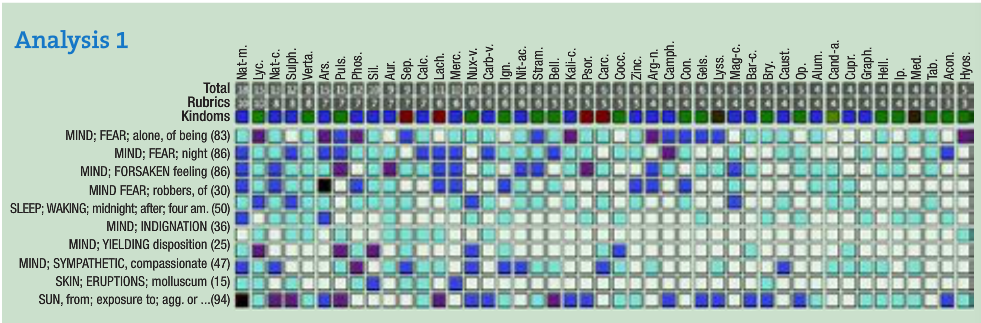
Four or five nights per week he wants his parents in order to sleep (yes, even at 11 years old). It is at night that his anxiety really presents itself. He will need to sleep between a person and the wall. He needs the safety.
Stephen needs to calmly be read to at night. He gets very nervous about fires(1) and robbers(3). He fears the robbers will come in and kill his parents. He fears his parents will leave him in the middle of the night(3). He can get “hysterically crazy” about this. There have been times when he was found hidden under the covers petrified.
Well once he does get off to sleep you would hope the fun and games are over, but no! Stephen wakes at 4 am. Once up he marches to his parents’ bedroom to ensure their presence, at which time he will snuggle in with them
He perspires from the cervical and shoulder areas at night. As far as the room goes, he prefers the environment on the coolish side for his evening’s activities.
Now for some odd reason at this point in the interview I turned to mom and asked if there was anything of note which occurred during her pregnancy. To my surprise I was knocked off my feet by the story that followed: At around the 31-week mark mom was afflicted by the aforementioned coxsackie B virus resulting in a case of viral meningitis that seemed to recur 3 times! During this illness mom became very anxious. She developed a very particular fear of ghosts at night. It was as if she was visited at night by the spirits of patients who had recently died in the hospital. In response to these visitations there was a strong sense of “how horrible to die alone in this cold room.”
The child then gestating, our Stephen, was later afflicted by this same virus that gave him pneumonia and rendered him unable to walk for one week due to cerebellar ataxia.
Emotions
Stephen tends to apologize a lot(3). He wants to please everyone. The mood of his parents affects him profoundly – he will weepy, get anxious, or try to please, depending on their mood (remember his nighttime behavior). He is quick to come to tears if the issue is unfairness.
General
History of molluscum. Eczema can occur in patches. There is a history of sensitivity to the brightness of the sun as a child.
Natrum mur 200 was given (2 pellets as a dose) September ‘08.
One-month Follow-up
That first night Stephen woke at 3am! That is one hour earlier than usual. Two days later he actually got into a fight at school. This was unheard of because he was normally so quiet. It was unusual for him to react angrily. From then on until last week he slept well. In general however he is much calmer and more confident.
Recent Visit
I repeated the remedy.
It was only today that I saw them again. Last week after no more doses, the problems partially relapsed. I increased the potency to a 10m. Let’s see what happens now.
It seems, I am told, that in their home I am referred to as “the sleep doctor”. Normally I hear this title bestowed to me after delivering a lecture. This one I like.
 Joe Kellerstein, DC, ND graduated as a chiropractor in 1980 and as an ND in 1984. He graduated with a specialty in homeopathy from the Canadian Academy for Homeopathy, and subsequently lectured there for two years. He also lectured in homeopathy for several years at CCNM; for eight years at the Toronto School of Homeopathic Medicine; and for two years at the British Institute for Homeopathy. Dr. Kellerstein’s mission is the exploration of natural medicine in a holistic context, especially homeopathy and facilitating the experience of healing in clients.