

A...
Chemotherapy-Induced Peripheral Neuropathy: An Evidence-Based Guide for Naturopathic Physicians
read more
A longitudinal pediatric case follows a 14-year-old girl with recurrent juvenile idiopathic arthritis, exploring how individualized naturopathic care, patient empowerment, and the principles of healing informed her recovery following a five-year symptom-free period.
A 14 y/o F diagnosed with JIA returns for continued adjunctive naturopathic care after a five-year interval of no clinical symptoms and no pharmaceutical interventions. This asymptomatic period was preceded by adjunctive naturopathic care within a collaborative medical university integrative clinic. Her mother reached out for consultation after recurrence of symptoms of joint pain after a routine acute illness. Complaints now also included abdominal pain, dysmenorrhea, headache, fatigue and low mood. She had to give up sports and dance because of her limited mobility. Her case continued to be consistent with initial assessment of Tuberculinic miasm and Lympho-Nervous temperament from when she first presented to clinic at age nine. She notes she has experienced cold/flu and fever throughout the years, but nothing triggered a flare until recently. The patient and family were counseled on maintaining relationships with their primary care physician and rheumatology and expressed their continued desire to avoid pharmaceuticals if possible. This case details the journey of the following five visits over 8 months and how the principles of Naturopathic medicine were recruited to navigate progression and recovery. The patient has been symptom free for three months as of this report.
One of the distinctions and strengths of naturopathic medicine is its regard for life and the Natural Laws that guide the life force. This case is meant to be less about the diagnosis and therapies used and more about the ways in which these philosophical frameworks are illustrated and how they may help our clinical judgement in our journey as lifelong learners of the practice of medicine. Polyarticular juvenile idiopathic arthritis (JIA) is a subtype of JIA, predominant in females, which is the most common rheumatic disease of unknown origin in pediatrics associated with long-term morbidity.1,2 Symptoms include persistent joint pain, swelling, and stiffness that can present in a cyclical nature. JIA is also associated with uveitis which can progress into cataracts, glaucoma, or blindness. JIA can stunt a child’s growth and affect bone development as well as iatrogenically through the use of corticosteroids.3
Conventional management involves the use of methotrexate as a first-line agent, tumor necrosis factor inhibitors and other various biologics, and corticosteroid therapies for pain management. JIA is associated with clinical remission (CR) in one third of patients over a nine-year period without medications.4 More frequent rates of remission are seen in females with early onset JIA, fewer joint involvement, and ANA-positivity, though there is a paucity of literature on what pharmaceutical and/or non-pharmaceutical factors may predict or contribute to CR.4
In this case, the parents of this 9-year-old sought out naturopathic care specifically in hopes of palliative non-pharmaceutical options and minimizing life-long dependence on medications. Her mother was familiar with methotrexate as a chemotherapeutic agent and was hesitant to start her 9-year-old on a medication requiring frequent lab work to monitor for renal and hepatotoxicity. More common side effects of conventional therapeutics for JIA include ulcerative stomatitis, leukopenia, nausea, and abdominal distress. In addition, infections, malaise, fatigue, chills, fever, and dizziness are frequently reported.5 The literature lists the following as more rare side effects that naturopathic providers often catch earlier due to longer visit times and continuity of care: increased susceptibility to infections (including tuberculosis), paradoxical development of additional autoimmune diseases and potential for increased risk of cancers.2
A 9-year-old girl with relapsing remitting joint pain since age 16 months presented to clinic for adjunctive support of oligoarticular juvenile idiopathic arthritis (JIA). Her parents were interested in alternatives to the steroid injections and methotrexate they had been recommended for their child. A typical naturopathic treatment plan was given: dietary recommendations, homeopathic remedies, and evidence-informed anti-inflammatory supplements. A period of approximately five years without reported symptoms followed. This served as a robust demonstration of the power of homeopathy and the adjunctive role of naturopathic care in pediatric autoimmunity for the young clinician building their clinical experience, but the strength of this case report is longitudinal data available with continuity and navigating recurrence. The practitioner and patient meet again, an elementary age child is now a teenager, a green doc has now been in practice for over 6 years and has never been more inspired to revisit old texts and understand the principles underlying the medicine.
The patient returned 5 years later with polyarticular joint pain and substantial limitations of her mobility and ability to participate in the many sports and extracurriculars in which she was involved. An individualized and evolving naturopathic principle-led approach was taken over the course of 8 months and five follow-ups.
She has been clinically asymptomatic for three months as of the writing of this report. Her participation in her care and use of targeted physiological support and energetic therapies has allowed her and her family to achieve their goal of symptom resolution without the use of DMARDS, biologics, and corticosteroids.
This longitudinal case study invites investigation into the nature of healing and recovery, the power of individualized care, and the importance of striving for better questions in our role as clinicians.
First Report of Symptoms: 2013-10-09
Mother notes new-onset swelling, inability to walk, and nodules. Came on within one week of her 15-month immunizations. Managed with naproxen and steroid injections. Intermittent flares over the course of the next 8 years.
First Naturopathic Encounter: 2021-07-14
Flare featuring new-onset small joint involvement triggered after fever in June. Pain and swelling noted in knees BL, L wrist, and L thumb. History significant for scoliosis, synovitis, and tenosynovitis. Modulate inflammation through dietary support.
Follow-up 1: 2021-08-19
Symptoms of joint pain and swelling are unchanged. Mother reports behavior as “a complete 180” after administration of homeopathic remedy. Mother was “amazed” with improvement in behavior and attitude and reminded of “how she used to be”.
First Visit After 5 Years: 2026-01-10
Notes symptoms came on a couple weeks ago after acute illness and concomitant eczema flare. Additional complaints of abdominal pain after meals X 1 year, headaches 4X/week, dysmenorrhea, fatigue, and nightmares. Notes anxiety about school shooters.
Follow-up 1: 2026-02-14
Continued joint pain, now extending into fingers and jaw. Occasional ear pain. Decreased mobility resulting in missing school and falls. Notes improvement in headaches. Less cramping this menstrual cycle but still experiencing abdominal pain with eating.
Follow-up 2: 2026-03-21
Notes she did well with maintaining dietary modifications and noticed improvement in knee swelling and joint pain. Also had reduction in post-prandial abdominal pain. Mother notes more pleasant affect overall.
Follow-up 3: 2026-04-28
Notes no pain after some meals. Is tolerating certain foods better. Notes loose stools, 1-2X/month. Difficult month for menstrual pain and fatigue. Yellow-green nasal d/c. Some joints are “back to normal”. R arm not hurting at all. Ankle and knee pain.
Follow-up 4: 2026-05-07
Mild-moderate improvement in symptoms of joint pain. Reports fatigue, menorrhagia and dizziness this cycle.
Follow-up 5: 2026-07-29
Pain less constant in the last month. Able to participate in summer camp. Milder menstrual symptoms, denies dizziness. Improved sleep quality and increased energy overall. BIA (bioelectric impedance analysis) testing reveals phase angle of 7.5.
No diagnostic data available
“N’s health journey has been long, painful, and at times overwhelming. From the moment she was just a toddler, our family has lived in a cycle of hospitalizations, uncertainty, fear, and constant prayer. She was officially diagnosed with Juvenile Idiopathic Arthritis at a very young age, and for years we were told that strong pharmaceutical drugs with serious side effects were our only option.
Over the years, N endured countless flares, swollen joints, pain that left her unable to walk, repeated hospital stays, sedated joint injections, fluid drawn directly off her joints, endless lab work, MRIs, and the emotional toll that comes with watching your child suffer while feeling powerless to fix it. N has never gone into remission on her own. Any remission she experienced in the past only came after invasive medical interventions such as sedation and joint injections.
As parents, we always felt there had to be more than simply masking symptoms.
In July of 2021, everything changed when we met Dr. Sonam. For the first time in our journey, we felt truly heard. Dr. Sonam listened to N’s full medical history, not just the most recent flare. She validated concerns we had carried quietly for years. She looked at N as a whole person, not just a diagnosis. She respected our desire to help our daughter heal safely and naturally, and she never dismissed our intuition as parents.
She carefully explained inflammation, immune response, and how different systems in the body are connected. She created a thoughtful and individualized treatment plan that focused on supporting N’s body rather than suppressing it.
Slowly but clearly, N’s swelling began to go down. Her pain improved. Her joints returned to normal. By November of 2021, N reached remission without rheumatology drugs, without injections, without sedation, and without fluid being drawn from her joints. This was something we had never experienced before. Dr. Sonam is the only provider who ever helped N reach this safely. That remission lasted for almost five years, something we never thought possible.
Now, nearly five years later, N has experienced another flare. Even in this moment, Dr. Sonam remains a steady source of guidance, reassurance, and expertise. She continues to adjust N’s care thoughtfully and safely, always focused on healing rather than simply suppressing symptoms and we are confident and at peace knowing that Dr. Sonam will once again help guide N back into remission. She practices true holistic care, treating the whole body, and that is something we have never experienced anywhere else. She has walked this journey with us when others could not and has given our daughter a chance at healing we were once told was impossible.”
“Through this case, we can see healing as a process rather than a dramatic event.”
In accord with Drs. Zeff, Snider, and Myers model of naturopathic medicine, we organize around the process of healing and the conditions that support it. The principles of this process of healing are supportive in understanding how to provide meaningful support and do the least harm while engaging deeper faculties to allow for more health across the lifespan as opposed to perpetual symptom management.
Conventional medicine prioritizes disease identification and “fighting” it through therapies such as pharmaceuticals, prescriptive drugs, and surgery.5 The naturopathic model of healing prioritizes the multiple systems at play within the living body in which the disturbance and recovery process is occurring.
The emphasis is less on the diagnosis itself and more on the restorative processes that are innate to life. Therapies are individualized to meet the individual’s evolving capacity to meet the challenge and selected to support the constructive principles of health.
Limitations: minimal follow-up with rheumatology and ophthalmology for quantitative assessment markers. A single case report cannot establish effectiveness of interventions utilized. There is evidence for spontaneous periods of absence of clinical symptoms and remission in a variety of rheumatoid conditions, including JIA.
Strengths: illustration of the use of adjunctive naturopathic care and homeopathy without harm in pediatric arthritis, case followed over a longer period of time, allow for data points, periods of observation, opportunities for counseling on red flags and when to seek higher force interventions, and overall more depth of care. Patient perspective, words directly from the mother of this child to provide further context and qualitative insights on the impact of chronic pediatric disease on the whole family.
Further considerations: recent addition of BIA monitoring to assess body composition and cellular capacity over time. Continued encouragement to maintain conventional care and quantitative assessments of disease process. Will follow-up in 6-month intervals.
Through this case we can see healing as process and less as a dramatic event. Though her initial response could be considered dramatic, it is important to note that many pathologies including but not limited to autoimmune rheumatoid conditions, are known for high rates of spontaneous remission. However, this percentage is small and can be short-lived. Pediatric diagnoses carry additional weight as poor management or no management can result in poor health outcomes, progressively reduced mobility, ophthalmologic dysfunction, and a slew of co-morbidities associated with chronic pain and mental health impacts. Supporting quality of life, mental-emotional health, and engaging myriad tools to manage pain are areas where naturopathic medicine particularly shines. Improvement in chronic rheumatological symptoms is a happy side effect in this case.
Healing is a process. The more we can commit to understanding this process, the less we are likely to knowingly or unknowingly violate and undermine the wisdom of our physiology. It helps the people that come to us for support and it also helps us when we may not be clear on what to do to support them.
Naturopathic philosophy (which echoes ancient systems of healing, ranging from Ayurveda, Daoist medicine, anthroposophical medicine, etc.) allows us to perceive illness as ordered, intelligent, and logical as opposed to chaotic and random.
Whatever diagnosis or complexity comes through our door, we can refer back to our guiding principles and questions to support the constructive processes of health: are we identifying patterns and habits that contribute to ease and dis-ease and helping our patient remove obstacles to healing? Does this intervention economize the vital force? Does the patient know how to build the blood and lymph? Do our selected interventions support physiology in removing endogenous and exogenous accumulations and toxic waste burden or add to them? Are we assessing for structural integrity and making appropriate referrals? And, my favorite, are we able to arouse the highest consciousness and awaken an intrinsic spark to participate in their own care, feel empowered to make choices, and know that they are designed to heal?
My hope is that fellow Vitalists, systems-thinkers, naturopathic doctors and humanists will share their experiences and observations so we can continue to better understand the workings of the Naturopathic principles not just in theory but as they appear in real life humans.
Docere (Doctor as Teacher): the importance of expanding a patient’s imagination for what is possible versus limiting their imagination with a defeating prognosis.
I would like to thank mothers everywhere. The ones who risk ridicule and disdain to honor their instincts, to fight for their children, demand better answers, and better standards of care. And for the doctors who keep their inner flame burning and wish to ask better questions. I would also like to thank Dr. Wynne Brown, MD who provided clinical oversight for this case and allowed this collaboration to be possible within a conventional medical university integrative clinic within a pre-licensed state.
Table 1. Treatment and follow-up timeline, January–July 2026
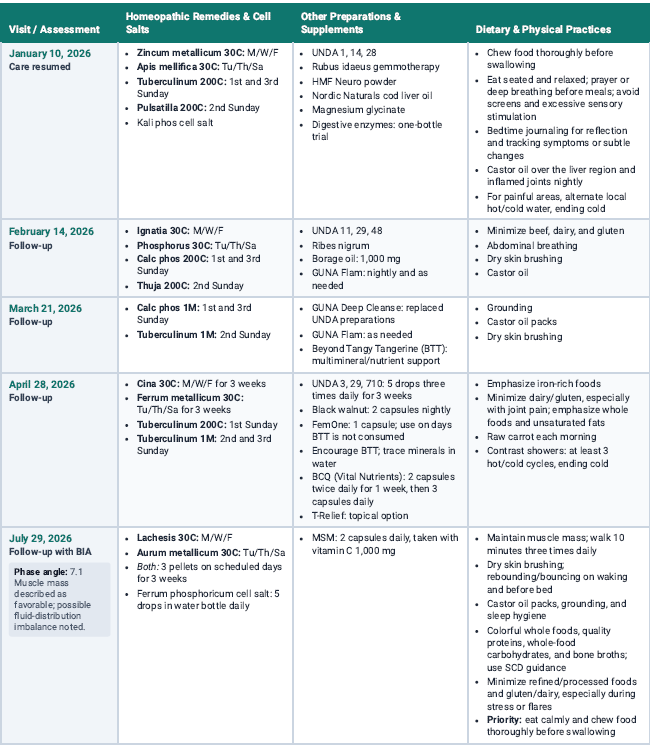
Abbreviations: M/W/F = Monday, Wednesday, Friday; Tu/Th/Sa = Tuesday, Thursday, Saturday; BIA = bioelectrical impedance analysis; SCD = Specific Carbohydrate Diet.