


A...
Chemotherapy-Induced Peripheral Neuropathy: An Evidence-Based Guide for Naturopathic Physicians
read more

A longitudinal pediatric case reveals two recurring patterns of behavioral dysregulation and language regression associated with gastrointestinal disturbances, suspected microbial imbalances, and repeated responses to targeted antimicrobial treatment.
Gastrointestinal symptoms are common in children with autism spectrum disorder (ASD), but their relationship to behavioral and developmental changes can be difficult to characterize. This case describes a child with ASD and extreme prematurity whose family identified recurrent constipation as an early and reproducible marker preceding changes in behavior, stimming, aggression, and functional language. Across several years of care, two recurring clinical patterns emerged with suspected microbial origins; 1) a behavioral pattern associated with fungal flares and 2) a language pattern associated with bacterial flares. Serial urinary organic acids testing demonstrated recurrent elevations in yeast/fungal-associated and Clostridia-associated metabolites, while stool molecular testing demonstrated changing patterns of bacterial imbalances but no C. difficile toxins or Candida detection. Antifungal and antibacterial treatment were repeatedly associated with improvement in the corresponding patterns. The case highlights the value of longitudinal symptom tracking, individualized naturopathic assessment, alongside supportive laboratory testing.
Gastrointestinal symptoms are common in children with ASD, with constipation among the most frequently reported complaints 1,2. Relationships have also been described between gastrointestinal symptoms and developmental regression, language and communication, challenging behavior, sleep, and sensory processing issues, although findings across studies remain heterogeneous and the mechanisms of these relationships remain incompletely understood 1-3.
This case is notable because the family observed a highly reproducible sequence over several years where autistic “symptoms” were amplified with gastrointestinal flares and diminished with the associated treatment. Constipation was repeatedly the earliest recognizable change, followed by alterations in behavior or language, with subsequent improvement following targeted treatment.
The longitudinal nature of the observations allowed for evaluation of these patterns alongside serial laboratory testing and repeated treatment responses.
The patient is a female child, born extremely premature at 24 weeks’ gestation and requiring a 133-day neonatal intensive care hospitalization, and was later assessed to have ASD.
At her initial naturopathic assessment at age 5, constipation was the family’s primary concern, along with suspected yeast, bacterial imbalances, and general gut health. The parent described periods of several days without bowel movements and marked behavioral dysregulation with constipation. The initial therapeutic goal was therefore to improve gastrointestinal function and overall physiologic regulation.
During subsequent follow-up, a recurring sequence became increasingly recognizable. Constipation often appeared first, sometimes subtly, followed by increased stimming, hyperactivity, irritability, aggression, destructive behavior, or changes in language. Magnesium improved bowel regularity but did not consistently prevent recurrence. Over time, 2 distinct clinical patterns emerged.
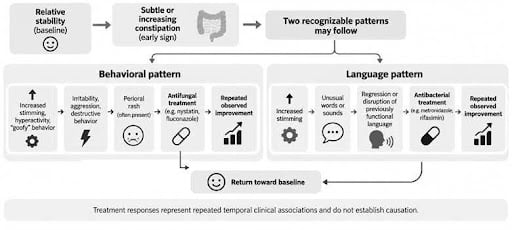
Figure 1. Two recurring clinical patterns. Constipation was frequently an early sign in both patterns. One progressed predominantly toward behavioral dysregulation and perioral rash; the other toward loss or disruption of previously functional language. Repeated responses to antifungal or antibacterial treatment informed clinical decision-making but do not demonstrate causality.
“Constipation was repeatedly the earliest recognizable change, followed by alterations in behavior or language, with subsequent improvement following targeted treatment.”
The first pattern consisted primarily of what the family reported as increased stimming, hyperactivity, irritability, aggression, destructive behavior, and an unusual or “goofy” behavioral presentation, as described by the parent. A recurrent facial or perioral rash was sometimes present concurrently.
The family came to associate this presentation with what they described as “yeast” flares. Antifungal treatment, initially with nystatin and later with intermittent fluconazole, was repeatedly followed by noticeable and rapid improvement in behavior and reduction or resolution of the perioral rash. On several occasions, this improvement was significant enough that the parent described the patient becoming “a completely different child” following initiation of treatment.
The repeated clinical response to antifungal treatment was used to inform subsequent care, rather than as proof of intestinal Candida infection, as evidence linking Candida to ASD remains limited and inconclusive in the available human studies 4.
The second pattern was more striking from a communication standpoint. The child would develop constipation and increased stimming, followed by deterioration in previously functional language. Caregivers described unusual words or sounds, difficulty producing intended words, and episodes in which speech became difficult to understand or appeared “mixed up”, while at other times communication was absent altogether.
The family came to recognize this language deterioration as a particularly important sign of a presumed recurring bacterial flare, initially presumed to be related to the Clostridia-associated metabolites seen on testing and later more non-specific bacterial origin. Several episodes demonstrated a repeated response to antibacterial treatment. In mid-2023, the family reported that language began returning within the first few days of metronidazole. Later episodes followed a similar pattern. By early 2024, the parent specifically distinguished these episodes from the child’s behavioral pattern, reporting that during what she recognized as the bacterial pattern, “speech goes [away].”
Rifaximin was subsequently used during similar recurrences. During an early 2025 flare, the family and clinician opted for a longer treatment period, after which the parent described a substantial change in mood, behavior, and language. The subsequent period of stability extended to approximately 5 months, compared with earlier flares that had tended to recur every 2 to 3 months.
Alternative explanations, including co-existing infection, nonspecific inflammatory effects, and Pediatric Acute-onset Neuropsychiatric Syndrome / Disorders Associated with Streptococcal Infection (PANS/PANDAS)-like presentations, were considered for the cause of symptoms seen during the course of care, but were not fully established. Evidence supporting antimicrobial treatment of PANS/PANDAS remains limited and heterogeneous.7
Symptom improvement following a course of metronidazole or rifaximin did not establish that a particular organism was responsible, but the continued response to the medications supported the role of alterations in the gut microbiome.
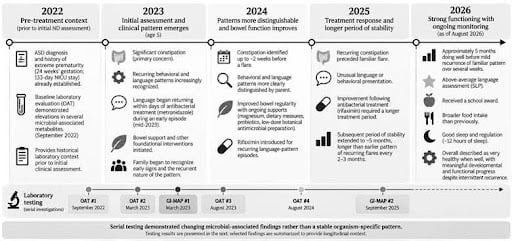
Figure 2. Longitudinal clinical course.
Management of bowel regularity remained foundational throughout care. Orally administered magnesium was titrated according to stool frequency and consistency, with dietary measures, probiotics, and other bowel-supportive strategies used at different stages, all of which offered varying degrees of benefit.
During a later flare, the parent identified slight constipation approximately 2 weeks before the more dramatic symptoms appeared. The interval between bowel movements gradually increased despite increasing magnesium and other laxative supports, helping to confirm constipation as a practical early warning sign of the beginnings of a presumed microbial flare for this child.
In an effort to reduce the frequency of recurring microbial flares, a low dose oral botanical antimicrobial preparation was introduced, and was particularly notable because the parent reported that the child had never had such regular bowel movements. It was therefore kept in the protocol as part of the broader effort to maintain regular elimination.
Serial testing provided supporting information, but no single finding fully explained the clinical course.
Organic Acids Testing (OAT)
OAT results demonstrated repeated abnormalities in both fungal-associated and Clostridia-associated urinary metabolites, but the pattern changed across time. These results were interpreted clinically as changing microbial-associated metabolite abnormalities rather than evidence of a confirmed Clostridia or C. difficile infection.
Stool Testing
Stool testing provided a complementary perspective. A stool sample collected March, 2023, shortly after the March OAT, was negative for C. difficile toxin A and B. However, it demonstrated elevations in several organisms categorized by the laboratory as dysbiotic or overgrowth organisms.
The same 2023 stool test did not detect Candida species. This finding was not considered sufficient to exclude a possible fungal-associated gastrointestinal process. Stool testing is limited to sampling the terminal region of the gastrointestinal tract and may not provide a clear representation of microbial communities distributed elsewhere in the gastrointestinal tract. The absence of Candida on these stool tests is not an absolute ruling out of its possible contribution to symptoms, since it displays biological and technical complexity in studies 6.
The 2025 stool test again showed no C. difficile toxins or Candida but a different microbial pattern, supporting a dynamic microbial picture rather than one persistent infection.
The 2023 study showed low secretory IgA and an elevated zonulin, while the 2025 study showed normalization of secretory IgA, and zonulin remained an elevated result. An elevated zonulin result can indicate hyperpermeability in the gut lining.
Overall, the laboratory findings supported a changing gastrointestinal microbial picture that informed clinical decision-making without establishing that microbial imbalances were a direct cause of changes in the child’s language or behaviour.
The most useful information in this case ultimately came from following the child over time. The clinical picture included bowel function, skin findings, behavior, stimming, communication, nutrition, sleep, sensory regulation, and overall development. The family became highly skilled at recognizing deviations from the child’s baseline.
One intriguing aspect of this case was that the recurrent episodes did not present as a nonspecific pattern of dysregulation but was very distinct and followed specific patterns. The family learned to distinguish a predominant behavioral pattern from an additional pattern characterized by disruption or regression of previously functional language. The mechanism underlying this distinction is unknown. However, emerging research on the microbiota-gut-brain axis raises the possibility that different gastrointestinal or microbial disturbances may produce downstream effects through microbial metabolites, immune signaling, intestinal barrier function, neurotransmitter shifts, and neuroinflammatory pathways.8 Neuroinflammation cannot be inferred from this patient’s clinical response. Nevertheless, the reproducibility of two clinically distinct patterns raises the question of whether altered gut-derived signals could have affected neurological function.
There are important limitations. This is a single observational case. Symptoms and treatment responses were largely caregiver-reported; treatment was not blinded or controlled; several interventions were used over the years; spontaneous fluctuation cannot be excluded; and response to an antimicrobial does not establish the organism or mechanism responsible. Urinary organic acid and stool molecular findings likewise cannot independently establish infection.
Despite these limitations, constipation repeatedly became recognizable before language or behavioural changes occurred. Two distinguishable patterns emerged over several years and corresponding treatment responses recurred often enough to become clinically useful.
Importantly, the episodic flares have not defined the child’s overall developmental trajectory. By August 2026, she had been doing well for approximately 5 months before the familiar pattern reappeared mildly over several weeks, representing a longer period of stability than earlier in the case.
The family’s primary ongoing concern was no longer baseline language ability, but the temporary loss or disruption of language during a flare. Constipation and rash also continued to serve as familiar physical signs. The recurrence of intermittent flares followed by substantial developmental progress with treatment is central to this case. The objective of treatment was to identify and address recurrent physiologic changes that appeared to interrupt the child’s progress and development.
Several years into treatment, the child is functioning well, and despite intermittent flares, the child has been clinically assessed to have above-average language, greater variety of food intake, good sleep and regulation, and meaningful academic success, including receiving a school award. Her parent describes her as very healthy overall. Her progress underscores the value of longitudinal, whole-child observation in revealing patterns that a single visit or laboratory result may miss.