

A...
Chemotherapy-Induced Peripheral Neuropathy: An Evidence-Based Guide for Naturopathic Physicians
read more

Serial next-generation sequencing and liquid-biopsy ctDNA can provide an evolving molecular map of cancer biology. This case explores how KRAS G13D and other genomic alterations were used to inform pathway-based integrative oncology strategies as metastatic colorectal cancer changed over time.
Next-generation sequencing (NGS) has changed oncology by allowing us to look at the molecular biology of an individual patient’s cancer rather than treating cancers solely according to tissue of origin. In practice, precision oncology often stops at one question: Is there a drug for this mutation? For the naturopathic oncologist, I think the more useful question is broader. What does this collection of mutations tell us about how this tumor is growing, metabolizing, resisting treatment and escaping immune surveillance, and which of those vulnerabilities can we realistically influence?
This becomes especially important when sequencing identifies major oncogenic drivers without an approved targeted drug. The same applies to variants reported by different platforms as “variants of uncertain significance” (VUSs), secondary findings, or “other significant alterations.” These findings should not automatically be thrown away as they are in conventional oncology. When several findings converge on the same pathway, or when they fit the patient’s phenotype and subsequent molecular evolution, they can add another layer to the biological map.
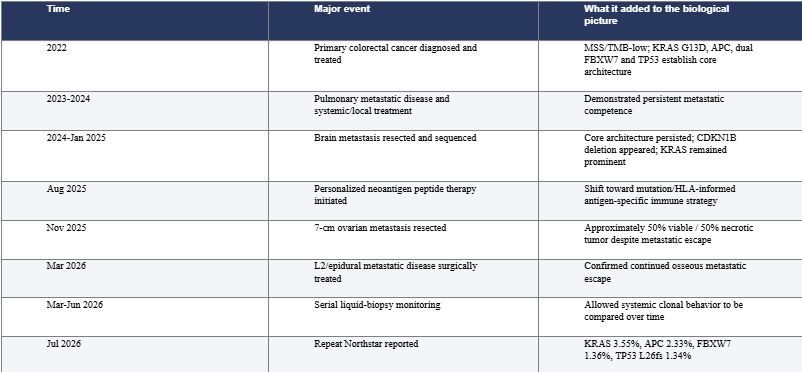
This case follows a woman with aggressive microsatellite-stable (MSS), low-tumor-mutational-burden metastatic KRAS G13D colorectal adenocarcinoma involving lung, brain, ovary and bone. What makes the case useful is not one unusual treatment. It is how serial tissue NGS, liquid-biopsy ctDNA, pathology and clinical behavior were repeatedly used to rebuild an integrative plan as the cancer changed.
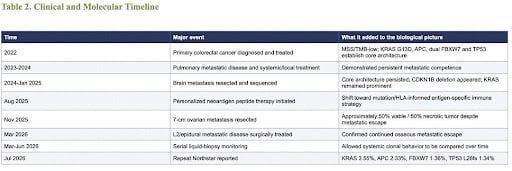
The patient was diagnosed with distal colorectal adenocarcinoma in 2022 and subsequently developed metastatic disease. Initial tumor sequencing demonstrated MSS, TMB-low disease (2 mutations/Mb), with KRAS G13D, APC Q1291fs, FBXW7 R224*, FBXW7 W406fs, TP53 L26fs and IRS2 amplification. The original KRAS G13D allele frequency was 28%.
She received conventional systemic and local therapies over the ensuing years, including chemotherapy, surgery and radiation. Treatment intensity was periodically limited by cytopenias and tolerance.
Brain metastases eventually required resection and radiation. Sequencing of brain metastatic tissue again showed the same core KRAS/APC/FBXW7/TP53 architecture, but now also demonstrated CDKN1B deletion. The brain tumor remained MSS and TMB-low, PD-L1 negative and HER2 negative.
This persistence was important. The cancer was evolving, but it had not abandoned its original operating system.
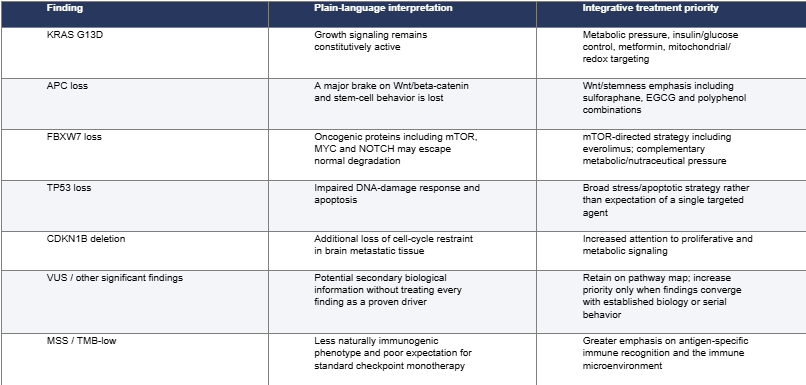
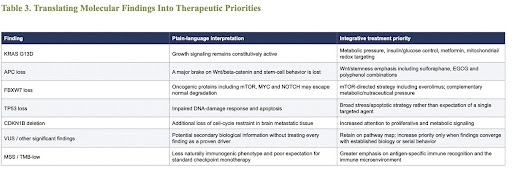
For providers who do not interpret NGS mutation reports every day, I find it easier to stop thinking about these as gene names and ask what each alteration is actually allowing the cancer cell to do.
KRAS G13D is essentially a growth switch stuck in the “on” position. It drives downstream proliferative and metabolic signaling and is associated with resistance to EGFR-directed antibodies such as cetuximab and panitumumab. The original tumor report documented KRAS G13D at 28% allele frequency.
APC loss removes an important brake on Wnt/β-catenin signaling. In practical terms, this supports proliferation and cancer stem-cell behavior. The later Northstar report again characterized her APC frameshift as disrupting β-catenin binding and potentially increasing Wnt signaling.
FBXW7 loss was especially interesting. FBXW7 normally tags proteins such as mTOR, MYC, NOTCH1, cyclin E and JUN for destruction. When FBXW7 is lost, several oncogenic proteins may persist longer than they should. Her reports repeatedly identified mTOR-directed therapy as a biologically relevant consideration.
TP53 loss weakens DNA-damage response, apoptosis and genomic stability. CDKN1B deletion, which appeared in the brain specimen, removes another restraint on cell-cycle progression.
Taken together, I did not view this simply as “KRAS-mutant colorectal cancer.” I viewed it as a KRAS-driven, Wnt-active, mTOR-permissive, apoptosis-impaired cancer with substantial stemness and immune-escape potential. This enhanced diagnosis / way we view the patient allows us to deliver a more comprehensive and precise cancer treatment plan.
“The technology is new. The naturopathic principle is not.”
The goal was never to accumulate the largest possible list of “anticancer supplements.” It was to apply nonredundant pressure to the pathways that repeatedly appeared in her tumor while keeping her nutritionally and immunologically capable of tolerating years of conventional treatment.
For the KRAS/metabolic axis, we used metformin alongside nutritional and nutraceutical strategies affecting insulin/glucose signaling, AMPK, mitochondrial metabolism and redox balance. With FBXW7 loss repeatedly pointing toward mTOR, everolimus became a particularly logical pharmacologic component.
Wnt/stemness and inflammatory signaling were addressed with combinations built around sulforaphane, EGCG, curcuminoids, quercetin, Boswellia, high-dose honokiol, IP6 and dihydroberberine. These were not chosen because each has a paper calling it “anticancer.” They were selected because their mechanisms overlapped with vulnerabilities repeatedly identified in her cancer. Combination products were used when possible so that the protocol did not become 30 bottles targeting the same three pathways.
In August 2025 we added patient-specific neoantigen peptide immunotherapy designed by Neo7 Biosciences, administered in our clinic through IV, subcutaneous and intramuscular routes.
A neoantigen is a protein fragment produced by a tumor-specific mutation. Because the immune system has not necessarily learned to tolerate that abnormal sequence as “self,” it can potentially become an immune target. Personalized peptide therapy attempts to present selected tumor-associated targets in a way that improves T-cell recognition.
This is fundamentally different from nonspecific immune stimulation. The peptide strategy was informed by the patient’s molecular data and immune/HLA characteristics. Her earlier peptide analysis also incorporated tumor-related molecular and immune information rather than relying on diagnosis alone.
The harder question came later. Cancer evolves. If a metastatic population escapes while a patient is receiving a personalized vaccine, the relevant question is not simply “Did the vaccine fail?” It is whether the surviving cancer has undergone clonal selection, lost important antigens, changed antigen presentation, or developed a different immune-evasion strategy. This is why repeat sequencing eventually became part of the vaccine strategy itself.
Three months after beginning peptide therapy, a 7-cm ovarian metastasis was removed. It was clearly metastatic colorectal cancer, but pathology found it to be approximately 50% viable and 50% necrotic, with negative pelvic washings and no ovarian capsule involvement. The pathology cannot tell us that peptide therapy alone caused the necrosis. The timing, however, was clinically interesting and supported our decision to continue investigating an immune-directed strategy rather than interpreting the appearance of a metastasis as evidence that all systemic control had been lost.
The immune program was supported with high-dose IV vitamin C, IV photobiomodulation/photodynamic approaches, hyperbaric oxygen therapy, locoregional hyperthermia when anatomically available, nutritional and mitochondrial support, and later microbiome-directed therapy including fecal microbial transplants – FMT.
This is where the case became particularly interesting. Liquid biopsy measures tumor-derived DNA circulating in plasma. Variant allele frequency (VAF) is simply the percentage of DNA reads containing a particular variant. It is not the same thing as tumor size. Shedding varies by metastatic location, treatment, tumor biology and assay.
Still, when several established mutations belonging to the same cancer all move strongly in the same direction, I pay attention.
On the July 2, 2026 her NGS report, the established tumor architecture remained recognizable, but the dominant circulating variants had contracted markedly:
KRAS G13D: 20.0% to 3.55%
APC: 18.0% to 2.33%
FBXW7: 9.81% to 1.36%
TP53 L26 frameshift: 14.0% to 1.34%
4 different low-level mutations had also disappeared completely.
The July report directly confirmed the latter values.
That represents roughly an 82% to 90% reduction in these dominant circulating variants. Several previously detected low-level variants were no longer detected.
It does not prove that peptides, supplements or any one therapy caused the change. What it tells us is something more useful: focal metastatic escape and systemic molecular improvement can occur at the same time, in the absence of standard systemic chemotherapy / immunotherapy / targeted therapy.
This case should change the way we think about the word “progression.” A new metastasis is progression and needs to be treated as such. But cancer is not one homogeneous mass. Brain, bone, lung and ovarian metastases live in different microenvironments, with different blood flow, immune surveillance, stromal signaling and drug exposure. One resistant population can escape while others remain under significant pressure. In this case, while all “metastatic colon cancer”, we treat the brain mets differently than the bone mets.
This fits the Naturopathic Therapeutic Order better than it may initially appear.
A patient with stage IV cancer often requires multiple levels of the Therapeutic Order simultaneously. Surgery, radiation, ablation and systemic oncology are high-force interventions and have been essential in this case. Waiting to work sequentially up the pyramid while dangerous disease progresses would be a misuse of the model.
At the foundation, however, the work remains very naturopathic: sufficient protein and calories, insulin regulation without causing weight loss, preservation of skeletal muscle, sleep, bowel function, correction of deficiencies, hematopoietic support and recovery from repeated treatment. A patient cannot benefit from a sophisticated cancer strategy if she becomes too depleted to receive it.
The next layer is the terrain in which cancer and immunity are operating: inflammation, metabolism, mitochondrial function, gastrointestinal integrity and the microbiome. Then come increasingly specific natural agents selected against the molecular pathways we have identified. Repurposed pharmaceuticals such as metformin and everolimus represent another increase in therapeutic force. Personalized neoantigen vaccination moves in a different direction altogether by attempting to improve the patient’s own recognition of tumor-specific targets.
NGS gives us a molecular-resolution view of obstacles that earlier generations of naturopathic physicians could not see. The Therapeutic Order then gives us a framework for deciding what to do with that information.
This patient’s course also demonstrates why serial testing matters. Her original rectal tumor and later brain metastasis retained the same basic KRAS/APC/FBXW7/TP53 architecture. Years later, the same lineage remains visible in plasma, but several of its major circulating variants have fallen by more than 80%. At the same time, she has experienced metastatic escape.
I do not view those findings as contradictory. I view them as ongoing evolutionary competition between tumor escape and multidimensional disease control, and we’re going to keep chasing and battling those changes as specifically as possible.
This patient has lived for more than four years with aggressive stage IV, MSS, KRAS G13D colorectal cancer capable of metastasizing to lung, brain, ovary and bone, yet most would look at her and see a beautiful mother of 2 young kids and never guess she is sick at all. She has required major surgery, radiation and systemic treatment and has certainly experienced real progression. Yet she remains actively engaged in her life and treatment, resected metastatic tissue has demonstrated substantial tumor necrosis, and her most recent liquid biopsy showed an approximately 82% to 90% contraction of several established circulating driver variants.
For me, that is the point of precision naturopathic oncology. It is not matching one supplement to one mutation. It is understanding the tumor well enough to connect genomics with metabolism, mitochondrial function, nutrition, immune recognition, the microbiome, natural medicines, repurposed pharmaceuticals and appropriate conventional oncology, then changing that strategy when the cancer changes.
We now have tools capable of showing us cancer biology at a resolution naturopathic physicians have never had before. We should learn how to use them. The future is not choosing between the Therapeutic Order and precision oncology. It is bringing precision oncology into the Therapeutic Order.
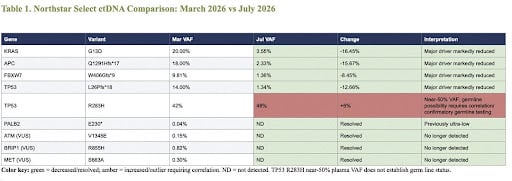
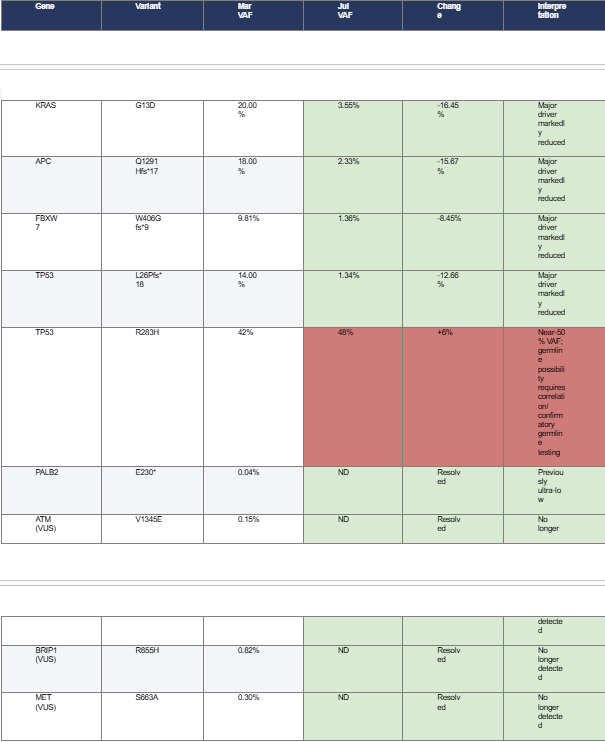
Color key: green = decreased/resolved; amber = increased/outlier requiring correlation. ND = not detected. TP53 R283H near-50% plasma VAF does not establish germ line status.