

A...
Chemotherapy-Induced Peripheral Neuropathy: An Evidence-Based Guide for Naturopathic Physicians
read more

A case of metastatic ER-positive, HER2-low inflammatory breast cancer demonstrates how naturopathic oncology, autologous dendritic cell immunotherapy, and targeted systemic treatment were integrated through interdisciplinary care, with response tracked using PET/CT, circulating tumor cells, ctDNA, and longitudinal immune profiling.
Inflammatory breast cancer (IBC) is an aggressive clinical presentation of breast malignancy characterized by rapid breast changes, dermal edema and erythema, frequent regional nodal involvement, and a high risk of distant progression. This case follows a 44-year-old woman with estrogen receptor (ER)-positive, HER2-low invasive ductal carcinoma of the right breast presenting with inflammatory features and biopsy-confirmed right axillary nodal metastasis. Her subsequent course included progression to osseous metastatic disease with naturopathic oncology management, immunotherapy with an autologous, double-loaded dendritic cell therapy, as well as an antibody-drug conjugate, leading to a complete radiographic and molecular response.
Her trajectory required repeated differentiation between treatment-associated inflammation and progressive malignancy. Serial physical examinations, PET/CT, circulating tumor cell (CTC) testing, circulating tumor DNA (ctDNA), and communication between naturopathic and medical oncology providers were used to guide care. The eventual transition from metabolically active metastatic disease to inactive sclerotic skeletal lesions, zero CTCs, and repeatedly undetectable ctDNA provides a clinically meaningful example of multimodal oncology management while also illustrating the limitations of assigning response to any single intervention.
The patient presented for naturopathic oncology consultation in June 2025 following a new diagnosis of right breast cancer.
Bilateral diagnostic mammography on May 26, 2025 demonstrated pleomorphic segmental calcifications throughout the central right breast extending from the near-subareolar region to posterior depth. Diffuse trabecular coarsening compatible with edema and diffuse skin thickening were also present. The following day ultrasound-guided biopsy was performed and demonstrated grade 1 invasive ductal carcinoma of the right breast. The sampled invasive focus measured 3mm without identified lymphovascular invasion and expressed estrogen receptor (ER) 80%, progesterone receptor (PR) 5%, and HER2 1+ by immunohistochemistry, and negative per fluorescence in situ hybridization (FISH). A right axillary lymph node contained a 10mm focus of metastatic carcinoma expressing ER 90%, PR 30%, and HER2 1+ by IHC, also FISH-negative. Biopsy of a left breast mass showed non-proliferative fibrocystic changes without atypia or malignancy.
PET/CT on June 2025, demonstrated diffuse mildly increased uptake in the right breast associated with cutaneous thickening (max SUV 3.4), multiple tracer-avid right axillary, subpectoral, and superior mediastinal lymph nodes suspicious for metastatic involvement (max SUV 3.3) along with low level activity in the marrow bearing skeleton. A small right internal mammary node was also noted. The patient was initially clinically characterized as having stage IIIB inflammatory breast carcinoma.
An incidental cystic intracranial lesion was identified on staging imaging. Subsequent brain MRI in November 2025 demonstrated no evidence of intracranial metastatic disease.
At presentation, the patient expressed limited confidence in conventional oncologic treatment and a strong preference for nonconventional therapeutic approaches. After discussion of available options and the recommendation to maintain conventional oncology involvement, she elected to pursue autologous double-loaded dendritic cell therapy through Immunocine. Their protocol included white blood cell mobilization, tumor tissue processing, preparation of autologous dendritic cells from monocytic precursors, and exposure of those cells to autologous tumor-derived mRNA and proteins. She subsequently received three image-guided dendritic cell treatment administrations during July and August 2025.
Following these treatments, the right breast developed substantial localized inflammatory changes, including scabbing, bleeding, erythema, ulcerative and weeping lesions, and papular changes inferior to the breast. These findings required frequent in-person breast examinations, local supportive care, and education regarding hygiene, infection precautions, and indications for urgent evaluation.
Soon after she completed her immunotherapy treatments, serological pro-inflammatory markers began trending upwards. Differential assessments included progressive malignancy, treatment effect presenting as pseudo-progression, infection, or overlapping processes. Findings became more concerning as erythema and bleeding continued alongside increased mobilization of CTC in the presence of deterioration of clinical status and hence consultation with medical oncology was encouraged.
Naturopathic oncology care was adjusted throughout this period according to symptoms, laboratory findings, and concurrent treatment. Support included individualized nutraceutical recommendations, pharmacologic interventions, intravenous therapies, nutritional counseling, and symptom management. A specific nutritional program became increasingly important as the patient experienced limited appetite, cravings, little interest in cooking, and diarrhea. Recommendations emphasized adequate protein and nutrient density while adapting to the patient’s practical limitations. Movement and exercise strategies were also incorporated to support conditioning, circulation, and lymphatic mobility.
“Effective integrative oncology requires neither rigid adherence to nonconventional treatment nor abandonment of the patient’s therapeutic values.”
A pivotal change occurred in late fall 2025. Increasing CTC findings and persistent breast abnormalities raised concern for progression. PET/CT performed November 2025 formally documented worsening disease compared with the June examination. Low level tracer activity remained associated with right breast skin thickening and was present throughout the right breast parenchyma. FDG-avid bilateral axillary lymph nodes were identified, and new left-sided nodal involvement included the left supraclavicular region.
Most importantly, diffuse tracer activity was present throughout the marrow-bearing skeleton (similarly to previous), with multiple new lesions suspicious for skeletal metastases (SUV max 5.9).
Following documented metastatic progression, interdisciplinary review by the naturopathic and medical oncologists led to the selection of trastuzumab deruxtecan as a personalized systemic strategy aligned with her aversion to conventional chemotherapy, concerns regarding treatment-related toxicity, and priority of preserving quality of life. By December 2025, her regimen also included ovarian suppression and anastrozole. Although HER2 amplification was absent, HER2 expression of 1+ by IHC was consistent with a HER2-very low phenotype.
The patient completed nine cycles of trastuzumab-deruxtecan, commenced exemestane plus ovarian suppression, and ribociclib on an alternative regimen, all fully integrated alongside the patient’s main treatment of choice – naturopathic oncology.
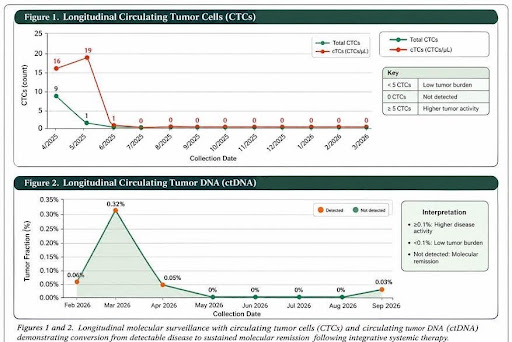
Objective disease markers subsequently became increasingly favorable. CTC testing was reported as zero by December 2025. PET/CT in February 2026 was reported as showing no evidence of metabolically active disease. Serial ctDNA and CTC testing was incorporated as additional means of molecular surveillance, with longitudinal trends presented in Figures 1 and 2. Serial CTC monitoring demonstrated an initial period of elevated circulating tumor burden, followed by a marked decline to predominantly undetectable levels, with only brief low-level re-emergence, supporting an overall favorable and sustained treatment response.
PET/CT in August 2026 provided an important comparison with the documented metastatic disease present in November 2025. Mild right breast skin thickening persisted but was stable compared with July, and substantially improved from more remote examinations, with no significant FDG uptake above background. No hypermetabolic lymphadenopathy was identified, and there was no evidence of new or progressive disease.
Scattered sclerotic skeletal lesions, including lesions of the medial right clavicle and right femoral neck, remained visible on CT but demonstrated no significant metabolic uptake. In the context of the previously confirmed osseous metastatic disease, these findings were consistent with treated skeletal metastases.
Following achievement of complete metabolic response, integrative priorities shifted from acute disease and treatment support toward restoration of vitality, preservation of immune response and mitigation of long-term treatment effects. Previously metabolically active skeletal lesions remained visible as non-FDG-avid sclerotic lesions consistent with treated metastatic disease, supporting continued imaging and molecular surveillance.
ctDNA surveillance demonstrated sustained molecular response, with ctDNA remaining at 0% across consecutive assessments before a subsequent low-level increase to <0.01% (Figure 1). Although the clinical significance of this minimal increase remains uncertain in isolation, the transition from a consistently undetectable ctDNA pattern did not alter the patient’s treatment course, as she was already scheduled to receive her fourth Immunocine double-loaded dendritic cell therapy (IDCT) injection as a booster. The booster had been administered by the time of this writing. See Figures 6 and 7 for the corresponding longitudinal trends.
Bone health became particularly relevant in the setting of ovarian suppression and endocrine therapy. DXA demonstrated osteopenia, prompting modification of the naturopathic protocol to attend to osteopenia, while pharmacologic bone-directed therapy remained under consideration. Additional priorities included preservation of lean body mass, nutritional adequacy, physical activity, metabolic health, neurocognitive and psychosocial resilience.
This case illustrates a critical challenge in integrative oncology: distinguishing treatment-associated immune inflammation (pseudoprogression) from progressive malignancy. Following autologous, double-loaded dendritic cell therapy the patient developed substantial inflammatory changes involving the breast. Pseudoprogression remained a plausible consideration; however, increasing levels of CTCs and ctDNA, persistent local abnormalities and ultimately PET/CT evidence of nodal and skeletal hypermetabolism was concerning enough to include conventional modalities.
This clinical crossroads brought out the best of integrative oncology, herein rather than relying on either interpretation in isolation, the naturopathic oncologist and medical oncologist collaboratively reviewed the patient’s evolving clinical status, disease trajectory, treatment preferences, and true potential for pseudoprogression. Given the patient’s strong aversion to conventional cytotoxic chemotherapy, concerns regarding treatment-related toxicity, and priority of preserving quality of life, the team undertook a deliberate interdisciplinary review of her disease biology. Particular consideration was given to selecting a systemic therapy that could achieve meaningful tumor-directed cytotoxicity without unnecessarily disrupting the immune-directed strategy already underway. Trastuzumab deruxtecan was selected as a mechanistically complementary antibody-drug conjugate that could provide targeted tumor killing while preserving continuity of the broader integrative treatment approach. The subsequent response was substantial, with CTCs declining to zero, ctDNA becoming repeatedly undetectable, and PET/CT demonstrating resolution of metabolically active disease, including conversion of previously active skeletal metastases to non-FDG-avid sclerotic lesions.
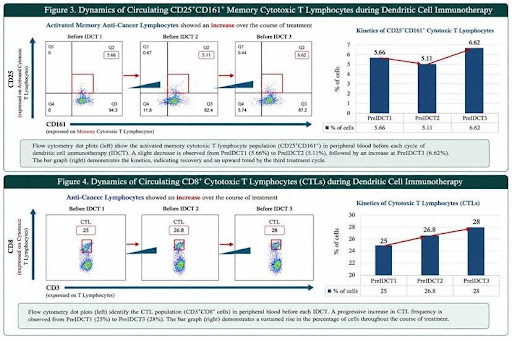
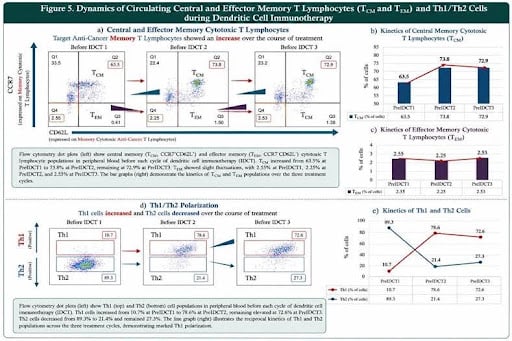
This patient’s immunomonitoring provides additional context for this response. As a result of IDCT, circulating CD3⁺CD8⁺ cytotoxic T lymphocytes progressively increased from 25.0% before the first treatment to 28.0% before the third. Activated memory CD8⁺CD25⁺CD161⁺ cells increased to 6.62% by the third treatment, while central-memory CTLs (cytotoxic T lymphocytes) increased from 63.5% to 73.8% and remained elevated at 72.9%; as seen in Figures 3 and 4. Most notably, marked Th1 polarization occurred: Th1 cells increased from 10.7% to 78.6% and remained 72.6% before the third treatment, while Th2 cells declined from 89.3% to 27.3% (demonstrated in figure 5). Collectively, the immunophenotyping demonstrated measurable remodeling of cytotoxic, memory, and Th1associated immune populations during Immunocine Dendritic Cell Therapy. Noting too that these numbers account for such immuno-active and immuno-educated cells trafficking in and out of the multiple tumor microenvironments.
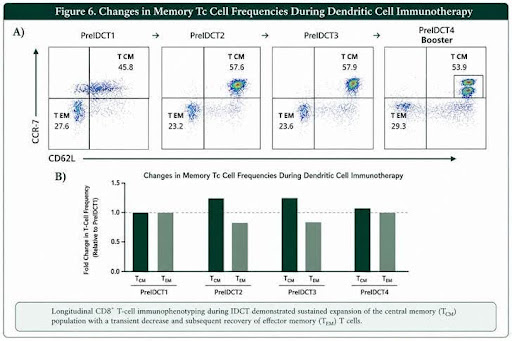
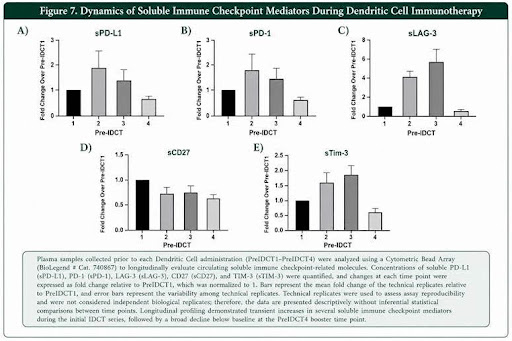
Moreover, immunodynamic assessment following completion of eight cycles of T-DXd demonstrated persistent changes. Longitudinal immune profiling during IDCT demonstrated coordinated changes in circulating CD8⁺ T-cell memory subsets and soluble immune checkpoint mediators. Central memory T cells (T_CM; CD62L⁺CCR7⁺) increased from 45.8% at baseline to 57.9% during the initial IDCT series and remained elevated at 53.9% before the booster, while effector memory T cells (T_EM; CD62L⁻CCR7⁻) transiently decreased before recovering above baseline to 29.3%. Concurrently, soluble PD-L1, PD-1, LAG-3, and TIM-3 demonstrated transient increases during the initial treatment series, with sLAG-3 showing the greatest increase, whereas sCD27 progressively declined. By the booster time point, all evaluated soluble checkpoint mediators were below baseline levels. Collectively, these findings demonstrate dynamic immune modulation over the course of IDCT, characterized by sustained expansion of the central memory CD8⁺ T-cell compartment, recovery of effector memory T cells, and a broad reduction in circulating soluble immune checkpoint mediators at the booster time point. These longitudinal immunodynamic changes are demonstrated in Figures 6 and 7.
The immune kinetics presented by the figures above are absolutely clinically meaningful. The double-loaded approach exposes autologous dendritic cells to tumor-derived mRNA and tumor-associated proteins with the intent of presenting a broad representation of the patient’s malignancy and generating tumor-directed T-cell responses, again as represented in the figures above. In this context, the subsequent use of tumor-directed systemic therapy raises an intriguing mechanism. Cytotoxic tumor-cell death increases tumor-antigen availability within the microenvironment, potentially providing additional antigenic substrate for an immune system previously exposed to tumor antigens through dendritic cell therapy. This provides a biologically plausible framework in which direct cytotoxic treatment and previously generated immune effector populations operate in parallel.
This case demonstrates the importance of adaptive, interdisciplinary decision-making in integrative oncology. Rather than abandoning the patient’s treatment preferences, collaboration with medical oncology allowed systemic tumor-directed treatment to be strategically incorporated into an established immune-centered and naturopathic approach.
The subsequent convergence of zero CTCs, repeatedly undetectable ctDNA, resolution of metabolically active lymphadenopathy, and conversion of active skeletal hypermetabolic activity to metabolically inactive sclerotic lesions represent a remarkable response to the overall multimodal treatment strategy.
Ultimately, this case illustrates that effective integrative oncology requires neither rigid adherence to non-conventional treatment nor abandonment of the patient’s therapeutic values. Rather, it requires meeting the patient clinically where she is and strategically integrating conventional and naturopathic modalities in pursuit of disease control, quality of life, long-term survivorship and potential cure.
Co-Authors:
Dr. Elisa Tso Bomgaars,MD
Dr. Melissa Coats,ND, FABNO
Dr. Monica Graffius, ND
Dr. Matthew Halpert, PhD