

A...
Chemotherapy-Induced Peripheral Neuropathy: An Evidence-Based Guide for Naturopathic Physicians
read more
A case of recurrent anal squamous cell carcinoma explores topical Calendula officinalis as an adjunct for severe tumor-associated anal pain, with rapid pain reduction and decreased reliance on opioid analgesia during palliative cancer treatment.
Anal squamous cell carcinoma (SCC) frequently causes severe pain requiring opioid analgesia. Calendula officinalis has demonstrated anti-inflammatory properties and evidence supporting its use in radiation dermatitis and perineal wound pain, but its application to tumor-associated anal pain has not been reported.
A 68-year-old male with recurrent stage III anal SCC undergoing palliative carboplatin/paclitaxel experienced severe anal pain (8/10 NRS) despite concurrent supplements, cannabis, and chemotherapy. Intermittent hydromorphone and clonazepam (for pain-related anxiety) provided inadequate relief, and the patient preferred to avoid opioids due to side effects.
A certified organic calendula oil (20% Calendula officinalis flower extract in olive oil) was applied topically to the perianal region 4–5 times daily as an adjunctive analgesic.
Within 48 hours, pain decreased to 2–3/10 NRS — a 63–75% reduction exceeding the IMMPACT threshold for substantially important change (≥50%). The patient reported no further need for hydromorphone or clonazepam, with sustained relief through at least 19 days of follow-up. Pre- and post-intervention clinical photographs appeared to show reduction in visible tissue abnormality. No adverse effects occurred.
Topical calendula oil may offer rapid, opioid-sparing analgesia for cancer-related anal pain. Prospective studies are warranted.
Calendula officinalis, anal squamous cell carcinoma, cancer pain, integrative oncology, opioid-sparing, palliative care
Pain is a prominent symptom in anal SCC, occurring in approximately half of patients at presentation.[1] ASCO guidelines recommend that clinicians should offer opioids to patients with moderate-to-severe cancer pain.[2] However, opioid adverse effects — constipation, nausea, sedation, and cognitive impairment — are common; nearly half of cancer patients initiating strong opioids experience four or more concurrent adverse effects that persist over time.[3] These burdens are particularly problematic during chemotherapy, when gastrointestinal toxicity may compound opioid-induced bowel dysfunction.
On the 0–10 NRS, a reduction of approximately 2 points or 30% has been established as the clinically important difference for chronic pain.[4] The IMMPACT consensus further classifies reductions of 50% or greater as substantially important change.[5]
Calendula officinalis contains pentacyclic triterpenes and flavonoids with demonstrated anti-inflammatory and wound-healing properties, with experimental evidence supporting modulation of inflammatory pathways and cytokine production.[6,11,12] A phase III RCT by Pommier et al. demonstrated that calendula ointment significantly reduced radiation dermatitis (41% vs 63%, P < .001) and radiation-induced pain in breast cancer patients.[7] De Angelis et al. (2022) showed that calendula ointment significantly reduced perineal pain following episiotomy — the closest anatomical analogy to the perianal region — suggesting analgesic benefit distinct from radiodermatitis prophylaxis.[8] Cruceriu et al. reviewed calendula’s underexplored potential in cancer palliative care.[6]
While evidence supports calendula in other inflammatory and wound-related conditions, its application to tumor-associated anal pain remains undescribed. This case is notable for its rapid pain reduction, opioid-sparing effect, and photographic documentation of tissue changes.
“This case demonstrates rapid, clinically significant analgesia following topical calendula oil for tumor-related anal pain, with an opioid-sparing effect enabling discontinuation of intermittent hydromorphone.”
The patient is a 68-year-old male (BMI 27) with recurrent stage III anal SCC, with remote history of AIN3/HSIL treated with chemoradiation and surgery approximately 25 years earlier. Abdominoperineal resection was declined due to multiple comorbidities: resected pheochromocytoma, reversible cerebral vasoconstriction syndrome, hypertension, hyperlipidemia, peripheral arterial disease, severe aortic arch calcification, emphysema and previous anesthesia complications. Re-irradiation was not pursued given prior pelvic radiation and significant comorbidities.
The patient was seeking integrative cancer care to help him better tolerate chemotherapy and improve quality of life. He had been experiencing persistent severe anal pain (8/10 NRS) for approximately 5 months, significantly impairing daily function and quality of life. He used intermittent hydromorphone (PRN) for pain and clonazepam PRN for anxiety related to chronic anal pain. He strongly preferred to minimize opioid use due to side effects. Despite intermittent opioid availability, pain remained poorly controlled at 8/10.
Recurrent stage III anal SCC was diagnosed by the oncology team approximately 6 months prior to the index intervention. Laboratory findings included normal G6PD, liver and kidney function tests. Fatigue (energy 3/10) was assessed as multifactorial. Weight loss was 20 lbs over the preceding year.
Chemotherapy (initiated before calendula): Palliative carboplatin/paclitaxel began on Day −17 at 80% standard dosing with further reduction after cycle 1.
Supplements (initiated before calendula): A supplement plan was proposed on Day −13, and supplements were started on Day −7. This included omega-3 fatty acids, vitamins K2/D3, digestive enzymes, melatonin 20 mg/d, Coriolus versicolor, reishi, astragalus, and palmitoylethanolamide (PEA). PEA is an endogenous lipid mediator with demonstrated analgesic properties across multiple pain conditions, primarily through activation of peroxisome proliferator-activated receptor-α (PPAR-α), resulting in downregulation of NF-κB signaling and reduced production of pro-inflammatory cytokines, as well as modulation of the endocannabinoid system.[9] Subcutaneous mistletoe (dose A5) was initiated on Day −5 without reaction. The patient elected to discontinue his supplement protocol 2 days before and 5 days after each chemotherapy cycle to minimize potential supplement–chemotherapy interactions.
Cannabis: Started on Day −11, with notable improvement to stress and anxiety reported by Day −5.
High-dose intravenous vitamin C (HDIVC): First treatment (25 g) administered on Day −10; second treatment (35 g) on Day −2. Both well tolerated with stable blood pressure throughout.
Concurrent medications: Verapamil 80 mg/d, topiramate 25 mg BID, ezetimibe 10 mg/d, evolocumab biweekly, ASA 81 mg/d (held during chemo), cannabis PRN. Terazosin was discontinued due to hypotension associated with chemotherapy.
Calendula oil (the index intervention): Initiated on Day 0 — after 17 days during which chemotherapy, cannabis, HDIVC, supplements including PEA, and mistletoe were sequentially introduced, with pain persisting at 8/10 throughout. The product used was a Calendula Oil, a certified organic formulation containing 20% Calendula officinalis flower extract in an olive oil base with tocopherols as the sole non-medicinal ingredients. Application was 4–5 times daily to the perianal region. The patient also resumed a healthier diet around this time after a 2-month period of increased sugar intake.
Within 48 hours of initiating calendula oil (Day 2), anal pain decreased from 8/10 to 2–3/10 NRS — a reduction of 5–6 points (63–75%), exceeding the IMMPACT threshold for substantially important change and shifting the patient’s pain from the severe to the mild range.[4,5] The patient reported no further need for either hydromorphone or clonazepam, with sustained relief through at least Day 19, including through chemotherapy cycle 2.
At follow-up on Day 16, the patient described the effect as a “miracle.” Pre- and post-intervention clinical photographs of the perianal region (obtained on Day 17) appeared to show reduction in visible tissue abnormality (Figures 1 and 2). Cannabis continued to be helpful for generalized body pain and anxiety.
No adverse effects were attributed to calendula oil, including no local irritation or allergic reaction.
Day 0 = initiation of topical calendula oil.
– ~25 years prior: AIN3/HSIL — chemoradiation and surgery.
– ~2 years prior: Pheochromocytoma resected.
– ~4 months prior: After cholecystectomy, hypertensive crises resolved.
– ~6 months prior: Recurrent stage III anal SCC diagnosed; APR declined; re-irradiation not pursued.
– Day −27: Initial naturopathic consultation. Bloodwork requested. Referral for cannabis for pain and anxiety. Concern regarding opioid use noted. Pain 8/10 NRS; intermittent hydromorphone and clonazepam use providing inadequate relief.
– Day −17: Cycle 1 carboplatin/paclitaxel (80% dose). No supplement use at this time.
– Day −11: Cannabis started.
– Day −10: First HDIVC treatment (25 g) well tolerated.
– Day −7: Supplements started (including PEA).
– Day −5: Notable improvement in stress and anxiety with cannabis. Subcutaneous mistletoe therapy initiated (A1).
– Day −2: Second HDIVC treatment (35 g) well tolerated. BP stable.
– Day 0: Calendula oil initiated for anal pain. Pain 8/10 despite intermittent PRN opioid use.
– Day 2: Pain 2–3/10 NRS (63–75% reduction). No further hydromorphone or clonazepam use.
– Day 2–9: Supplements held (2 days pre- and 5 days post-chemotherapy cycle 2). Calendula oil continued throughout.
– Day 4: Cycle 2 carboplatin/paclitaxel. Anal pain relief sustained.
– Day 16: Follow-up: patient reports calendula effect as a “miracle.” Application 4–5 times daily.
– Day 17: Clinical photographs of perianal region obtained, documenting tissue changes (Figures 1 and 2).
– Day 19: Anal pain relief sustained. No hydromorphone or clonazepam use since Day 0.
This case demonstrates rapid, clinically significant analgesia following topical calendula oil for tumor-related anal pain, with an opioid-sparing effect enabling discontinuation of intermittent hydromorphone and resolution of pain-related anxiety that had required clonazepam. The 63–75% pain reduction far exceeds both the established clinically important difference of 2 points / 30% for chronic pain and the IMMPACT threshold for substantially important change (≥50%).[4,5]
Standard salvage for locally recurrent anal SCC after prior chemoradiation is abdominoperineal resection.[1] The need for effective non-opioid analgesic adjuncts is underscored by the high burden of opioid adverse effects in cancer patients.[3]
The sequence and timing of interventions support calendula as the most plausible contributor to the observed analgesic response. Pain remained 8/10 for 17 days despite sequential introduction of chemotherapy, cannabis, HDIVC, supplements, and mistletoe. Within 48 hours of calendula initiation, pain decreased to 2–3/10. While PEA has demonstrated analgesic efficacy in meta-analyses of chronic pain, pooled data demonstrate an average reduction in pain intensity of approximately 1.04 NRS points every two weeks.[9] In the present case, PEA had been initiated only 7 days before calendula, making it less likely to account for the abrupt 5–6-point reduction. Furthermore, the patient held supplements around each chemotherapy cycle, yet pain relief was sustained through these hold periods while calendula oil continued — further supporting calendula as a plausible contributor to the observed analgesic response. Chemotherapy-related tumor response cannot be excluded because calendula was initiated 17 days after treatment began; however, pain remained unchanged immediately before calendula initiation and improved within approximately 48 hours thereafter.
Mechanistic plausibility is supported by calendula’s triterpene-mediated anti-inflammatory effects and confirmed wound-healing properties.[6,11,12] The Pommier et al. phase III trial demonstrated calendula’s superiority for radiation-induced pain, and De Angelis et al. demonstrated analgesic benefit in perineal pain following episiotomy.[7][8] Serial photographs provide an independent visual observation of apparent tissue change.
Although the Oncology Nursing Society guidelines did not recommend routine use of calendula for the prevention or management of radiation dermatitis because of insufficient evidence in that specific setting,[10] the present case involves a distinct clinical indication—tumor-associated anal pain rather than radiation-induced skin injury.
This is a single uncontrolled case report and causation cannot be established. Multiple interventions were introduced within a short timeframe, raising the possibility that the observed improvement reflects a combination or cumulative effect — including PEA, cannabis, chemotherapy-related tumor response, mistletoe, HDIVC, and dietary modification — rather than calendula alone. However, the persistence of severe pain through 17 days of sequentially added interventions, followed by rapid improvement only after calendula addition, and sustained relief during supplement hold periods, makes calendula the most temporally correlated intervention. The patient’s hydromorphone and clonazepam use was intermittent (PRN) rather than scheduled; nonetheless, achieving adequate pain control without any opioid or anxiolytic use represents a meaningful clinical improvement. Clinical photographs were patient-taken with variable angles and lighting, limiting direct visual comparison. The observation period is limited, and long-term outcomes are not yet available.
This case reports rapid analgesia (8/10 to 2–3/10 NRS within 48 hours) with topical calendula oil applied 4–5 times daily for cancer-related anal pain in recurrent stage III anal SCC, with sustained relief for at least 19 days. The detailed timeline — with improvement occurring only after calendula was added to an established multimodal regimen that had failed to control pain for 17 days and sustained through supplement hold periods — along with photographic documentation of apparent tissue changes support topical calendula as a plausible contributor to the observed analgesic response. Given its favorable safety profile, accessibility, and preliminary evidence of analgesic benefit in related clinical settings, topical calendula warrants prospective investigation as an opioid-sparing adjunct in anal cancer pain management.[6-8]
Figures
Figure 1A and 1B. Pre-Intervention Clinical Photographs of the Perianal Region (Day -5)
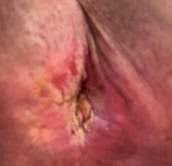
Legend: De-identified patient-taken photographs of the perianal region prior to initiation of topical calendula oil, with patient-reported pain of 8/10 NRS. Images were selected from three available pre-intervention photographs; the two demonstrating the most clearly abnormal findings are presented. A third pre-intervention photograph was excluded due to angle variability limiting comparability. Images are de-identified and reproduced with written patient consent.
Figure 2. Post-Intervention Clinical Photograph of the Perianal Region (Day 17)
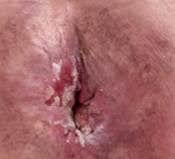
Legend: De-identified patient-taken photograph following 17 days of topical Calendula officinalis use (20% flower extract in olive oil base; applied 4–5 times daily), corresponding to patient-reported pain of 2–3/10 NRS. Direct comparison is limited by differences in photographic angle and lighting between patient-taken images; however, the visible tissue changes are consistent with the reported clinical improvement. Image is de-identified and reproduced with written patient consent.
Abbreviations: AIN3, anal intraepithelial neoplasia grade 3; APR, abdominoperineal resection; HDIVC, high-dose intravenous vitamin C; IMMPACT, Initiative on Methods, Measurement, and Pain Assessment in Clinical Trials; NRS, numeric rating scale; PEA, palmitoylethanolamide; SCC, squamous cell carcinoma.